Robotics in Education & Research
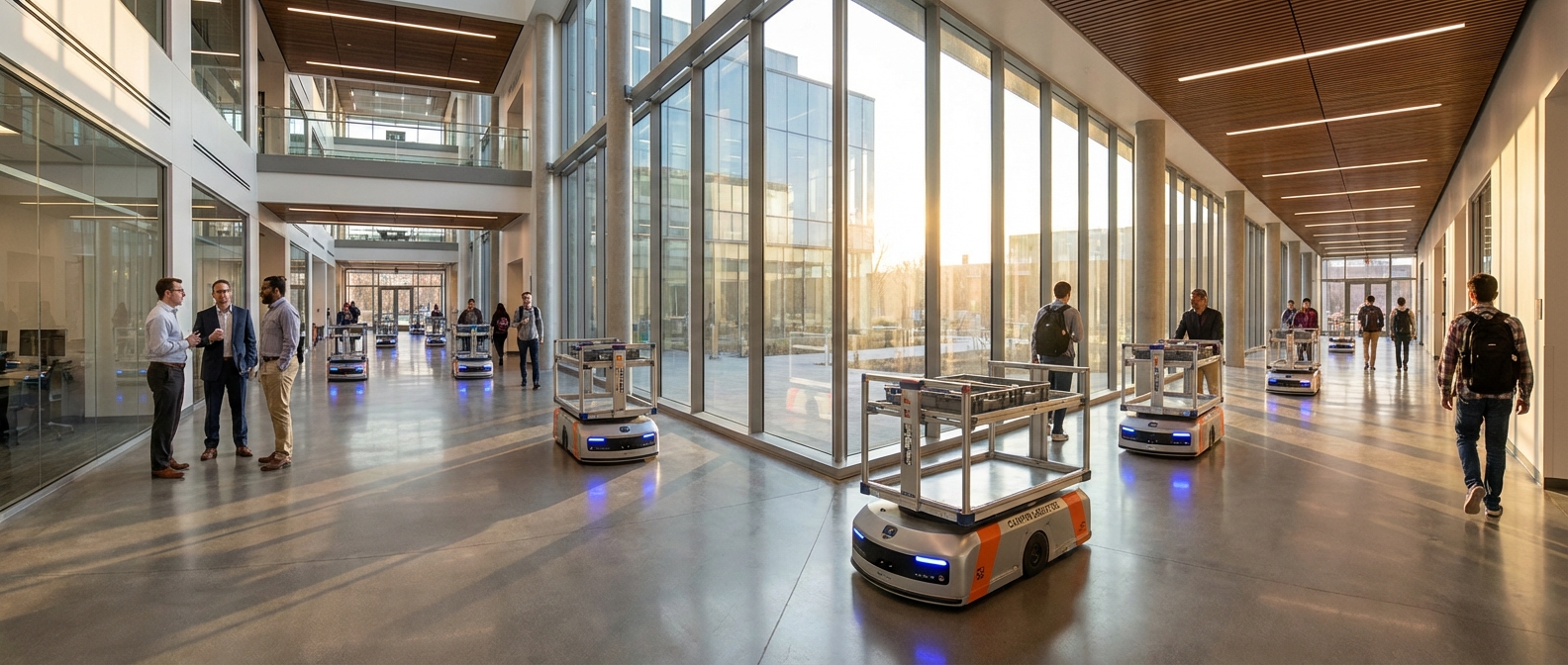
Academia's moving from abstract theory to real hands-on action. Advanced robotics deliver the physical platform that connects complex algorithms to actual real-world behavior, speeding up lab discoveries and boosting classroom engagement.
Why Robotics Matters Here
Bridging Theory & Practice
Students often struggle to picture complex kinematic theories. Robots give instant physical feedback on coding and mechanical engineering concepts.
Lab Safety & Consistency
Dealing with hazardous materials or endless pipetting brings risks and mistakes. Automation keeps things safe and delivers 100% repeatable results every time.
Data Precision
Human observation can introduce bias. Robots paired with sensors grab detailed, objective data that's perfect for those peer-reviewed publications.
Open Source Ecosystems
Proprietary systems lock researchers in. Our platforms work with ROS 2 and Python, so you can tweak control loops and algorithms however you like.
Interdisciplinary Collaboration
Today's challenges need real collaboration. Robotics pulls together Computer Science, Mechanical Engineering, and Biology teams on one shared platform.
Remote Labs
Distance learning misses out on hands-on labs. Telepresence robots let remote students control hardware and run experiments from anywhere.
Applications in Education & Research
Educational Research Platform
Learn how our educational research platform shakes up education & research with flexible, code-agnostic foundations.
Explore Application →Laboratory Sample Transport
Learn how our laboratory sample transport revolutionizes education & research through autonomous intra-logistics and secure chain of custody.
Explore Application →Inspection & Monitoring
Learn how our inspection & monitoring upgrades education & research by automating environmental data collection and facility safety checks.
Explore Application →How to Deploy
Bringing robotics into education or research means balancing student-friendly access with researcher-level rigor. Start by nailing down your . Figure out if you're diving into low-level control theory (needing open hardware APIs) or high-level AI apps (with solid simulation setups).
Next up, tackle . Set up clear operating zones—like enclosed arenas for aerial drones or flat terrain for AMRs. Our systems pack built-in collision avoidance and emergency stops, but physical boundaries add that extra safety net for early student coding sessions.
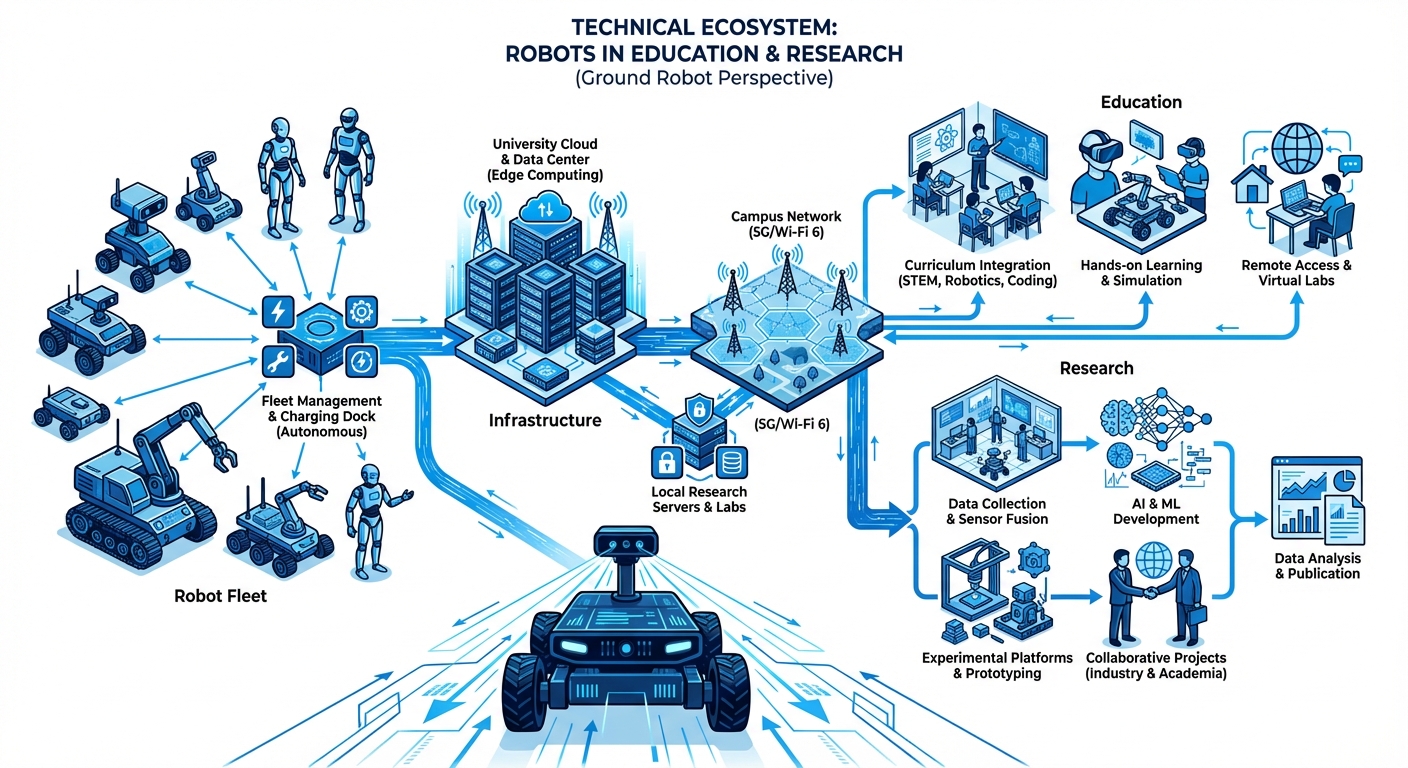
Finally, tie it all together with . We love ROS 2 (Robot Operating System) as your core framework. It lets you kick off with one unit for a pilot, then scale to a full fleet for multi-agent research—all without rewriting code.
Success Stories
Democratizing Reinforcement Learning
Challenge:
Solution: Deployed 10 ruggedized AMRs with NVIDIA Jetson cores.
Result:
24/7 Automated Sample Handling
Challenge:
Solution: Integrated a mobile manipulator with existing LIMS software.
Result:
Precision Phenotyping
Challenge:
Solution: All-terrain rovers equipped with multispectral cameras and LiDAR.
Result:
Workforce Readiness
Challenge:
Solution: Hands-on curriculum using modular, industrial-grade service robots.
Result:
Industry-Specific Questions
Do your robots support ROS // ROS 2?
Yes, our research platforms fully support ROS 1 (Noetic) and ROS 2 (Humble/Iron). We supply official packages, URDF models, and sim environments for smooth integration into your curriculum or research setup.
Are these robots safe for undergraduate student use?
Safety comes first. Our robots have multi-layer protections like physical E-stops, LiDAR collision avoidance, and software speed limits. We suggest training sessions, but the hardware's forgiving even with student coding slip-ups.
Can we attach custom sensors or payloads?
Absolutely. Our platforms have industry-standard mounting rails (extruded aluminum profiles) and easy-access power ports (5V, 12V, 24V) perfect for adding custom LiDARs, robotic arms, depth cameras, or bio-sampling gear.
Do you offer educational discounts?
Yes, we have tiered pricing for accredited schools and research grants. Just reach out to our sales team with your .edu email or grant info for a custom quote.
What programming languages are supported?
We primarily support Python and C++. But with standard TCP/IP and REST APIs, you can connect using MATLAB, Java, or LabVIEW—whatever your department prefers.
Is simulation software included?
We offer full digital twins for Gazebo and NVIDIA Isaac Sim. Students can code and test in virtual space before hitting the real robot, saving hardware and speeding up classes.
How durable are the robots for outdoor research?
Yes, we have IP54 to IP65-rated models for outdoors. They're built for terrains like grass, gravel, and asphalt—great for ag or environmental projects.
Can multiple robots communicate (Swarm Robotics)?
Yes. Our networking supports multi-agent setups right out of the box. Set up a fleet server or go peer-to-peer for swarm intelligence and decentralized control research.
What is the battery life for field experiments?
Depending on payload and terrain, our research robots run 4 to 8 hours straight. Hot-swappable batteries mean zero downtime for long field sessions.
Do you provide curriculum materials?
We include a "Getting Started" guide and sample code repos covering navigation, SLAM mapping, and object recognition. No full syllabus from us, but our stuff slots easily into your robotics courses.