Zigbee Communication
Transform your AGV fleet's comms with Zigbee—the low-power, self-healing mesh king. It keeps robots chatting reliably with controls in Wi-Fi-hostile factories.
Core Concepts
Mesh Topology
No direct links: Zigbee hops data via neighbors. AGV blocked? Signal reroutes on the fly.
Ultra-Low Power
Battery sippers: sensors and robot peripherals run years on standard cells, no fuss.
AES-128 Security
Industrial-grade secure: 128-bit AES encryption blocks rogue commands.
Interference Avoidance
Zigbee runs on the 2.4 GHz band, tapping into Direct Sequence Spread Spectrum (DSSS) and smart channel switching to stay rock-solid even in noisy factories.
Massive Scalability
One Zigbee network can handle up to 65,000 nodes in theory, making it perfect for massive warehouse robot swarms and sensor networks.
Standardized Protocol
Based on IEEE 802.15.4, Zigbee guarantees devices from different vendors play nice together, so you avoid getting locked into one supplier for your robot parts.
How Zigbee Drives AGVs
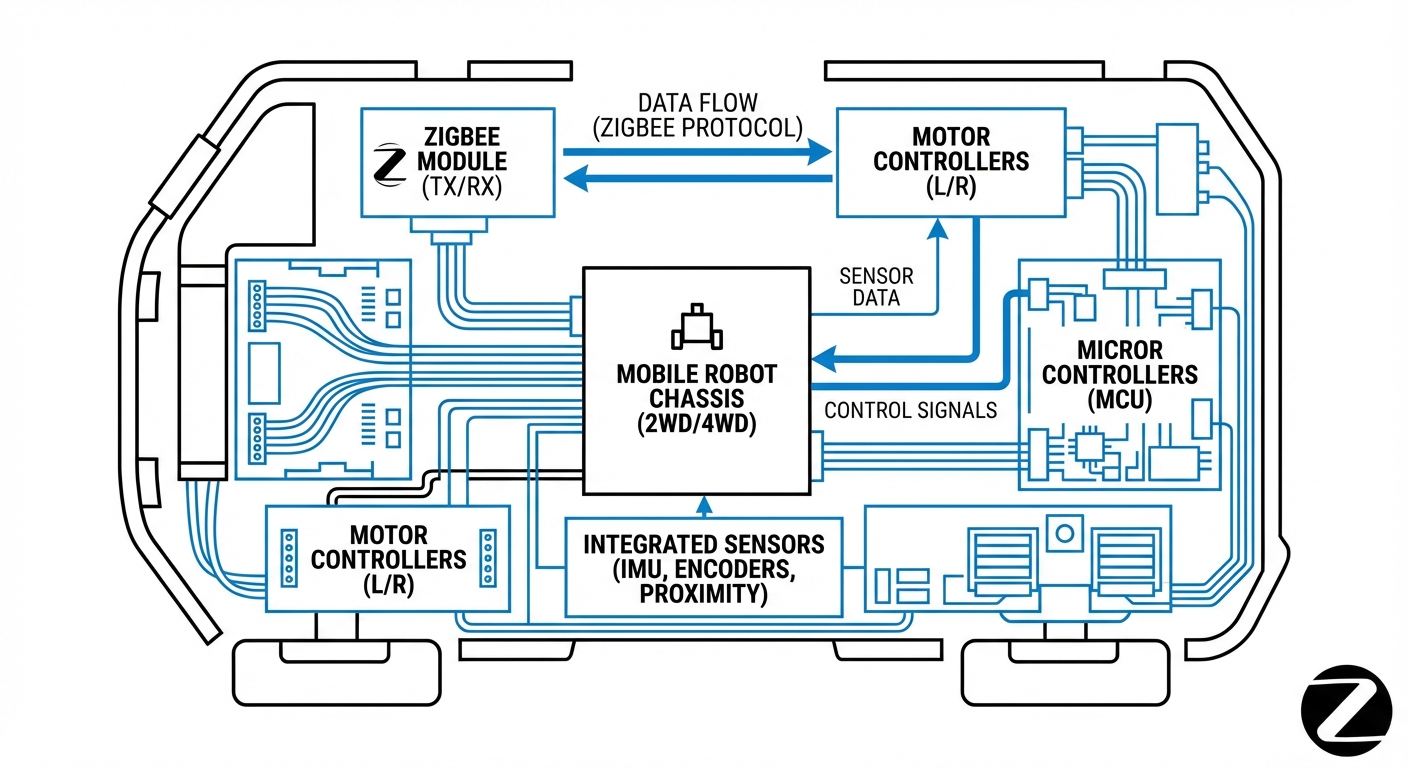
In a standard industrial robotics setup, Zigbee works via three key device types: the , , and . The Coordinator starts the network and keeps the security keys safe, often built right into your central Warehouse Management System (WMS).
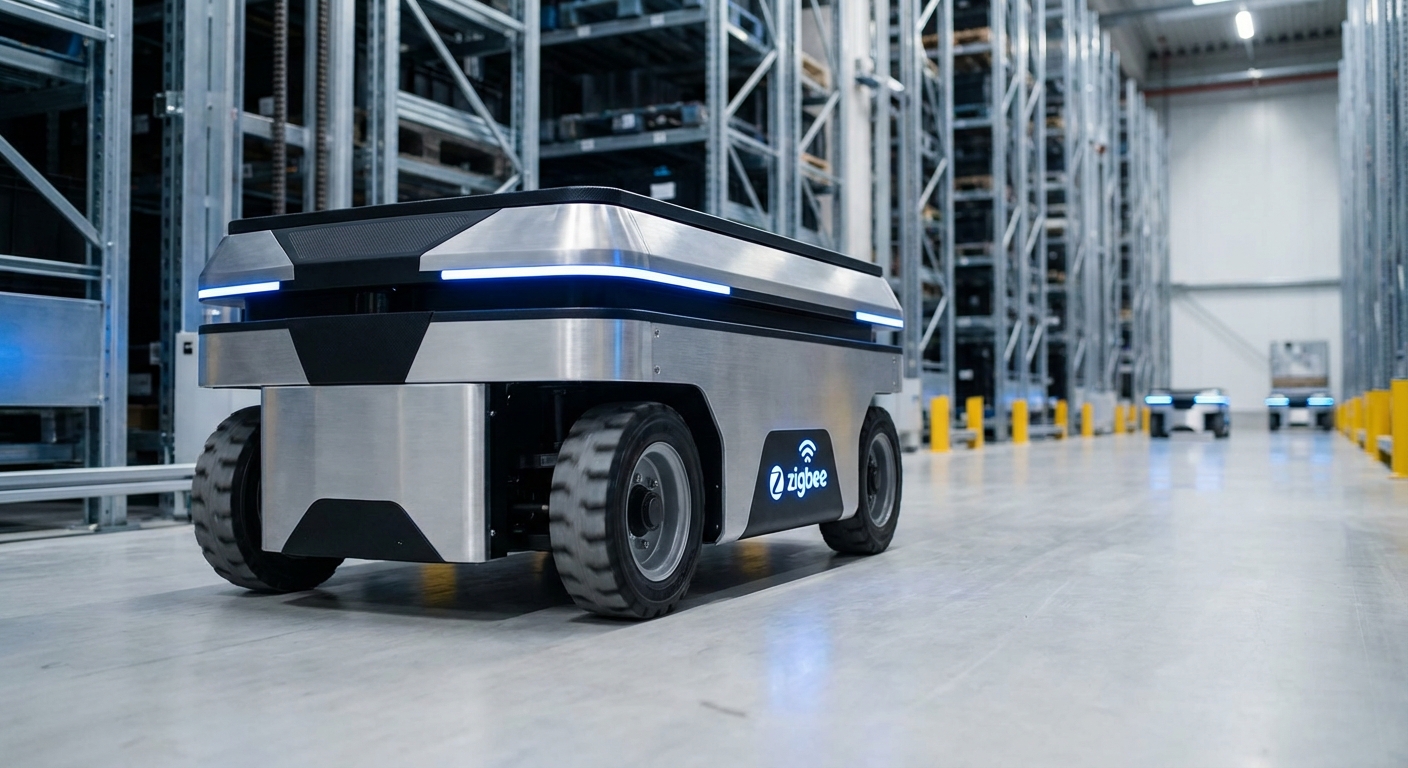
AGVs typically double as . That's the killer feature: every robot in your fleet boosts the signal. When Robot A rolls to the far end of the warehouse, it relays data through Robot B and C back to the main controller.
This dynamic "self-healing" setup means if a forklift blocks the path or a node drops offline, the network instantly reroutes packets—no downtime for your fleet's critical coordination.
Real-World Applications
Warehouse Swarm Coordination
In fulfillment centers, hundreds of Kiva-style robots use Zigbee to track each other's positions and grab picking instructions, without hogging the high-speed Wi-Fi humans rely on.
Industrial IoT Sensor Integration
Zigbee-equipped AGVs scoop up data from sensors on machinery—like temperature, humidity, vibration—as they drive by, then beam it to the central cloud.
Hospital Logistics Robots
Hospital delivery robots use Zigbee to talk to auto doors and elevators, ensuring smooth up-and-down, side-to-side hauls for linens and meds.
Asset Tracking & Geofencing
Zigbee tags on pallets and inventory let AGVs pinpoint items using triangulation (RSSI), giving you pinpoint inventory visibility across the facility.
Frequently Asked Questions
What’s the key difference between Zigbee and Wi-Fi for robotics?
It boils down to power use and data speed. Wi-Fi handles high-bandwidth tasks like video or big files but drains batteries fast. Zigbee delivers low-bandwidth (250 kbps) that's tuned for small packets like telemetry and commands, with super-low power draw—ideal for long battery life.
How does Zigbee handle interference in a bustling factory?
Zigbee shares the 2.4 GHz ISM band with Wi-Fi but has 16 channels to pick from. Setup folks scan the airwaves and lock the network onto channels like 25 or 26—tucked between Wi-Fi's go-tos (1, 6, 11)—to cut overlap and dropped packets.
What is the effective range of a Zigbee node?
A direct Zigbee link reaches 10 to 100 meters, based on line-of-sight and power. But the mesh topology makes the network's range practically endless, as data hops robot-to-robot to span the whole facility.
Is Zigbee fast enough for real-time robot control?
Zigbee latency runs about 15-30ms per hop. That's plenty for oversight, sending coordinates, and status checks, but too slow for real-time joysticking or rapid control loops—handle those on the robot's onboard smarts.
How many devices can a single Zigbee network support?
Zigbee's addressing supports up to 65,535 nodes per network. In real-world factories, though, we split into clusters of a few hundred to dodge congestion and keep latency low.
What happens if the Coordinator node fails?
Older Zigbee could crash hard if the Coordinator failed. Modern Zigbee 3.0 is tougher with distributed security. New devices can't join sans Coordinator, but Router-to-Router traffic (your AGVs) keeps rolling, so ops don't freeze.
Can Zigbee penetrate thick warehouse walls?
2.4 GHz signals hate thick concrete or metal racks. The mesh magic routes around obstacles via other nodes instead of punching through. For separate rooms, plant static, plug-in Routers in doorways to link areas.
Is the data transmitted over Zigbee secure?
Yes. Zigbee locks down with AES-128 encryption for keys and frames, plus frame counters to block replays. For high-stakes industrial use, install codes ensure only approved devices join the mesh.
How does Zigbee compare to LoRaWAN for robotics?
LoRaWAN nails kilometers of range but crawls on data rates and latency—great for fixed sensors, lousy for robot control. Zigbee strikes the perfect balance: speedy enough for telemetry, with mesh coverage for the whole facility.
Can I update robot firmware over Zigbee (OTA)?
Yes, Zigbee handles Over-The-Air (OTA) updates. But at 250 kbps, pushing big firmware to a fleet eats time and bandwidth. Wi-Fi or wired connections are better for major updates.
Does Zigbee work with ROS (Robot Operating System)?
Yes, ROS has packages like `zigbee_serial` or MQTT-to-Zigbee bridges that let ROS robots connect to modules (XBee, TI CC2531) over UART or USB, slipping seamlessly into the ROS graph.
What hardware do you need to add Zigbee to an existing AGV?
It's usually a breeze. Bolt on a Zigbee module (like Digi XBee or Silicon Labs) via UART/SPI to the main PLC or microcontroller. Add an external antenna mount on the chassis for top-notch signal.
Ready to implement Zigbee in your fleet?
Upgrade your swarm intelligence with robust, low-latency mesh networking.
Explore Our Robots