Wireless Inductive Charging
Transform your AGV and AMR fleets with contactless power transfer. Ditch mechanical connectors for true 24/7 autonomy, lower maintenance, and top safety in tough spots.
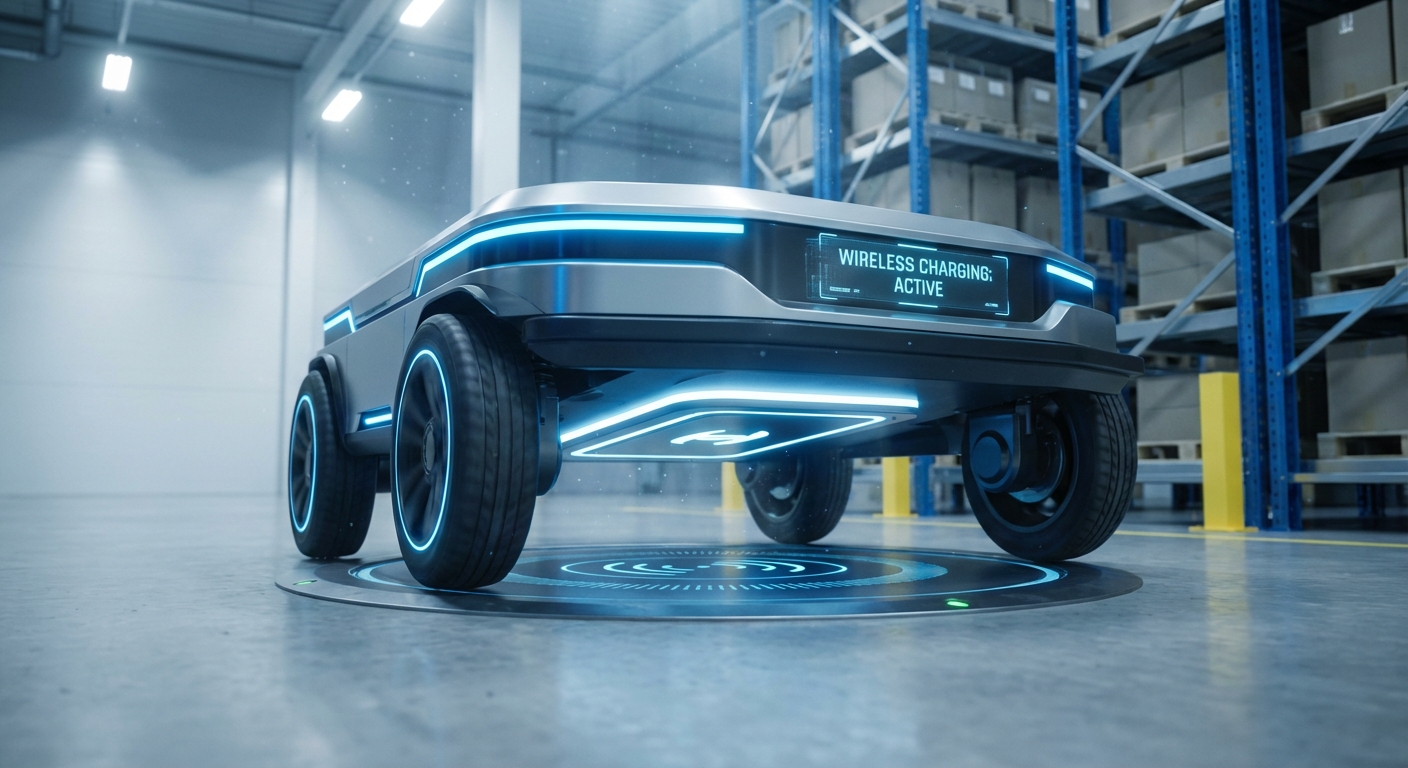
Core Concepts
Electromagnetic Induction
Uses magnetic fields to beam energy from a floor coil to the robot's receiver—no touching required.
Maintenance Free
No brushes or contacts to wear down means basically zero charger upkeep or replacement downtime.
Opportunity Charging
Powers 'snack charging' during quick workflow breaks. High-power pulses keep batteries topped off without long stops.
Enhanced Safety
No exposed electrics? Zero shock or spark risk—safe for people and hazardous zones (ATEX).
High Tolerance
Today's systems handle plenty of misalignment, so AGVs charge great even without perfect docking.
Smart Integration
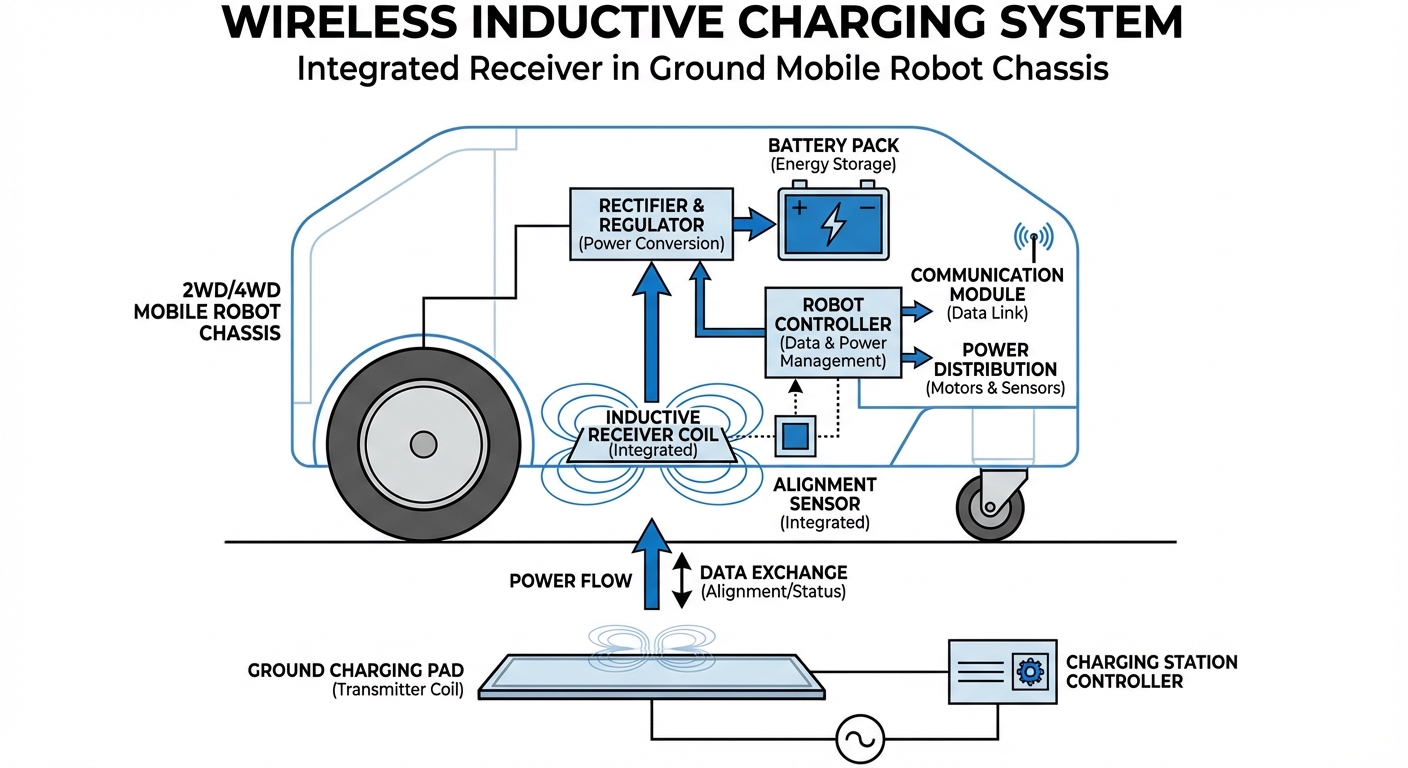
Built-in comms let the charger and robot's BMS swap battery health, charge status, and power tweaks.
How It Works
Wireless inductive charging works via resonant magnetic coupling. A primary coil—often in the floor or a mat—creates an oscillating magnetic field from grid power.
The robot's secondary coil grabs that field. Resonance turns it back into current for the battery.
Smart electronics tune frequency and power for 93%+ efficiency rivaling wires, while watching for foreign objects to avoid heat issues.
It all kicks in the instant the robot parks over the pad—no plugs, no fuss.
Real-World Applications
Cleanroom Environments
Perfect for semiconductors or pharma. No copper dust from friction—just clean, sealed charging.
24/7 Logistics Warehouses
Enables 'always-on' logistics. Robots grab 2-3 minute opportunity charges at stations, skipping battery swaps or long offlines.
Hazardous Areas
A game-changer for oil, gas, and chemical plants. By ditching spark-prone physical connections, wireless charging lets you deploy explosion-proof (ATEX) certified robot fleets with total confidence.
Outdoor Surveillance
Ideal for outdoor security robots facing rain, snow, and muck. Fully sealed electronics (IP67/IP68) keep humming along reliably, even where exposed contacts would rust out or short.
Frequently Asked Questions
What's the typical efficiency of wireless charging versus wired?
Modern resonant inductive systems are super efficient, delivering 90% to 94% wall-to-battery efficiency. That's right up there with premium wired chargers, so you get wireless convenience without wasting much energy.
How precise does the robot positioning need to be?
Unlike clunky old tech, today's systems are forgiving. Most industrial setups handle misalignment of ±30mm to ±50mm in X and Y, plus a few degrees of tilt, so standard navigation gets robots docked effortlessly.
Is it safe for people to walk over the charging pads?
Absolutely. Built-in Foreign Object Detection (FOD) and Living Object Detection (LOD) kick in if a person or metal gets between the coils, instantly shutting off power to avoid heat or radiation—fully compliant with ICNIRP safety standards.
What types of batteries are supported?
Wireless charging works with any battery chemistry, but shines with Lithium-Ion (LiFePO4, NMC) or Supercapacitors. It chats with the battery's BMS to nail the exact CC/CV profile every time.
Can we retrofit existing AGVs with wireless charging?
Yep, retrofitting is super common. Just slap a receiver plate on the robot, hook it to the battery terminals and BMS—its compact size means no big chassis changes for your existing fleet.
What are the power capabilities (charging speed)?
Systems range from 1kW for small AMRs to 30kW+ for beefy forklifts and tuggers. High-power ones support quick 'opportunity charging,' pumping serious energy in just minutes during load/unload breaks.
Does the charging system require an internet connection?
Basic ops run offline—no internet needed. Pad and robot talk locally via magnetic field or short-range radio. For fleet insights and predictive maintenance, though, hook the base station to your network.
How does it handle wet or dusty environments?
This is one of its biggest wins. Pads are fully potted (IP67/IP68), thriving underwater, in mud, or under thick dust—stuff that kills contact chargers on contact.
Will it interfere with Wi-Fi or other robot sensors?
Nope. It runs at low frequencies (20kHz to 140kHz), way below Wi-Fi, Bluetooth, or LiDAR's GHz range. EMC shielding keeps everything interference-free for onboard gear.
What is the expected lifespan of the hardware?
With no moving parts or contacts to wear out, these units last forever—often 10-15 years or more, outliving the AGV itself.
How does the cost compare to traditional contact charging?
Upfront costs (CapEx) are higher, sure. But running costs (OpEx) drop big time thanks to zero maintenance, fewer parts, and max uptime—ROI hits in 2-3 years.
Can multiple robots use the same charger?
Yes. Match voltage and power ratings, and one station handles your whole mixed fleet. Smart protocols detect the robot and tweak settings on the fly.
Ready to implement Wireless Inductive Charging in your fleet?
Upgrade your autonomy with robust, maintenance-free power solutions.
Explore Our Robots