Tethered Power Systems
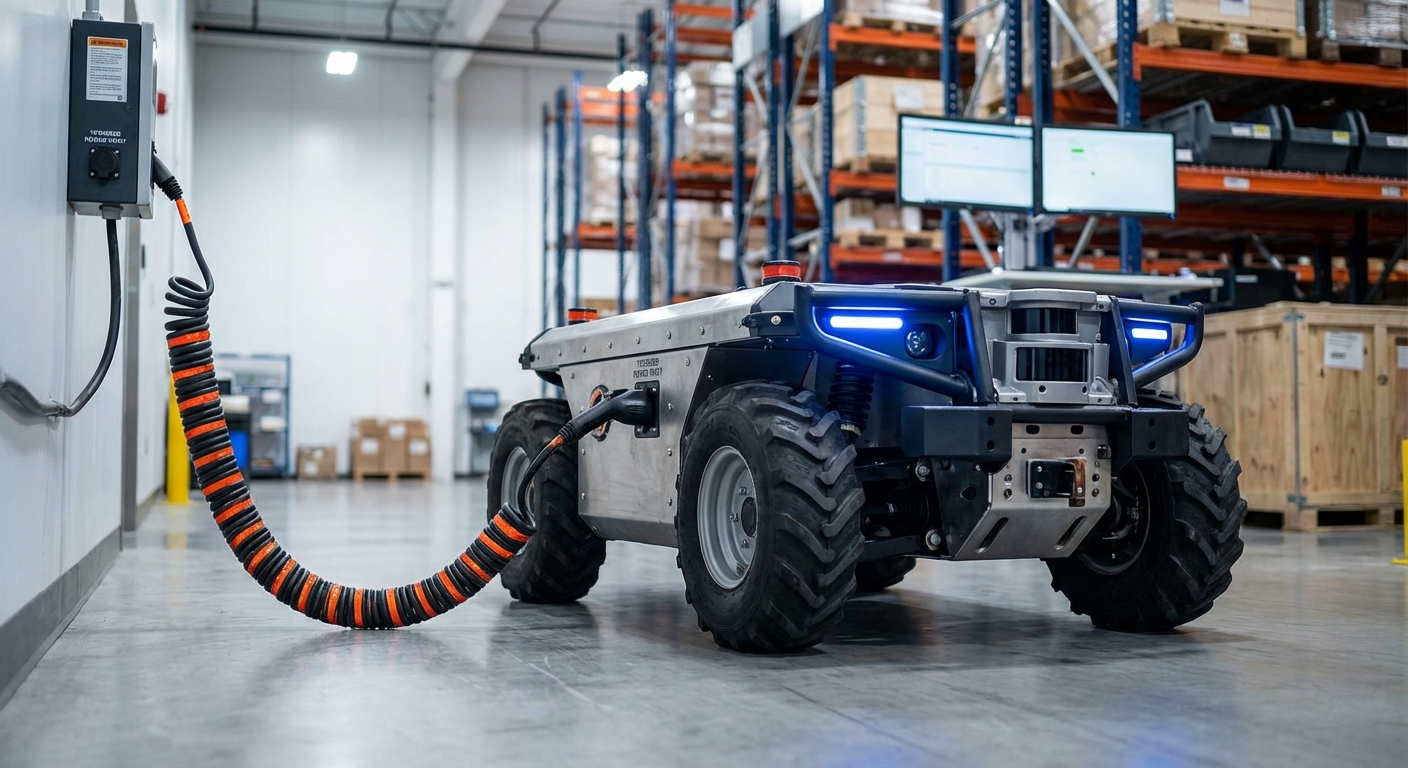
Unlock endless runtime and slash onboard weight with continuous power and high-speed data via physical umbilicals. Tethered systems deliver rock-solid performance for high-demand AGVs and stationary tasks where batteries fall short.
Core Concepts
Infinite Runtime
Ditch stored energy dependence, and your tethered robots run 24/7—no downtime for charging or swapping.
High-Bandwidth Data
The tether doubles as a conduit for Fiber Optic or Ethernet, delivering lag-free 4K video and massive sensor data.
Weight Reduction
Ditching heavy lithium-ion packs skyrockets your payload-to-weight ratio, letting smaller actuators haul bigger loads.
Tether Management
Automated spools and active tension control keep cables tangle-free and drag minimal as your robot zips around.
Operational Safety
Hardwired E-Stop circuits in the tether offer instant, ultra-reliable cutoffs that beat any wireless setup.
Slip Ring Technology
Advanced electrical rotary joints (slip rings) let the spool rotate freely while maintaining unbroken power and data links.
How It Works: The Umbilical Link
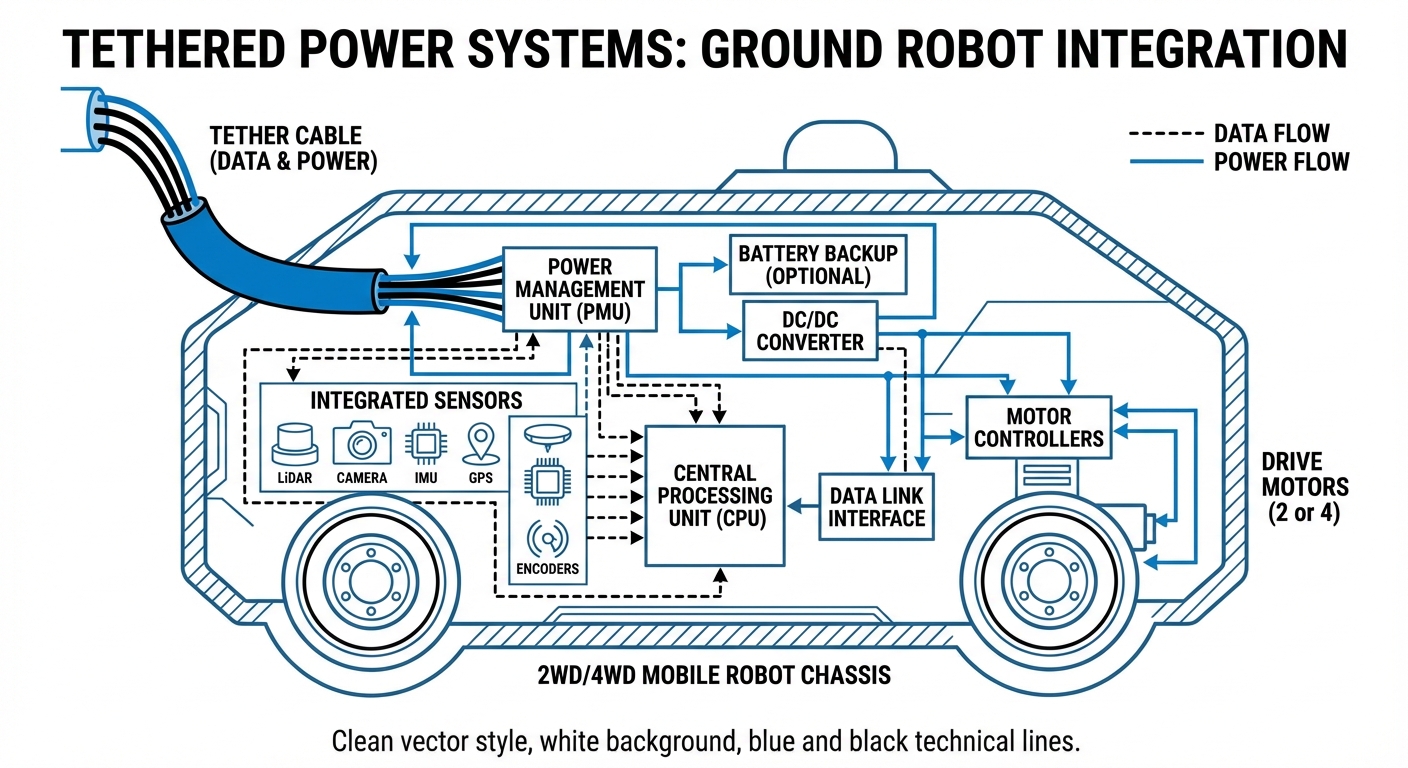
A Tethered Power System brings the electrical grid straight to your mobile robot. The star is the Tether Management System (TMS), mounted on the robot or base station. It uses a motorized spool with active torque control to pay out and reel in cable as the robot moves, keeping things taut without any drag.
The cable—often called an 'umbilical'—is a true engineering feat. It bundles high-gauge power conductors for motors, shielded twisted pairs for Ethernet, and often fiber optic lines for interference-free data. Kevlar reinforcement handles the tensile stress.
At the robot end, onboard converters step down high-voltage AC or DC. This setup swaps heavy chemical storage for a steady power stream, limited only by cable length and conductor heat capacity.
Real-World Applications
Underwater ROVs
Remotely Operated Vehicles (ROVs) depend on tethers for deep-sea work. Radio waves barely penetrate water, so tethers are essential for HD video and powering hefty hydraulic arms at depth.
Nuclear Decommissioning
In high-radiation zones, fancy battery electronics fail fast from ionization. Simple shielded copper tethers deliver reliable power to demolition robots where wireless flops and humans can't enter.
Vertical Wall Climbers
For inspection robots scaling storage tanks or wind turbines, gravity is brutal. Tethers eliminate battery weight, letting magnetic or suction climbers operate safely without overload risks.
Warehouse Gantry Systems
While AMRs roam freely, high-speed shuttles in Automated Storage and Retrieval Systems (AS/RS) use drag chains or flexible tethers to hit insane acceleration that would drain batteries in minutes.
Frequently Asked Questions
What is the primary advantage of a tethered system over batteries?
The biggest perk is unlimited runtime. Forget hours of charging or swapping—tethered robots run full-tilt nonstop. They're also way lighter, boosting payloads or agility.
How do you prevent the cable from getting tangled?
Tangling? Active Tether Management Systems (TMS) nip that in the bud. Motorized reels with sensors monitor slack and tension, auto-retracting or extending cable. Path planning even factors in tether history to stay clear.
What is the maximum effective range of a tethered robot?
It boils down to cable weight and voltage drop. Small ground robots handle 30-50 meters easily. Larger industrial setups with high-voltage (for thinner cables) can stretch to hundreds of meters, though management gets trickier.
Does the tether affect the robot's movement dynamics?
Yes, the tether adds drag. Robot controls factor in this changing force based on deployed length. Smart systems use force feedback from the tether point to counteract it in real time.
Can data and power run through the same cable?
Absolutely. Modern umbilicals pack shielded twisted pairs (for Ethernet) or fiber optics right alongside power lines. You get gigabit speeds immune to RF noise—perfect for secure or chaotic industrial spots.
Are high-voltage tethers safe?
Safety first. Tethers use thick, tough insulation like PUR or Teflon. Built-in Ground Fault Circuit Interrupters (GFCI) and insulation monitors cut power in milliseconds if anything's off.
What happens if the robot loses power (e.g., cable cut)?
Most tethered robots have a small backup battery or capacitor bank. This buffer gives just enough juice to park safely, save data, and shut down cleanly—no damage to actuators or lost position info.
Is a slip ring necessary?
If the cable reel rotates, a slip ring is required to maintain electrical continuity between the rotating spool and the stationary base. High-quality mercury or gold-contact slip rings are used to prevent signal noise in data lines during rotation.
Can tethered systems operate outdoors?
Yes, but the cable must be rated for the environment. Outdoor tethers require UV-resistant jackets and waterproofing. In muddy or rugged terrain, the drag increases significantly, so the tether management system must be more robust than in a clean warehouse floor.
How does the cost compare to battery systems?
Initial implementation costs can be higher due to the reel mechanism and infrastructure. However, operational costs (OPEX) are often lower because you eliminate expensive battery replacements (which degrade over time) and the logistics of charging management.
Can multiple tethered robots work in the same space?
Tangled tethers are a real headache, especially when paths cross—entanglement risks skyrocket. You can pull it off with super-strict path planning and staggered cable heights (like ceiling drops), but tethered setups really shine in single-robot zones or simple linear tracks.
What is a "Flying Tether"?
A 'flying tether' usually means a drone (UAV) plugged into a ground power station. This lets it hover endlessly for surveillance or lighting gigs, ditching the standard 20-30 minute battery limit on commercial drones.
Ready to implement Tethered Power Systems in your fleet?
Discover how continuous power can revolutionize your automation workflow.
Explore Our Robots