Tactile Sensors
Give your autonomous mobile robots the ultimate safety net. Tactile sensors deliver vital touch feedback, slamming the brakes on contact and linking perception to real-world action in busy spaces.
Core Concepts
Mechanical Bumpers
The go-to AGV tactile sensor. These are bump switches around the chassis edge that trigger an instant E-stop when squeezed.
Resistive Sensing
Uses conductive foam or ink. Pressure drops resistance, so the controller pinpoints impact spot and force.
Capacitive Skin
A 'robotic skin' sensing proximity and gentle touch via capacitance shifts. It dodges crashes before they happen.
Safety Ratings (PL d)
Tactile sensors on industrial AGVs usually hit Performance Level d (PL d) safety specs, staying reliable even if parts fail.
Force/Torque Sensors
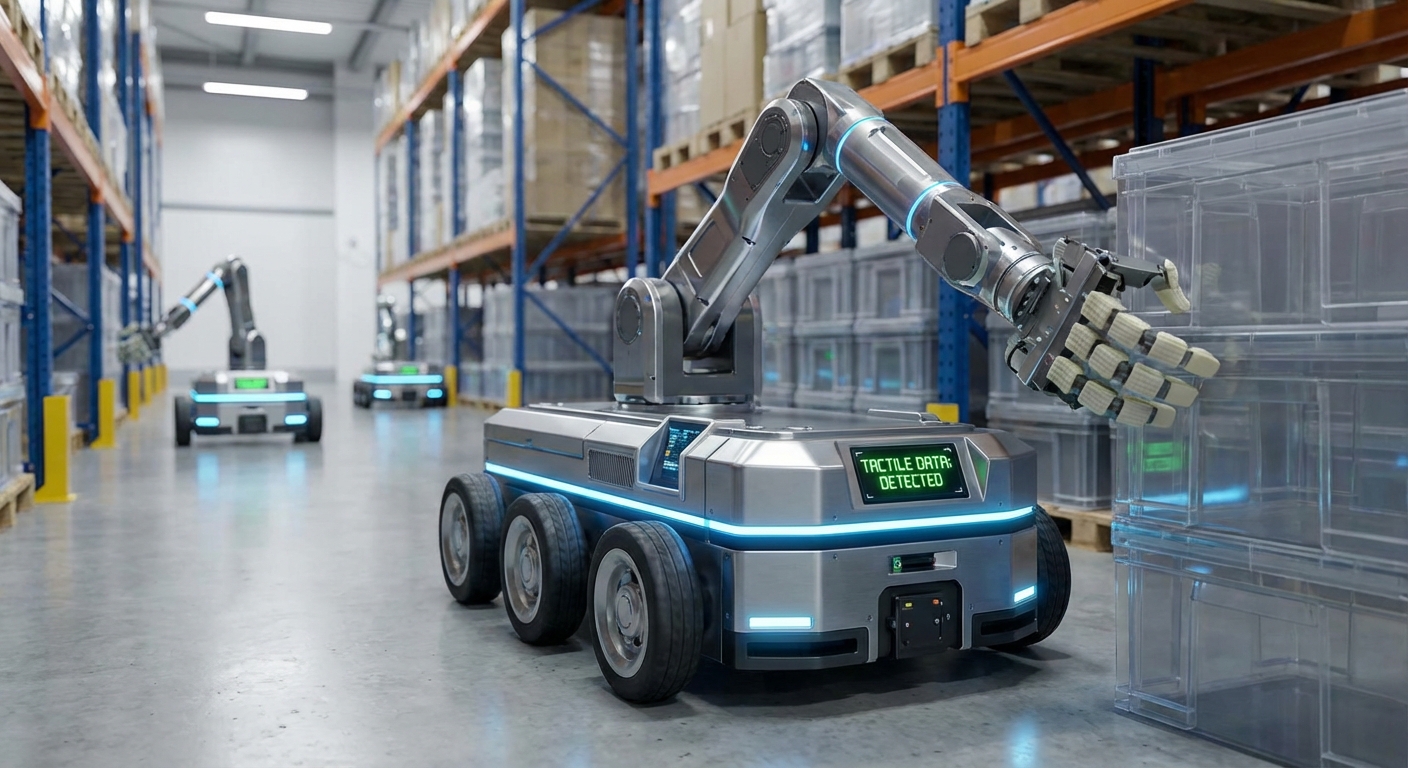
Common in mobile manipulators (robotic arms on AGVs), these gauge force vectors on the end-effector for gentle object handling.
Signal Transduction
It's all about turning a physical squeeze into an electrical signal. Speed matters big time here—it slashes the stopping distance once a collision's detected.
How It Works
From Deformation to Decision
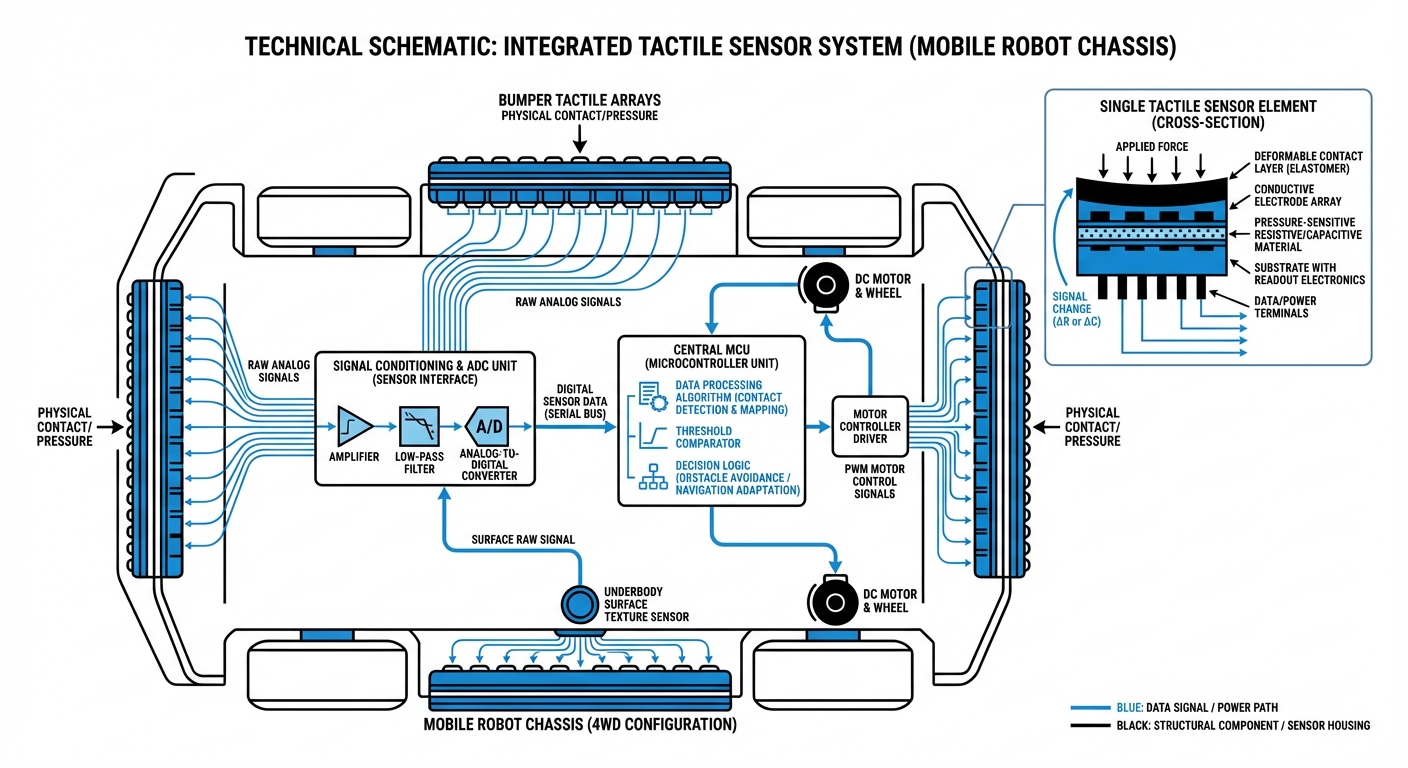
Tactile sensors are like the "nervous system" of the robot's outer shell. Unlike LiDAR or cameras that guess at collisions, these actually confirm them. When something presses on the sensor bumper or safety edge, the internal conductive layers get compressed.
That compression closes an electrical circuit (or tweaks resistance), firing a high-priority interrupt signal straight to the robot's safety PLC. It skips the high-level navigation stuff to launch a hardware-level braking sequence.
Modern setups use "Safety Edges"—flexible strips with copper wires separated by non-conductive rubber. Even a light finger-pinch sets off the stop, keeping human workers safe in shared spaces.
Real-World Applications
Warehousing & Logistics
High-speed AGVs wrap around with tactile bumpers. If a forklift tine or dropped pallet slips into a blind spot, the sensor stops the vehicle dead on contact to save the chassis.
Healthcare & Hospitals
Delivery robots zip through crowded hospital corridors. Soft tactile skins let them gently "nudge" past people or halt if a patient steps in unexpectedly.
Heavy Manufacturing
AGVs hauling multi-ton loads face serious crushing risks. Pressure-sensitive safety mats and skirt sensors spot obstacles underneath, preventing nasty foot injuries.
Mobile Manipulation
AGVs with robotic arms use fingertip tactile sensors to sense if an object's rigid or fragile, automatically dialing in the perfect grip strength.
Frequently Asked Questions
Why add tactile sensors if my AGV already has LiDAR?
LiDAR rocks for long-range spotting, but it misses blind spots right by the floor or chassis. Tactile sensors are your redundant, last-ditch safety backup (ISO 13849-1 compliant) for "negative obstacles" or glass that LiDAR skips.
What's the typical response time for a tactile bumper?
Super fast—usually 5 to 15 milliseconds. That near-instant signal is key to cutting stopping distance after a physical bump happens.
How durable are safety edges in harsh environments?
Industrial safety edges use chemically tough rubber (like EPDM or NBR) that laughs off oil, coolants, and scrapes. Most are IP65 or IP67 rated, dust-tight and ready for water jets.
What if the wire to the sensor gets cut?
Tactile sensors are built fail-safe. The system watches the circuit nonstop—if a wire cuts or the sensor disconnects, the circuit opens, and the robot sees it as a collision or fault, stopping immediately.
Can tactile sensors tell a person from a wall?
Basic safety bumpers can't—they're just on/off switches. But advanced force-torque or capacitive skins check 'compliance' (softness) to spot the difference between a hard wall and a human.
Do tactile sensors require regular calibration?
Mechanical bumpers and safety edges skip software calibration. Just inspect them regularly to check the rubber hasn't hardened or cracked, which could mess with activation.
How much force is required to trigger a stop?
It varies by sensor model but stays super low for safety. ISO rules often cap it under 150N for body contact, and much lower for fingers or hands.
Can I retrofit tactile sensors onto older AGVs?
Yep, retrofitting's easy and common. Cut safety edges to fit, mount with aluminum rails on the chassis, and tie the wiring into your AGV's E-stop circuit.
Do they work in freezing temperatures (Cold Storage)?
Standard rubber stiffens in freezing temps, risking failure. For cold storage AGVs, pick silicone or special low-temp rubber sensors.
What is the "overtravel" distance?
Overtravel is the distance the bumper compresses the signal is sent but the robot physically stops. The bumper must be thick enough to absorb the robot's kinetic energy during this braking distance to prevent injury.
Are there wireless tactile sensors for rotating parts?
Yes, wireless transmission works for safety edges on rotating turrets or doors where wires can't go. They need top-notch reliability to avoid signal drops from interference.
How does dust affect tactile sensors?
Unlike optical sensors (LiDAR/cameras) that dust blinds easily, tactile sensors are mechanical and ignore airborne particles. Perfect for sawmills, textile plants, and dusty warehouses.