Swerve Drive Modules
Unlock real omnidirectional agility for your autonomous mobile robots (AMRs). Swerve drive modules split steering from traction, letting AGVs slide sideways, move any direction, or spin on a dime—transforming efficiency in tight spaces.

Core Concepts
Holonomic Motion
Move freely in X, Y, and rotation (Theta) all at once. Your robot can sidestep or go diagonal without twisting the whole chassis.
Independent Control
Every module has its own steering and drive motors. That independence unlocks maneuvers differential drives can only dream of.
High Traction
Unlike mecanum wheels with their rollers, swerve modules rock standard traction tires for killer grip on floors and heavy payloads.
Integrated Encoders
Built-in absolute encoders keep wheel alignment spot-on and odometry precise, perfect for nailing paths and docking.
Zero Radius Turn
Point all wheels toward a central spot, and the robot spins in place—like turning on a dime—great for skinny aisles.
Slip Ring Technology
Advanced coaxial swerve modules use slip rings for endless steering rotation without wires getting tangled.
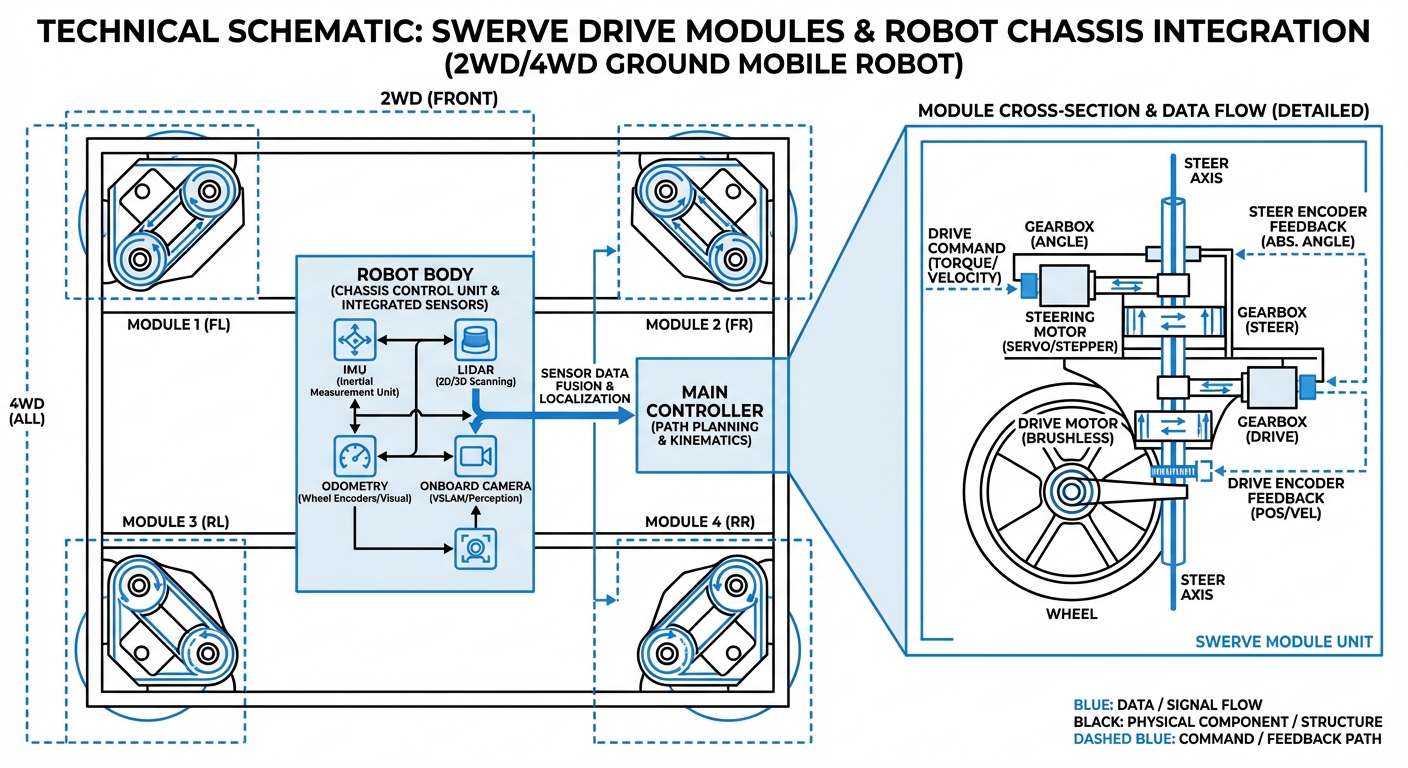
Anatomy of a Swerve Module
Think of a swerve drive module as its own 'robot leg.' It flips the script on chassis design by packing propulsion and steering into one tight package.
The Mechanism: Steering Motor Drive Motor
The Result:
- ✓ Standard: 4-Wheel independent swerve configuration.
- ✓ Handles big loads thanks to direct wheel contact.
- ✓ Way less energy wasted than mecanum's roller drag.
Real-World Applications
High-Density Warehousing
Swerve-equipped AGVs slip into narrow aisles and sidestep to grab pallets, shrinking needed aisle width by up to 30% over Ackerman-steered rigs.
Automotive Manufacturing
Hauling huge sub-assemblies like chassis or fuselage? Swerve drives nail precise alignments with tiny tweaks—no backing up required.
Medical Transport
In busy hospital halls, transport bots dodge people and gear effortlessly. Instant strafing avoids crashes and boosts safety in chaos.
Flexible Assembly Lines
Swap fixed conveyors for swarming AGVs. Swerve modules let factory floors reconfigure on the fly for production shifts—no big infrastructure changes.
Frequently Asked Questions
What’s the biggest win of Swerve Drive over Differential Drive?
The killer perk is holonomic motion. Differential bots have to spin around to turn, but swerve lets you strafe any direction instantly while keeping your heading—huge agility boost in tight spots.
How does Swerve Drive compare to Mecanum wheels?
Both go omnidirectional, but swerve crushes it on traction and payloads. Mecanum wastes ~30% force on vector fights and slips on rollers. Swerve's standard tires shine on bumpy floors, ramps, and heavy industrial hauls.
Are Swerve Drive modules difficult to control?
They need fancier software for coordinating those four independent modules via inverse kinematics. But today's motion libraries and ROS packages make it way easier to implement.
What is a "Coaxial" Swerve Module?
In coaxial designs, the drive motor sits right above the steering axis, piping power through a central shaft in the steering gear. Keeps motors safe and still inside the chassis, cuts rotating mass, and enables full 360-degree spins.
Can Swerve Drive AGVs handle ramps or inclines?
Yep, way better than mecanum. Wheels always point where you're going with grippy tire material (polyurethane or rubber), so they hold traction on slopes—as long as your center of gravity stays put.
What maintenance is required for these modules?
Keep up with bevel gear lube checks, wheel tread wear, and absolute encoder zero-offset calibration. More parts than a basic hub motor, so peek at steering bearings now and then.
Why are absolute encoders necessary?
Absolute encoders know exactly where the wheel points right at startup—no homing dance needed. Vital for safety and instant go, so wheels don't guess wrong when powering up.
Does Swerve Drive consume more power?
A 4-module swerve bot runs 8 motors (4 drive, 4 steer) vs. 2-4 elsewhere. Power draw peaks higher, but smarter paths (no backing up) often mean equal or better energy per job.
What is the typical payload capacity?
Depends on the module. Small ones manage 50-100 lbs per wheel; beefy industrial ones haul tons, perfect for aircraft parts or machinery.
How does scrub radius affect performance?
Non-zero scrub radius (that offset between steering axis and wheel center) drags when turning from a stop. Smart designers shrink it to ease motor load, though a bit can help sense wheel position.
Are slip rings required for all swerve modules?
Not always mandatory, but a must for industrial use. No slip rings? Wires twist and break after limited turns. They unlock true endless rotation and simplify your software.
Is Swerve Drive cost-effective?
Upfront cost is higher with all those motors and gearboxes. But in pricey space like dense warehouses, you recoup via faster throughput and smarter layouts.