Supercapacitors
Boost your AGV fleet's uptime with energy storage made for lightning-fast 'opportunity charging' and insane durability. Supercapacitors fill the sweet spot between basic caps and batteries, delivering explosive power density for hardcore industrial robots.

Core Concepts
High Power Density
Batteries win on energy density, but supercapacitors dominate power density—unleashing massive bursts for high-torque AGV lifts.
Flash Charging
Charge a full robot in seconds, not hours. This powers 'opportunity charging,' where AGVs top off during quick stops at loading docks.
Extreme Cycle Life
They shrug off over 1 million charge cycles, outlasting Li-Ion batteries by 100x and slashing replacement costs to near zero.
Enhanced Safety
Supercapacitors use safe electrostatic storage instead of finicky chemicals, slashing risks of thermal runaway or fires in warehouses.
Wide Temp Range
They deliver steady performance from -40°C to +65°C—ideal for cold storage or sweltering foundries.
Maintenance Free
Built as a true 'fit and forget' part. No chemical breakdown means basically zero maintenance on the power unit.
How It Works: Electrostatic Storage
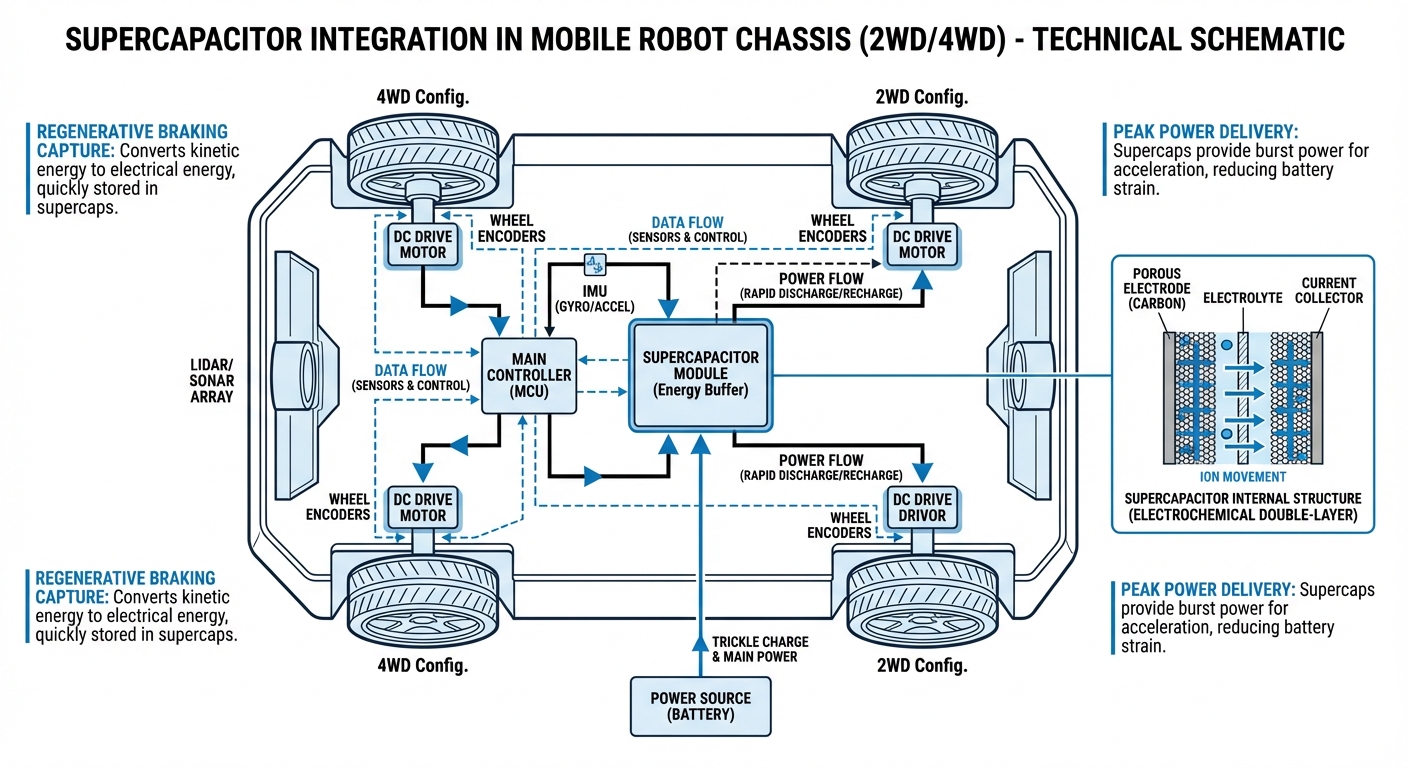
Forget batteries' sluggish chemical reactions—supercapacitors (or ultracaps) store energy electrostatically with the Double-Layer effect (EDLC). Charges pile up on porous carbon electrodes, split by electrolyte.
That physics enables near-instant charge/discharge. For AGVs, no workflow-halting hours; just 10-30 seconds on a charging plate for the next task cycle.
For top efficiency, modern robots pair up with a : supercapacitors tackle peak power needs like lifts and acceleration, while batteries handle steady cruising—extending life for both.
Real-World Applications
24/7 Warehouse Logistics
In fast-paced fulfillment centers, AGV downtime is the enemy. Supercapacitors let them charge mid-pallet load, keeping fleets running non-stop without backups or battery swap stations.
Cold Chain Automation
Li-Ion batteries tank in freezing temps; supercapacitor AGVs power on strong in sub-zero freezers for food and pharma cold chains.
Heavy Payload Lifting
Robots needing huge current surges for heavy chassis or parts lifts rely on supercapacitors to deliver peak amps without wrecking battery cells.
Automated Guided Trams
Fixed-path shuttles ditch overhead wires thanks to supercapacitors—flash-charging at each station before zipping to the next assembly spot.
Frequently Asked Questions
What is the main difference between a supercapacitor and a Li-Ion battery?
It's all about power density vs. energy density. Batteries pack more total energy for longer runtime but charge/discharge slowly. Supercapacitors hold less energy overall but blast it out (and recharge) in seconds—perfect for power bursts and quick cycles.
Can a supercapacitor replace the battery in my AGV entirely?
Yes, for certain jobs. If your AGV runs fixed loops with stops every few minutes and charging spots, supercapacitors shine with their speed. For free-roaming AMRs needing hours of range, hybrid or battery setups work better.
How long does it take to charge a supercapacitor-based robot?
Seconds, typically. A standard industrial AGV grabs enough juice for its next run in 10-60 seconds—right while loading or unloading.
What is the expected lifespan of a supercapacitor?
Supercapacitors are beasts, rated for 1,000,000+ cycles. In 24/7 ops, that's 10-15 years without swaps, vs. 2-3 years for lead-acid or Li-Ion.
Do supercapacitors have a self-discharge issue?
Yes, they self-discharge faster than batteries. Parked for days? They might go flat. But seconds to recharge on startup makes it a non-issue for active fleets.
Are special electronics required to use supercapacitors?
Yes. Batteries hold steady voltage; supercapacitors drop it linearly when discharging. Add a DC-DC converter to smooth power for motors and sensors.
How does temperature affect performance?
Supercapacitors beat batteries on thermal stability, thriving from -40°C to +65°C. They're the go-to for chilly unheated warehouses or cold storage where batteries slow or quit.
Is it expensive to implement supercapacitor technology?
Upfront cost per kWh beats batteries, but total ownership cost? Often lower—no replacements, maintenance, or pricey swap setups over the robot's life.
What is a "Hybrid Configuration"?
Hybrid setups wire battery and supercapacitor in parallel: supercap grabs high-current peaks (accel, lifts) to shield the battery, which supplies steady energy—bigly extending battery life.
Are supercapacitors safe for indoor use?
Super safe. No heavy metals or volatile solvents like batteries. Ship them discharged at 0V risk-free, no thermal runaway—huge win for factory fire safety.
How do I size a supercapacitor for my robot?
Size them for peak power draw and duration: calculate Joules for that move (like lifting 1 ton) plus margin, not shift-long amp-hours.
Can existing robots be retrofitted with supercapacitors?
Yes, retrofitting works great—especially swapping lead-acid batteries. Just add a power management system (PMS) for voltage swings and ensure chargers deliver the high current for quick top-ups.