Stepper Motors
Precision and rock-solid reliability. Stepper motors are the backbone of modern AGVs, turning digital pulses into pinpoint mechanical motion for spot-on navigation—no fancy feedback loops required.

Core Concepts
Step Angle
The tiniest rotation from a single digital pulse. Common ones like 1.8° give you 200 steps per revolution, unlocking super-fine positioning.
Holding Torque
Steppers are a robotics dream: they deliver max torque when holding still, acting like a built-in dynamic brake to keep AGVs planted on inclines without any mechanical helpers.
Open-Loop Control
Unlike servos, steppers skip encoders entirely. The controller just commands a position, assumes it's there, and boom—simpler circuits and lower costs.
Microstepping
Drivers mix current between coils to split steps into tiny 'microsteps' (up to 256x finer). It kills vibrations for that silky-smooth AGV glide.
Detent Torque
That magnetic 'drag' you feel hand-turning the unpowered shaft. Strong detent torque is a safety win for vertical lifts if power drops.
Speed vs. Torque
Steppers swap speed for torque: massive pull at low RPMs, but they taper off at high speeds—perfect for heavy, slow warehouse haulers.
How It Works
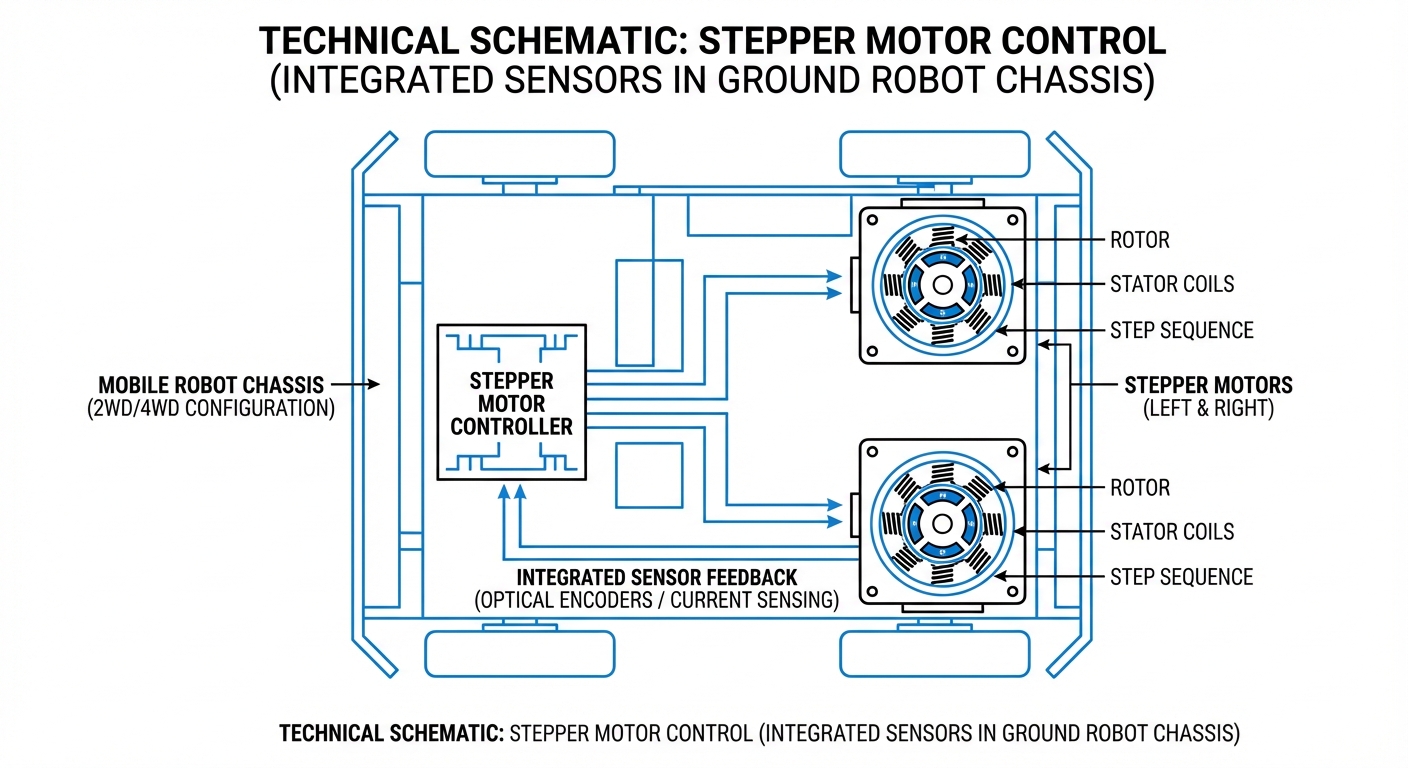
At the core of every stepper motor? A permanent magnet rotor nestled in a stator full of electromagnetic coils. The real wizardry is in the .
Energize one coil phase, and its magnetic field snaps the rotor teeth to the stator's. Switch to the next coil in line, and it tugs the rotor right along.
For AGVs, this pulse-based magic lets the nav computer track distance by counting wheel pulses. 1,000 pulses = exact distance traveled, no creeping errors like DC motor drift.
Real-World Applications
Differential Drive AGVs
The go-to setup: two steppers independently driving the main wheels. Dial the pulse rates differently, and your bot pivots on a dime or cruises straight across warehouse floors.
Vertical Lift Modules
A staple in autonomous forklifts and shelf-retrieval bots. That killer holding torque locks the lift platform steady at precise shelf heights during loading or unloading.
On-Board Conveyors
Lots of mobile robots top off with mini conveyor belts for tote handoffs. Steppers nail the start-stop precision to sync onboard belts perfectly with factory lines.
LIDAR Sensor Rotation
SLAM navigation demands steady LIDAR spins. Compact precision steppers keep the sensor head turning smoothly for rock-steady, jitter-free mapping data.
Frequently Asked Questions
Stepper Motors vs. Servo Motors: Which Wins for AGVs?
It boils down to your use case. Steppers are budget-friendly with killer low-speed torque and dead-simple control for steady loads. Servos rule high-speed, shifty scenarios needing efficiency and feedback. For everyday warehouse AGVs at moderate paces, steppers often deliver the best bang for your buck.
What causes 'missed steps' and how do you dodge them?
Missed steps hit when load torque beats the motor's pull-out torque, leaving the rotor lagging the field. Blame quick ramps or obstacles. Beat it with S-curve acceleration in your code and size motors with a 30-50% torque buffer.
Why do steppers run hot even at a standstill?
Unlike DC motors, steppers suck full current to hold torque when stopped, brewing heat. Counter it with driver 'current reduction' or 'standby' modes that drop to 50% when idle just a few milliseconds.
Do I need a gearbox for my stepper motor?
Usually, yeah. Direct-drive wheels work okay, but for heavier bots, planetary gearboxes boost torque and resolution while taming vibes. 5:1 or 10:1 ratios strike the sweet spot for speed and hauling power.
What is the difference between Bipolar and Unipolar wiring?
Bipolar (4-wire) motors tap the full coil for 30-40% more torque than unipolar (5/6/8-wire) ones. They need fancier H-bridge drivers, but they're the robotics standard for that torque edge.
How does microstepping affect positioning accuracy?
Microstepping smooths things out and cuts resonance—it's not always about pinpoint accuracy. Even at 1/16, the tiny torque drops mean friction can throw it off. Stick to full steps for dead-certain positioning.
What NEMA size for a warehouse AGV?
Light loads under 10kg? NEMA 17 does it. Medium bots to 50kg? NEMA 23 is your reliable beast. Heavy pallet-movers need NEMA 34 or 42 to conquer inertia and resistance.
Can you go closed-loop with steppers?
Totally—'closed-loop' or 'hybrid' steppers add encoders. The driver checks commanded vs. actual position and fixes stalls on the fly. Stepper torque meets servo dependability.
How does voltage affect stepper motor performance?
Crank up the voltage, and coil current ramps faster for better high-speed torque. For zippy AGVs, run a 3.5V motor at 24V or 48V via chopper driver to keep power where it counts.
Are stepper motors waterproof?
Standard steppers are open-loop and basic IP40—not waterproof. For washdowns or outdoors, grab IP65/IP67 versions with sealed bodies, waterproof plugs, and shaft seals to fight corrosion.
What is resonance and why is my robot vibrating?
Every stepper has a resonance sweet spot that amps vibes and noise, risking stalls. Dodge it by skirting those speeds in software, upping microsteps, or slapping on a shaft damper.
How to figure AGV battery life with steppers?
Tally total motor current (amps/phase × 2 phases), multiply by voltage for wattage, then divide battery Wh by that. Steppers guzzle more than DC, so oversize that pack.