Soft Robotics Materials
Discover how switching from stiff links to compliant, flexible materials lets AGVs manage fragile loads, tackle messy environments safely, and team up smoothly with humans.

Core Concepts
Elastomers & Silicones
The backbone of soft robotics, these super-stretchy polymers let grippers and bumpers squish without breaking, for safe interactions.
Shape Memory Alloys
Shape-memory alloys that snap back to form when heated. Perfect for compact, high-force actuators in AGVs.
Electroactive Polymers
Known as "artificial muscles," EAPs morph with electric fields—quiet, efficient power for mobile bots.
Variable Stiffness
These switch from soft to rigid (like jamming), so AGVs can slip through tight spots but still haul heavy gear.
Pneumatic Networks
Channels tucked inside soft materials that inflate to drive motion. This fluidic logic makes complex bending and twisting possible, creating super adaptable robotic limbs.
Self-Healing Materials
These advanced polymers fix tiny cracks and cuts on their own, dramatically boosting the lifespan of AGV bumpers and soft skins.
How Soft Materials Function
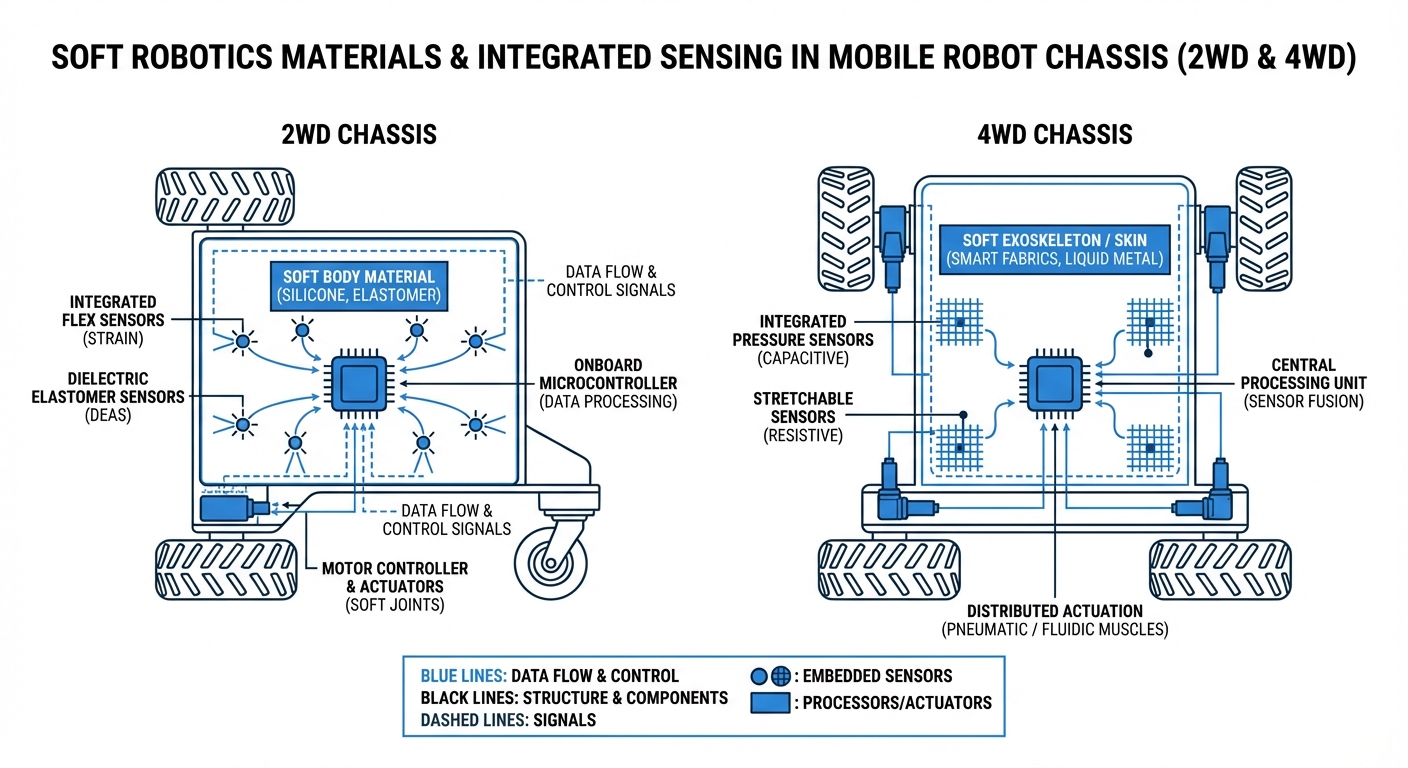
Unlike old-school robotics with their rigid kinematics and precise joint angles, soft robotics taps into to get the job done. The material itself becomes the joint, the sensor, and sometimes even the actuator.
In AGVs, we pull this off with . Forget spinning gears—instead, inflate a silicone chamber or zap voltage into a polymer sheet. It spreads the force out, letting a gripper hug odd-shaped packages or a wheel squish over obstacles instead of bouncing off.
Controlling these materials means modeling their non-linear stretchiness. By figuring out how the material deforms, the robot knows its position without clunky encoders—often using stretchy conductive sensors right in the robot's 'skin.'
Real-World Applications
Fragile Inventory Handling
Soft grippers on AMRs make grabbing groceries, electronics, or even glassware a breeze. The material's give stops crushing, so you can handle all sorts of shapes at high speed.
Collaborative Safety Skins
AGVs wrapped in soft, sensor-packed skins spot collisions the instant they happen. Unlike rigid bumpers, the squishy stuff soaks up impact energy, letting robots work right alongside humans—no safety fences needed.
Adaptive Locomotion
Soft, shape-shifting wheels or tracks let outdoor delivery bots tackle curbs, gravel, and bumpy ground by conforming to the surface, gripping better and cutting vibrations.
Food & Hygiene Processing
Monolithic soft silicone grippers wipe clean easily with no nooks like mechanical claws have. Perfect for AGVs in clean rooms or food lines dealing with raw ingredients.
Frequently Asked Questions
What is the primary advantage of soft materials over rigid metal components?
The big win is 'compliance'—that ability to give under pressure. It makes soft robots safer around people, way more flexible in messy environments, and great at handling fragile or funky-shaped stuff without fancy sensors.
Are soft robotics materials durable enough for industrial AGV use?
You bet—today's industrial elastomers and composites handle millions of cycles. They might not take a steel-like hit, but self-healing polymers and toughened silicones fight fatigue like champs and shrug off rough warehouse wear.
How do soft grippers handle heavy payloads?
Soft grippers grab via friction and 'form closure'—wrapping snugly— not brute squeezing. For heavy stuff, tricks like jamming stiffen them up post-grab, locking everything tight.
Do soft materials require different control systems?
Yes, taming soft materials means wrangling non-linear dynamics with endless degrees of freedom. Regular rigid physics sims choke, so we turn to finite element analysis (FEA) or ML models to guess deformation under load.
What is the power source for soft actuators?
Compressed air (pneumatics) rules for speed and power punch. But electrically driven stuff like Dielectric Elastomer Actuators (DEAs) is hot now—they ditch bulky pumps for mobile bots.
Can soft materials be used for AGV wheels?
Totally. Deformable wheels with soft lattices or air pockets give natural suspension, so AGVs roll over small bumps, cables, or floor glitches without jarring delicate cargo.
How does temperature affect soft robotics materials?
Standard silicones handle wide temps fine, but Shape Memory Alloys (SMAs) fire up with heat. Super cold can stiffen some elastomers, so pick materials to match—like for freezer warehouses.
Are soft robotics safer for human collaboration?
Yep, that's a huge perk. Low inertia and built-in softness mean accidental bumps barely transfer energy, slashing injury risk versus metal arms.
Is it expensive to implement soft materials?
The base materials (silicones, plastics) cost less than precision metal parts. But custom molds and fancy pneumatic controls can bump up startup costs.
Can we retrofit existing AGVs with soft components?
Sure, the easiest swap is ditching rigid grippers for soft ones. Slapping on soft bumpers or skins is another smart upgrade to boost safety on your current robot fleet.
What happens if a soft robot gets punctured?
Pneumatics lose steam from punctures, but 'self-healing' polymers seal cuts chemically. Plus, many designs have backup chambers, so the bot keeps rolling even if one part's toast.
What is the future of soft materials in logistics?
The future? 'Hybrid' bots blending rigid strength with soft adaptability, plus fully biodegradable softies. And 'smart skins' with printed-on sensors for total-body awareness.