Servo Motors
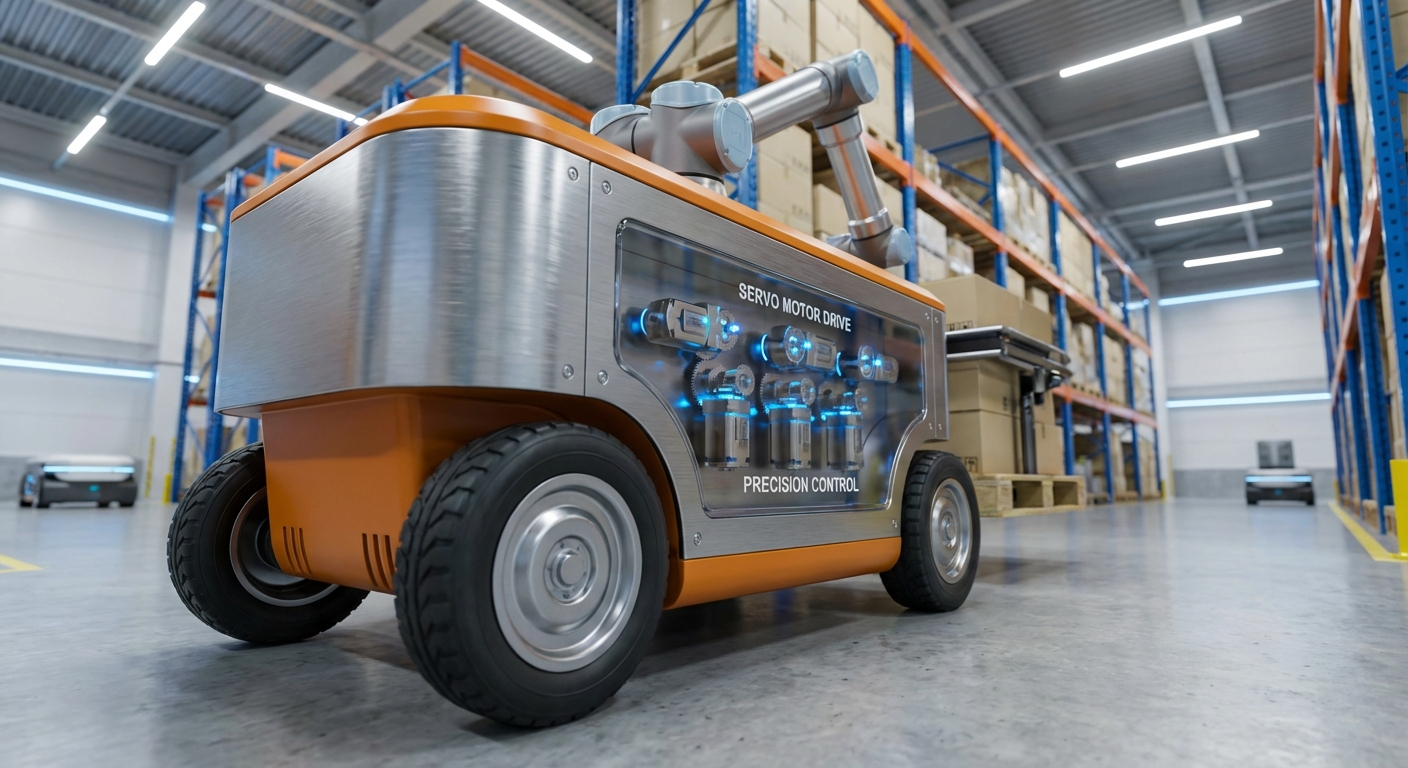
Servo motors are the precision workhorses powering today's Autonomous Guided Vehicles (AGVs), turning electrical signals into pinpoint position, speed, and torque. Closed-loop feedback lets them tackle complex spaces with millimeter accuracy.
Core Concepts
Closed-Loop Control
Unlike stepper motors, servos run a constant feedback loop—they check real position against target and correct instantly.
Feedback Encoders
Integrated encoders monitor motor shaft rotation, feeding crucial data for AGV odometry and localization.
High Torque Density
Servos deliver big torque for their size, even at high speeds, so compact AGVs can haul heavy payloads without stalling.
PID Control
The controller leans on Proportional-Integral-Derivative (PID) algorithms to smooth motions, dodging jerky accel or overshoot on stops.
Dynamic Response
Servos ramp up and down super quick, giving mobile robots the agility to react fast to obstacles or path changes.
Efficiency
They sip power based on load—idle or light duty means low draw, stretching battery life.
How It Works
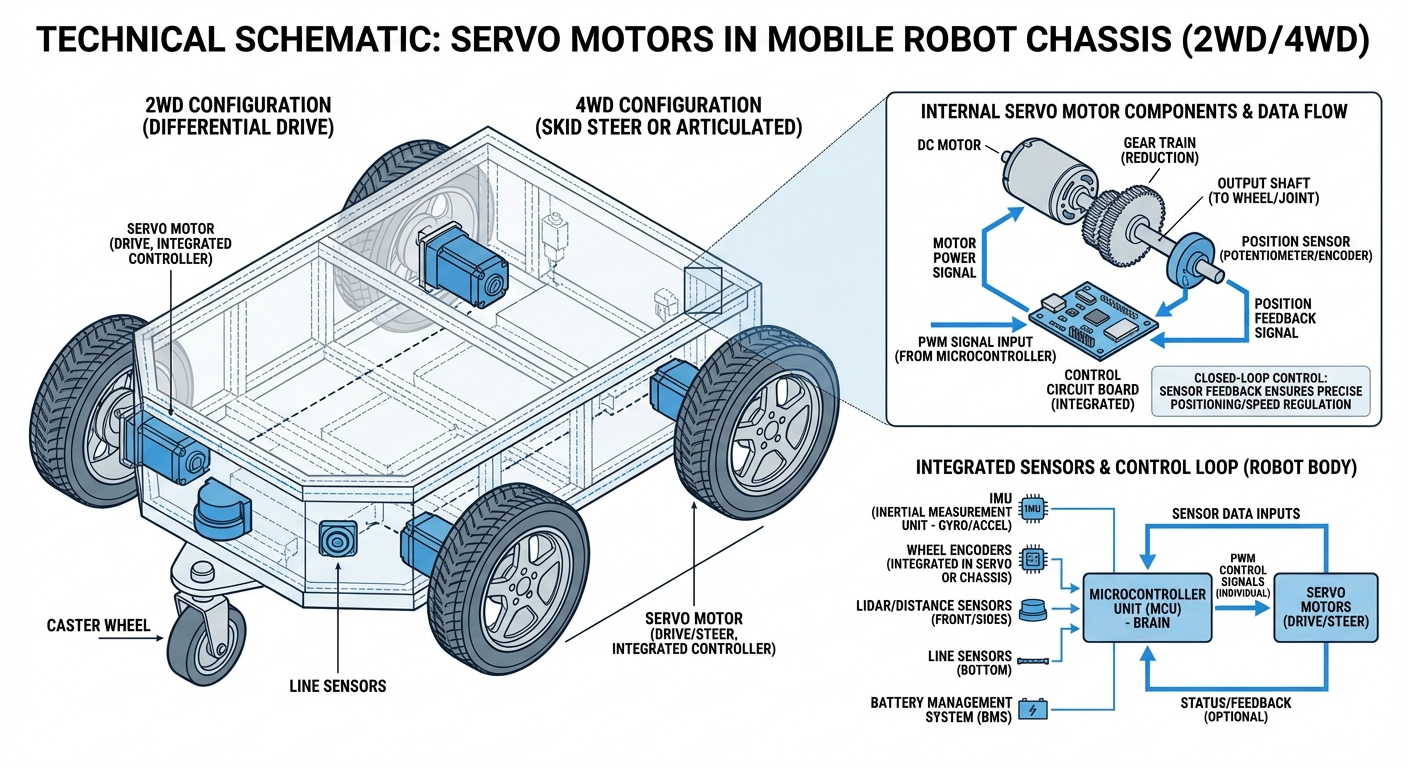
At servo system's core: the controller, motor, and feedback device. For AGVs, the main computer fires commands (often CANopen or EtherCAT) for target position or velocity.
The servo drive boosts that signal to drive the motor. As it spins, the encoder pipes real-time position data back. The drive checks it against the target hundreds of times a second.
Mismatch? The drive tweaks voltage and current to fix it. This loop keeps AGVs on course even over bumps or with extra weight.
Real-World Applications
Drive & Steering
Servos drive main wheels on differential AGVs and control steering on Ackermann AMRs, nailing tight warehouse aisles.
Heavy Lifting
In automated forklift AGVs, beefy servo motors pump hydraulics or ball screws to hoist 1,000kg+ pallets with silky vertical lifts.
Mobile Manipulation
AMRs with robotic arms (cobots) use mini-servos for joint motion, grabbing and placing shelf items effortlessly.
Turret & Conveyors
Top attachments like rotating turrets or roller conveyors rely on servos to sync speeds with production lines for flawless handoffs.
Frequently Asked Questions
What is the difference between a Servo Motor and a Stepper Motor?
The big difference is feedback: servos use encoders for closed-loop control, delivering higher high-speed torque and efficiency. Steppers go open-loop and skip steps under overload—making servos the go-to for dynamic AGV tasks.
Why are Brushless DC (BLDC) servos preferred for robotics?
BLDC servos skip brushes to cut wear, boost lifespan, slash maintenance, improve power-to-weight, and run cooler—perfect for battery-powered mobile robots.
What is an Absolute Encoder vs. an Incremental Encoder?
Incremental encoders track relative to a start point and need homing post-power-up. Absolute encoders know exact position right at startup—safer and slicker for autonomous vehicles.
How does PID tuning affect AGV performance?
PID tuning fine-tunes error response. Bad tune means oscillation (shaking) or lag. Spot-on tuning delivers smooth accel, dead-precise docking stops, and laser-straight paths.
Do servo motors consume power when the AGV is stopped?
Yes, but barely—a trickle to hold torque against gravity (on slopes) or pushes. Electronic brakes often kill power entirely for long halts.
What is the "Gear Ratio" and why does it matter?
Servos spin too fast for wheels, so gearboxes cut speed and multiply torque. Pick the right ratio to balance top speed with heavy-load hauling or ramp-climbing power.
How do communication protocols like CANopen apply here?
Protocols like CANopen or EtherCAT let the robot controller sync multiple servo drives over one cable. They nail real-time wheel coordination for tricks like pivoting in place.
What causes servo motor overheating?
Overheating hits from undersized motors, nonstop accel/decel cycles, or drivetrain friction. Thermal sensors kick in to shut down and save the day.
Are servo motors waterproof?
Standard servos aren't built for it. For outdoor or wash-down spots (like food plants), grab IP65/IP67 models with sealed housings and connectors.
Can I mix different brands of motors and drives?
Possible, but tricky—you must match voltage, current, feedback, and pinouts perfectly. Better to stick with matched kits or universal drives to speed integration.
What is "Safe Torque Off" (STO)?
STO cuts torque generation for safety. On AGV e-stops, it ensures motors won't restart by accident, safeguarding operators.
Ready to implement Servo Motors in your fleet?
Check out our AGV-ready servo lineup, built for rock-solid industrial performance.
Explore Our Robots