Robotic Power Budgeting
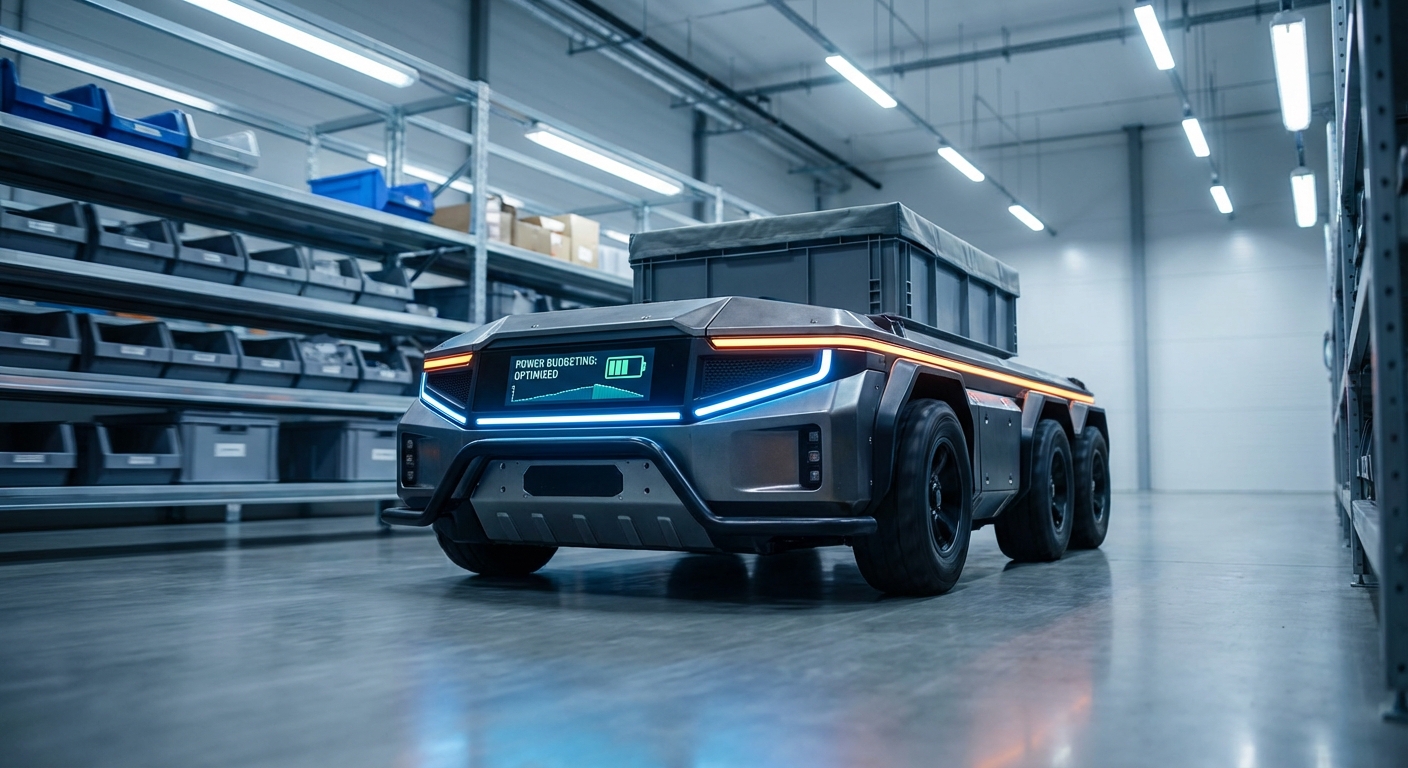
Master power budgeting—the vital skill of matching energy capacity to real loads. It ensures your AGVs and mobile robots hit runtime goals, manage peak currents safely, and maximize fleet efficiency without surprise shutdowns.
Core Concepts
Total Power Draw (TPD)
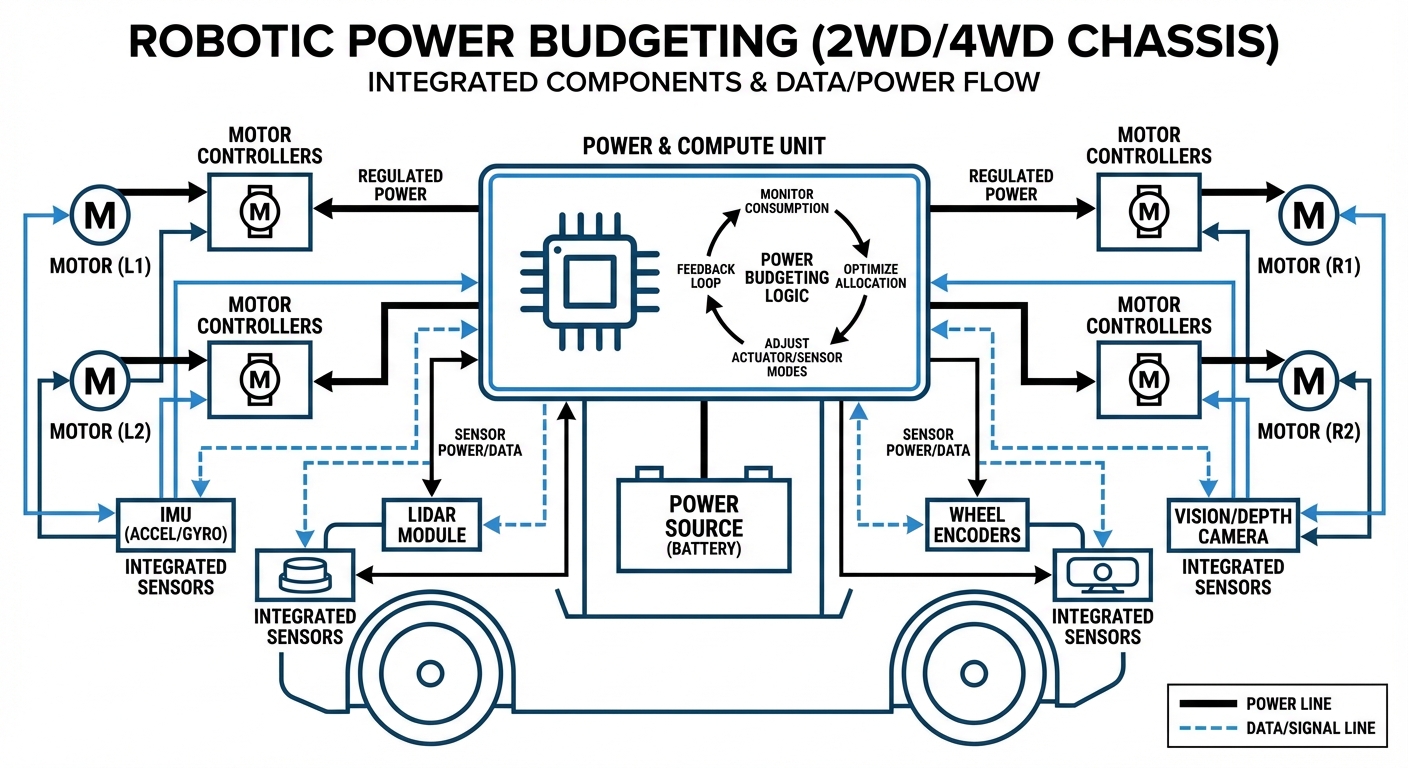
The total power draw from all components, like motors, sensors (LiDAR, cameras), compute (GPU/CPU), and comms modules.
Peak vs. Nominal Load
Spotting the gap between steady 'cruising' power and those sudden spikes from motor accel or compute bursts.
Duty Cycle Analysis
Duty cycle calcs based on active vs. idle time ratios. A robot moving just 20% of the time needs a way different budget than a nonstop operator.
Safety Margins
Build in a buffer (usually 20-30%) for aging components, extreme temps, and unexpected friction.
Conversion Efficiency
Factor in heat losses from voltage conversion. DC/DC converters aren't perfect, often wasting 5-15% system-wide.
Battery Chemistry
Choose the best battery (LiFePO4, NMC, Lead Acid) based on your budget, C-rates, and weight limits.
The Calculation Workflow
Start power budgeting with a detailed audit of every component on the robot's bus. Tally Watt-hours (Wh) for a full mission by mapping voltage (V) and current (I) needs for logic, drives, and peripherals.
Always include 'Worst Case Scenarios'—like max payload uphill with heavy SLAM processing. If the PDN can't hold voltage during spikes, the computer browns out and resets.
Finally, the budget sizes your battery pack. For a 500Wh mission over 4 hours, go significantly bigger than 2000Wh to avoid deep discharges that kill battery life.
Real-World Applications
Warehouse Logistics (AMRs)
In 24/7 warehouses, AMRs lean on tight power budgets for 'opportunity charging.' Accurate planning gets them to docks before running dry, maxing uptime and throughput.
Outdoor Agriculture
Farm robots tackle uneven ground with wild motor current spikes. Budgeting here emphasizes peak management and thermal efficiency in solar heat.
Medical Delivery Robots
Hospital robots can't fail mid-delivery. Conservative budgeting guarantees long runtimes and safe ops for critical meds and supplies.
Heavy Payload AGVs
Heavy-hauling robots face massive inrush currents from start/stop inertia. Budgeting calls for cap banks or high C-rate batteries to buffer loads without tripping safeties.
Frequently Asked Questions
What’s the first step in creating a power budget for a new robot?
Kick off with a full component audit. Build a spreadsheet of every power user (motors, sensors, compute, lights), their voltages, max/nominal currents—and don't skip efficiency losses from regulators.
How does temperature affect my robotic power budget?
Temperature hits both ways: Cold slashes battery capacity and discharge rates; heat boosts conductor resistance, hurts motor/electronics efficiency, and demands cooling that eats more power.
What’s a safe margin for battery capacity?
Industry standard is 20-30%. Calc 1000Wh for a shift? Size for 1200-1300Wh min, covering degradation, surprise loads, and spotty charging.
How do I calculate power for a DC motor?
Voltage × Current = Watts, but motors change states. Figure power for accel (peak current), constant speed (nominal), and holding (if needed). Use RMS current for thermal sizing, peak for battery C-rate.
Why account for DC/DC converter efficiency?
Conversion always wastes energy. A 90% efficient 12V regulator loses 10% as heat. With multiple rails (5V, 12V, 24V), these add up big in your total budget.
Does software optimization impact the power budget?
Yes, big time. Smart path planning cuts distance; 'sleep modes' for idle sensors/compute add hours; accel curve software tames peak spikes.
What’s the power hit from LiDAR and depth cameras?
Perception sensors are total power hogs. A 3D LiDAR can guzzle 8-15W on its own, and crunching that point cloud data demands heavy GPU work—often another 15-30W. For a small robot, seeing the world can sometimes drain more battery than actually moving.
How does regenerative braking factor into the budget?
Heavy robots that stop a lot? Regen braking can claw back 5-15% of your energy. That said, it's smarter to see it as 'bonus' juice rather than banking on it for your main power budget—its magic really hinges on the terrain and how you run things.
What happens if I under-budget for "Inrush Current"?
Inrush current hits when gear powers up and capacitors charge. Skip budgeting for it, and that sudden spike trips the battery's BMS (Battery Management System) over-current protection, killing the robot right at startup or when you switch on a beefy payload.
Should I calculate cabling losses?
For high-current robots, you bet. Voltage drop over long or thin wires ($\Delta V = I \times R$) wastes power as heat. Grabbing the right wire gauge is key so the juice actually hits the motors instead of toasting the frame.
How does battery aging affect the budget over time?
Batteries fade with every cycle. A power plan that flies with a fresh pack at 100% capacity might tank after a year when it's down to 80%. Always plan around the battery's 'End of Life' capacity, not that shiny new spec.