Regenerative Braking Systems
Turn kinetic energy into reusable power, stretching the life of your Autonomous Guided Vehicles (AGVs). This game-changing tech grabs energy during slowdowns, easing battery wear and supercharging fleet efficiency in demanding setups.
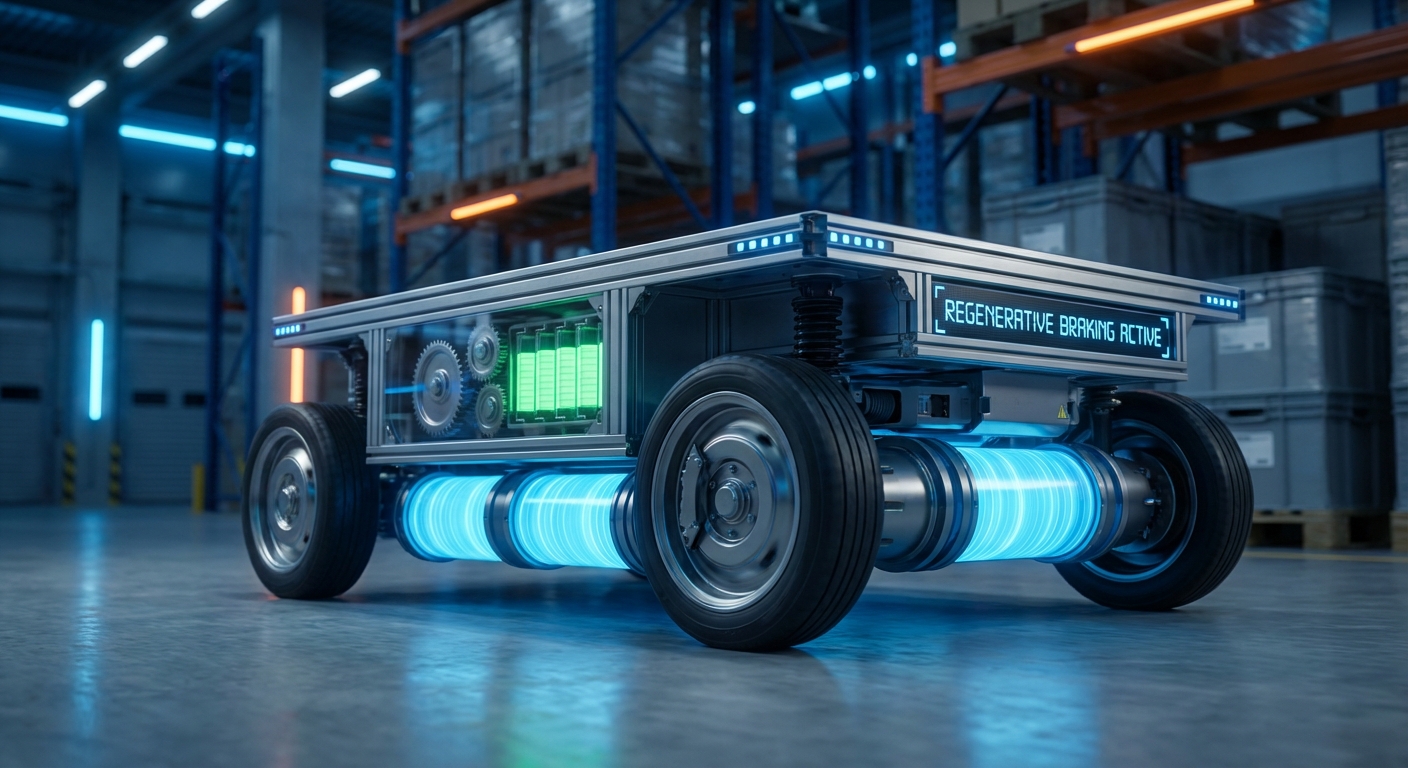
Core Concepts
Energy Recovery
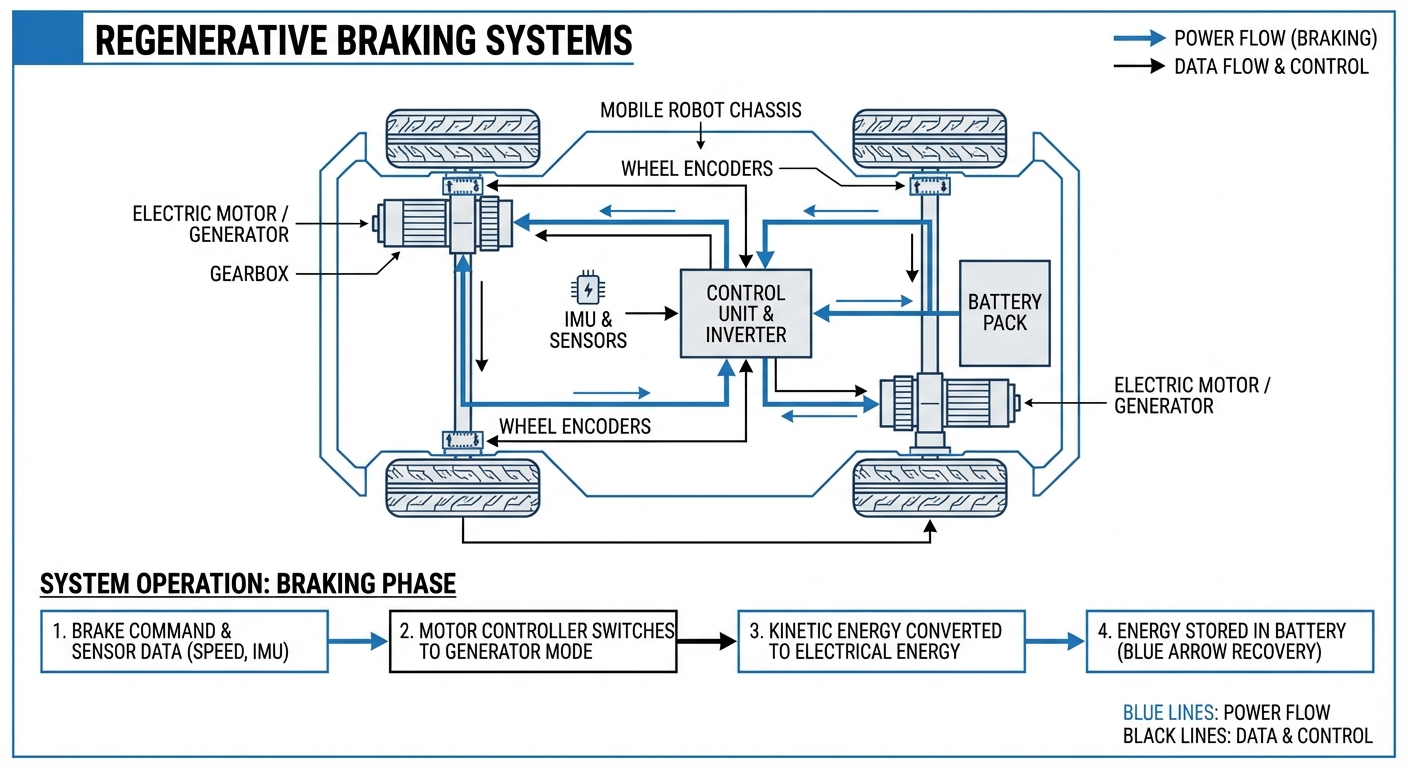
The basic idea: during deceleration, the electric motor switches to generator mode, converting kinetic energy back to electricity to recharge the battery.
Four-Quadrant Control
Advanced motor controllers handle all four quadrants, flipping effortlessly between driving (motoring) and braking (generating) in forward or reverse.
Battery Absorption
The battery management system (BMS) has to swallow those big current spikes from braking. Lithium-ion batteries excel at soaking up that sudden energy rush, outperforming lead-acid hands down.
Overvoltage Protection
Safety circuits kick in to protect a full battery. If it can't take more current, energy gets shunted to a braking resistor (rheostatic braking).
Duty Cycle Optimization
In stop-start heavy scenarios, regenerative braking slashes heat in mechanical brakes, stretching out maintenance and boosting component longevity.
Torque Control
Fine control over regenerative torque delivers smooth, precise deceleration—vital for AGVs hauling delicate cargo or liquids.
How It Works
In a typical electric drive, the battery feeds current to the motor for torque. Issue a "Regen" command, and current reverses. The AGV's momentum spins the motor, turning it into a generator.
The motor controller tweaks the firing angle on its transistors (MOSFETs or IGBTs) to ramp up the motor's generated voltage past the battery's. Physics takes over—current flows from high to low voltage, pumping energy back into the battery.
It all hinges on Back Electromotive Force (Back-EMF). As long as wheel speed generates enough Back-EMF, the controller harvests energy. It shines at higher speeds and tapers off near zero, when mechanical holding brakes step in.
Real-World Applications
High-Throughput Warehousing
AMRs in fulfillment centers thrive on stop-go traffic. Regenerative braking recaptures energy from hundreds of stops per hour, potentially boosting shift runtime by 15-20%.
Heavy Payload Transport
AGVs hauling 1-ton+ pallets pack massive kinetic energy. Capturing it with regen prevents brake fade and cuts thermal stress on parts.
Ramp & Slope Navigation
Descending a ramp? Gravity wants to accelerate. Regenerative braking plays speed cop, converting gravitational potential into battery charge while keeping speeds safe.
Cleanroom & Hospital Logistics
Friction from mechanical brakes kicks up dust and particles. Regenerative braking? Totally contactless—perfect for cleanrooms where airborne gunk is a no-go.
Frequently Asked Questions
What is the difference between Regenerative Braking and Dynamic Braking?
Regenerative braking feeds energy back to the battery for later. Dynamic (or rheostatic) braking dumps it as heat via resistors. Regen is more efficient, but dynamic serves as backup for full batteries.
How much energy can actually be recovered?
AGVs typically reclaim 10-20% of energy, depending on the duty cycle. Heavy loads with frequent starts/stops (like shuttles) get the biggest wins; long-haul cruising sees less.
Does regenerative braking work when the battery is 100% charged?
No way. Forcing current into a full battery risks overvoltage hazards. Smart BMS units cut the regen path, forcing the controller to use resistors or mechanical brakes for safe stops.
Can regenerative braking bring an AGV to a complete stop?
Not fully. As speed drops, back-EMF weakens, softening the brake force. It gets you to a near-stop, but you always need a mechanical parking or electromagnetic brake to hold position.
Does this technology require special motors?
Most modern AC induction and Brushless DC (BLDC) motors support regen out of the box. The star is the motor controller—it needs four-quadrant operation to handle reverse current flow.
How does battery chemistry affect regeneration efficiency?
Lithium Iron Phosphate (LiFePO4) and Li-NMC batteries have lower internal resistance than lead-acid, so they gulp high-current braking pulses efficiently. Lead-acid might overheat or struggle to keep up.
Is there a maintenance benefit to using this system?
Yes! With the motor handling primary braking, physical pads or shoes barely wear. That means way less downtime and cheaper brake replacements.
What happens if the emergency stop (E-Stop) is pressed?
In an E-Stop, safety rules demand instant mechanical brakes. Some controllers sneak in quick regen to slow down, but raw stopping power rules—often bypassing regen for dead-reliable locking.
Does regenerative braking generate heat?
Yes, motor controllers and batteries do heat up during energy conversion. Still, it's usually less than friction brakes produce. You'll want solid thermal management for the electronics box.
Is it cost-effective for small AGV fleets?
For small fleets with light loads, ROI takes longer. But since most modern industrial controllers have regen built-in, setup costs are minimal. The real expense is bulking up your battery to handle those current spikes.
Can we retrofit existing robots with regenerative braking?
It hinges on your current motor controller. If it's a basic 1- or 2-quadrant drive, swap it for a 4-quadrant one. Also check wiring and battery protection circuits.
How does it impact navigation accuracy?
It can actually make things better. Electronic braking gives you incredibly precise control over deceleration curves—far superior to the inconsistent friction of mechanical brakes. That leads to more reliable stopping distances and spot-on positioning.