Power Distribution Boards
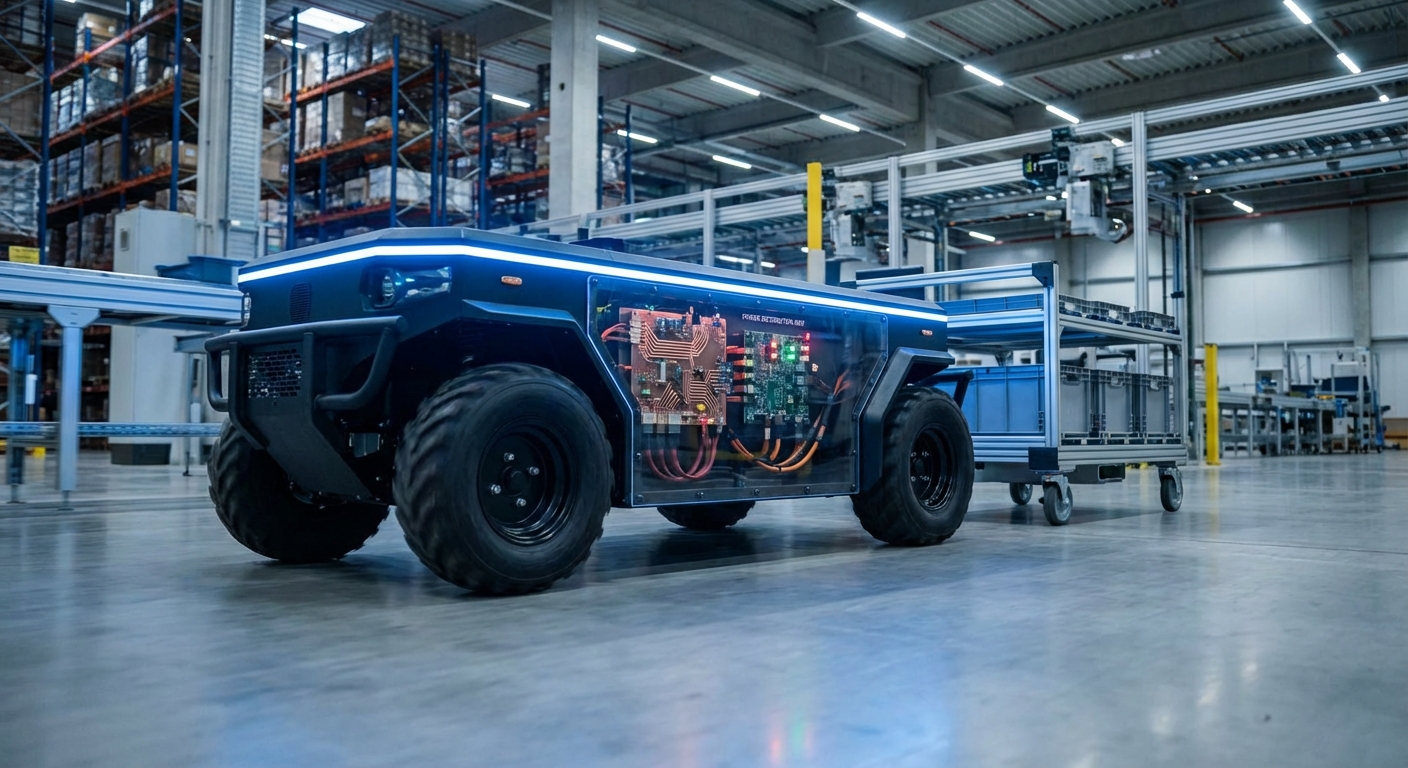
Think of the PDB as the central nervous system for autonomous mobile robots. It smartly directs power from high-capacity batteries to motors, sensors, and compute units, delivering steady voltage and vital overload protection for dependable fleet operations.
Core Concepts
Voltage Regulation
AGVs usually run on 24V or 48V main battery packs, but sensors need 5V or 12V. PDBs pack in high-efficiency BECs (Battery Elimination Circuits) to step down the voltage without creating excess heat.
Current Handling
Built with thick copper traces and toughened PCBs, these PDBs handle the huge inrush currents for drive motors while keeping power rock-steady for delicate electronics.
Short Circuit Protection
With built-in fuses, PTCs (resettable fuses), and electronic breakers, PDBs catch faults right away, stopping one bad component from wrecking your main battery or the whole robot.
Power Monitoring
Smart PDBs come with shunt resistors and current sensors that chat with the main controller over I2C or CAN bus, giving you real-time insights into power usage.
EMI Filtering
Clean power is a must for LiDAR and IMUs. PDBs use capacitors and ferrite beads to block out the electrical noise from brushed or brushless motors.
Thermal Management
High currents mean heat buildup. Top-tier PDBs use aluminum substrates or beefy heatsinks to shed that thermal load, keeping everything in safe temps.
How It Works: The Power Architecture
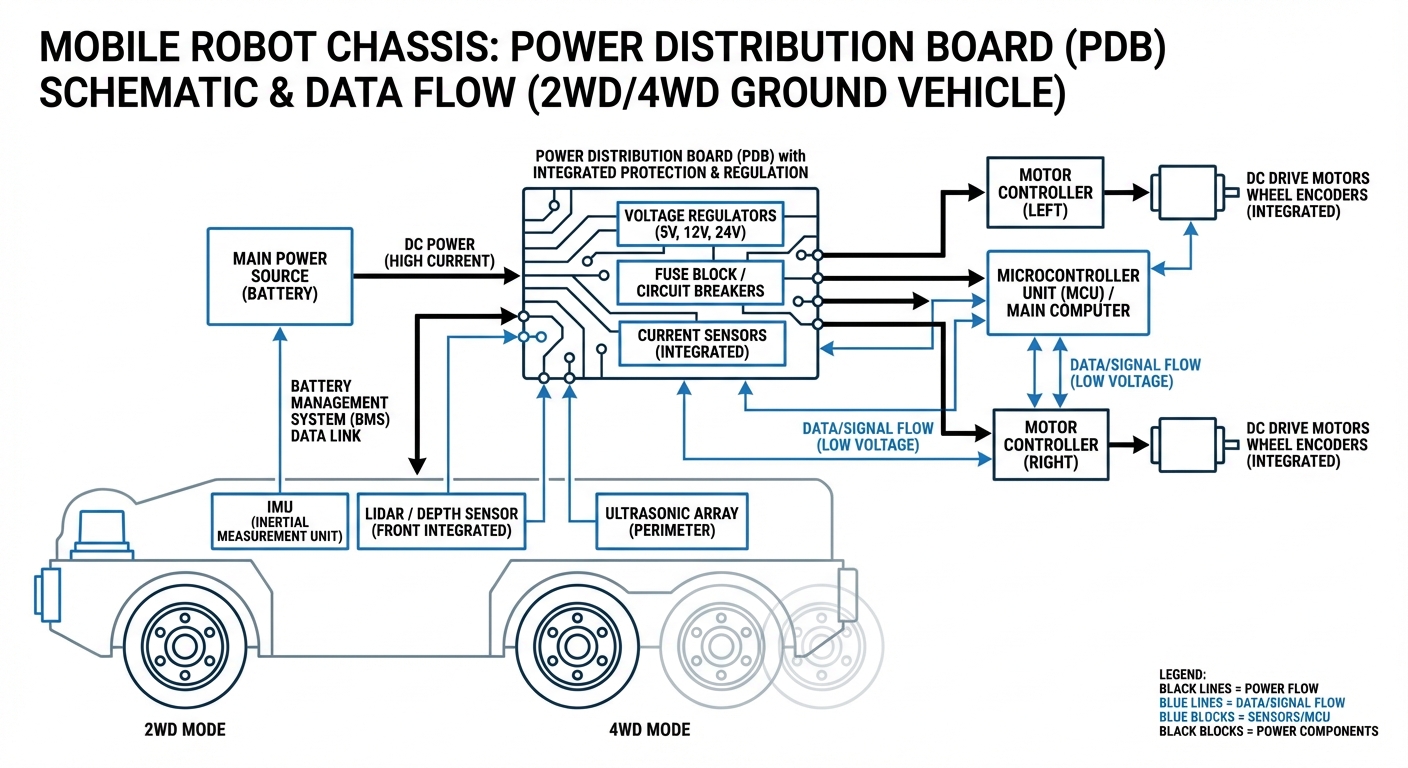
At the core, the PDB is like a smart hub for your robot's electrical power. It takes the raw, unregulated high-voltage feed straight from the lithium-ion battery pack through hefty connectors like XT90 or Anderson Powerpoles.
From there, power splits into two paths: the 'dirty' one sends high current straight to ESCs (Electronic Speed Controllers) and motors for max torque, skipping fancy regulation. The 'clean' path goes through buck converters (step-down regulators).
These converters lock in exact voltages – usually 5V for micros like Arduino or ESP32, and 12V/19V for SBCs like Jetson or Raspberry Pi – so your robot's brain stays sharp even under heavy acceleration.
Real-World Applications
Warehouse AMRs
Logistics AMRs need PDBs that thrive on 24/7 duty, handling big surge currents for lifting heavy pallets without dropping Wi-Fi.
Agricultural Rovers
Outdoor ag robots call for PDBs with IP-rated cases and strong filtering to manage long cables and bumpy terrain loads.
Medical Delivery Bots
In hospitals, PDBs must be super quiet and efficient to stretch battery life and avoid messing with sensitive medical gear.
Inspection Drones
Drones need lightweight PDBs where weight matters most, packing high power density and OSD (On-Screen Display) telemetry.
Frequently Asked Questions
What’s the difference between a PDB and a BMS?
A BMS keeps your battery healthy by balancing cells and guarding against over-charge or discharge. A PDB, on the other hand, distributes that power across the robot, regulates voltages for various parts, and splits the main line.
How do I pick the right amperage for my PDB?
Add up the max continuous draw from all motors, then tack on 20-30% safety buffer. If your four motors pull 10A each at peak, go for a PDB rated at least 50A continuous, with even higher burst capacity.
What is a "Smart" PDB?
A smart PDB has its own microcontroller and comms like CAN Bus, UART, or I2C. It sends back telemetry on current, voltage, and temps to the main computer for smart maintenance and power tweaks.
Why do I need separate voltage rails (5V, 12V)?
Components have unique power needs – 3.3V or 5V for logic and micros, 12V for LiDARs, cameras, and beefy servos. A PDB with onboard regulators means no juggling multiple batteries.
Can a PDB handle regenerative braking?
Yes, but design for it carefully. Braking motors spit back current, so your PDB and BMS upstream need to handle reverse flow without tripping over-voltage, or use a shunt to burn off the extra as heat.
What connector types are standard for Robotics PDBs?
For small-to-mid robots, XT30, XT60, and XT90 are go-to connectors for their solid performance. Big industrial AGVs lean on Anderson Powerpoles or heavy screw terminals for toughness and easy swaps.
Do PDBs protect against reverse polarity?
Not every PDB does. Fancier ones have diodes or MOSFETs to stop reverse current, but basic ones can fry if you plug the battery backward. Check the specs or use polarized plugs to avoid mishaps.
How does a PDB help with "Ground Loops"?
Smart PDBs use a 'Star Ground' setup, routing all grounds to one spot. This cuts voltage differences between parts, slashing noise and keeping sensors from going haywire.
What is the lifespan of a PDB?
Solid-state PDBs are built to last a robot's life (5-10 years). But watch those electrolytic caps for filtering – they wear out faster in heat. Check for bulges or scorch marks regularly.
Can I use a drone PDB for a ground robot?
Usually, yeah. Drone PDBs are lightweight and high-performant. But ground bots might need different outputs (12V/19V for computers vs. 5V for flight controllers) and sturdier mounts than drone vibration setups.