Pneumatic Artificial Muscles
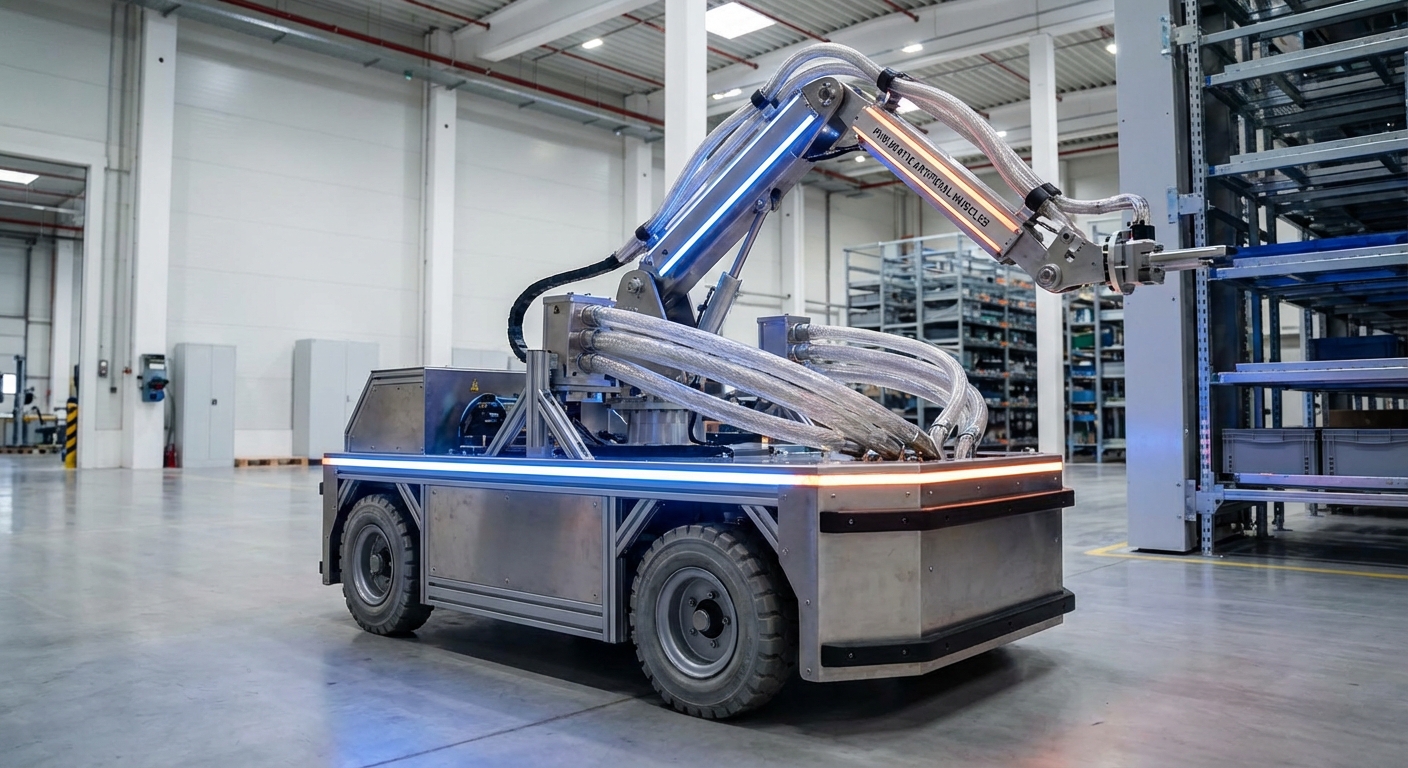
Pneumatic Artificial Muscles (PAMs) mimic real muscle flexing with air pressure, delivering killer power-to-weight ratios and built-in give. These soft powerhouses are shaking up AGV lifts, cobots, and shock systems for safer, smarter ops.
Core Concepts
The McKibben Effect
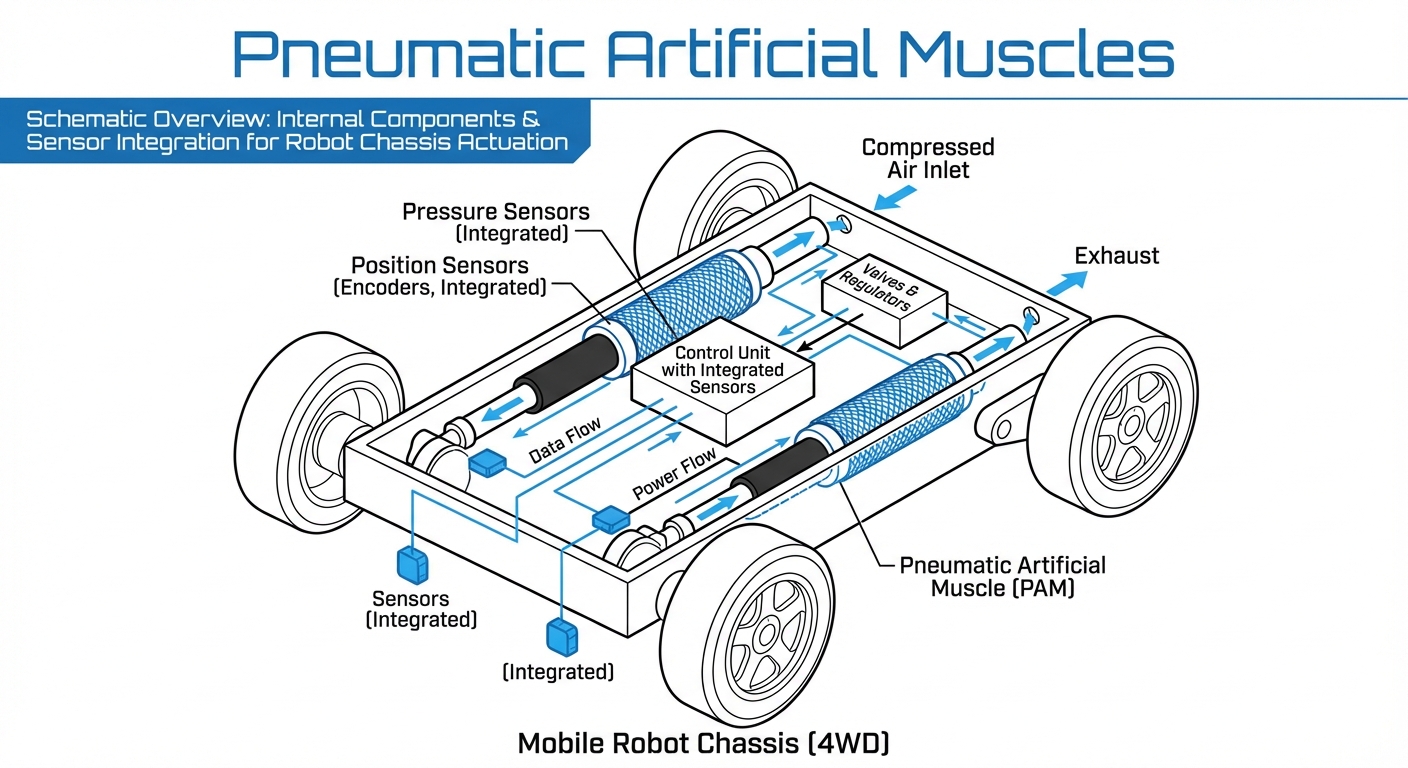
The core trick: an inner bladder bulges outward against a braided mesh sleeve, triggering axial shortening and massive pull force.
Inherent Compliance
Forget rigid motors—compressed air brings natural bounce, acting like a shock absorber to shield AGV frames from jolts and rough terrain.
High Power Density
PAMs are featherweights that punch way above: a few hundred grams can hoist hundreds of kilos, boosting AGV payload to the max.
Non-Linear Control
Pressure-to-contraction is nonlinear with hysteresis, so precise positioning needs clever control algorithms.
Antagonistic Setup
PAMs pull only (no push), so they're teamed in antagonistic pairs—like biceps and triceps—for full back-and-forth motion.
Clean Operation
Air-powered means zero hydraulic leaks—perfect for cleanroom AGVs and food lines.
How It Works
A Pneumatic Artificial Muscle is an elastic inner tube wrapped in a braided mesh sleeve of tough nylon or metal fibers, with sealed end fittings for air inflow.
Crank up internal pressure, and the rubber bladder swells. But the mesh reins it in: as diameter expands, length contracts via that scissor-like geometry, unleashing serious force.
No pistons or sliders like old-school cylinders, so zero stick-slip friction. Activation means instant, jerk-free smoothness—vital for AGVs with delicate cargo or humans nearby.
Real-World Applications
Soft Grippers for Warehousing
PAMs drive adaptive grippers on mobile manipulators, grabbing irregular or fragile items with natural compliance—no fancy force sensors, slashing damage in warehouses.
Active Suspension Systems
High-speed AGVs tap PAMs as tunable springs: dial up air for stiff stability in turns, or ease off to soak vibes on bumpy floors.
Heavy Payload Lifting
Their peak force at stroke start powers scissor-lifts on AMRs, hoisting 1000kg+ pallets with barely-there actuator weight.
Collaborative Assembly (Cobots)
In human-robot factories, stiff actuators risk hurts. PAM arms? Air's squishiness soaks collision energy, keeping operators safe.
Frequently Asked Questions
What's the top edge of PAMs over hydraulic cylinders in robotics?
Weight and cleanliness rule. PAMs crush hydraulics on lightness (better batteries), and air skips oily leaks for sensitive spots.
How much can a Pneumatic Artificial Muscle contract?
Typically, PAMs shrink 25% to 35% of resting length. Shorter stroke than telescopes, but the pull power is off the charts—ideal for short, mighty tasks.
Does my AGV need a beefy air compressor for these?
Not always. Sure, you need compressed air, but compact onboard micro-compressors and tanks suffice. PAM efficiency plus air's compressibility means burst ops on stored pressure—no constant pumping.
Are PAMs difficult to control precisely?
They're trickier than stepper motors thanks to air's nonlinear springiness and bladder hysteresis. But modern PID and proportional valves deliver precision for most handling or suspension jobs.
What is the typical lifespan of a pneumatic muscle?
Lifespan hinges on load and pressure: hundreds of thousands to millions of cycles. Bladder wear from mesh rub is common—head it off with lube and pressure caps.
Can PAMs lock a load in place powerless?
Seal the air valve, and yes (beats slack motors). Long-term, tiny leaks might drift it—pair with mechanical locks for holds.
Why are they considered "safer" for human interaction?
Passive compliance is key: block a PAM arm with your own? Air just compresses more, dodging rigid-force crashes and capping impacts.
Do PAMs require lubrication?
No gear/chain lube needed. Keep air clean; a light oil mist in the line cuts bladder-mesh friction for longer life.
Can they operate in wet or dusty environments?
Yep, PAMs thrive in tough spots. Sealed internals and rugged mesh shrug off dust or washdowns—no IP fuss like motors.
How does temperature affect performance?
Freezing makes rubber brittle, scorching softens it or frays mesh. Standard PAMs, though, run steady from -20°C to +80°C.
Are they cost-effective compared to electric actuators?
The actuator itself is usually way cheaper than a high-torque precision servo motor and gearbox. That said, don't forget to factor in the full system cost—like valves, air regulation, and the compressor. For high-force, low-precision jobs, they're often a fantastic bargain.
How do I size a PAM for my AGV lift?
Sizing means figuring out the force needed at the start of the contraction (when it's highest) and at the end of the stroke. Check the manufacturer's force-contraction curves, and make sure the muscle's diameter and length deliver enough power across your full range of motion.