Piezoelectric Actuators
Unlock nanometer-precision motion control and lightning-fast responses for next-gen AGVs. Piezo tech turns digital signals into physical moves with bulletproof solid-state reliability.

Core Concepts
Inverse Piezo Effect
The actuator stretches when voltage hits it. This gear-free, solid-state action cuts wear and maintenance for AGV fleets.
Microsecond Response
Piezo actuators fire in microseconds—way quicker than regular motors. Perfect for damping vibrations or high-speed sorting.
Nanometer Precision
Resolution? Only your electronics limit it. Infinite within the stroke—ideal for precise optical tweaks in navigating bots.
High Blocking Force
Tiny but mighty: stacked piezos pack thousands of Newtons, tackling heavy loads or clamping parts tight.
Zero Backlash
Atomic-level expansion means zero play or backlash—pure positional repeatability every time.
Energy Efficiency
Holding position? Zero power draw. Huge win for battery life in idle mobile robots.
How It Works
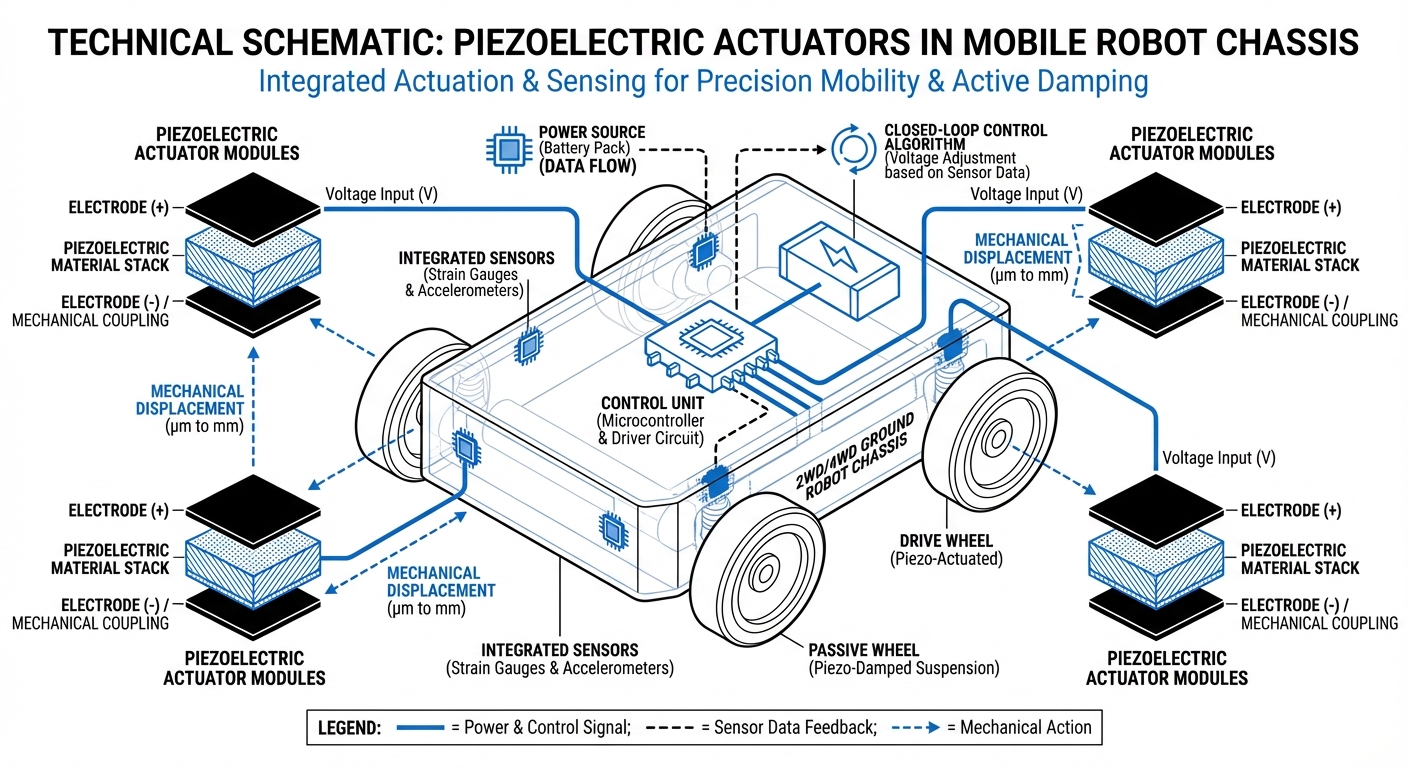
Piezo actuators rely on ferroelectric ceramics like Lead Zirconate Titanate (PZT). Voltage deforms the crystal lattice, creating visible expansion.
For robotics, they're stacked: hundreds of thin layers with electrodes, glued tight. This amps up stroke for real mechanical work while keeping voltages sane.
In AGVs, a controller sends exact voltage; the piezo expands instantly and proportionally. Use it to push loads, flex grippers via hinges, tweak sensors, or steady the chassis.
Real-World Applications
Active Vibration Damping
In AGVs hauling fragile goods like electronics or liquids, piezos act as active suspension—zapping floor bumps in milliseconds for payload stability.
Precision Micro-Grippers
For manipulation bots, piezo grippers handle tiny or delicate parts with force control pneumatics can't touch.
LiDAR & Sensor Scanning
Piezos shake mirrors or lenses in LiDAR/cameras for fast scanning and focus shifts—no clunky motors needed.
Micro-Fluidic Dispensing
In med or industrial mobile bots, piezos drive valves for precise droplet dispensing of lubes, glues, or reagents.
Frequently Asked Questions
What distinguishes a piezoelectric actuator from a solenoid?
Piezo actuators pack a much higher force in a smaller package and respond lightning-fast—in microseconds, not the milliseconds solenoids take. Plus, piezos let you dial in precise proportional control with infinite resolution, while solenoids are just basic on/off switches.
How much travel (stroke) can these actuators achieve?
Your standard stacked actuators only stretch about 0.1% to 0.15% of their length, typically 10 to 200 micrometers. Amplified versions, though, use flexure mechanisms to boost that stroke to several millimeters—sacrificing a bit of force for way more travel.
Are piezo actuators suitable for battery-powered AGVs?
Absolutely, they're super efficient. They act like capacitors, using energy just to move into position, then practically zero to hold steady. Perfect for robots that need to stay put for ages without sucking down the battery.
Do they require high voltage to operate?
Yep, most multilayer piezo actuators run on 60V to 150V. But specialized drivers can step up your AGV's standard 12V/24V/48V battery voltage efficiently, with super low current draw.
What is Hysteresis and how does it affect control?
Hysteresis is that lag you see—the difference in position when ramping voltage up versus down at the same level, often 10-15% in open-loop setups. For pinpoint accuracy, go with actuators that have built-in strain gauges and closed-loop control to wipe it out completely.
Are piezo actuators fragile?
Piezo ceramics crush compression (pushing) but struggle with tension (pulling) or shear. In tough robot environments, we preload them with a spring mechanism to keep everything compressed, shielding the ceramic from nasty tensile hits.
Does temperature affect performance?
Yep, the expansion rate shifts with temperature. And you gotta stay way under the Curie Temperature (usually >150°C), or it loses its piezo magic. Smart AGV designs build in thermal management for nonstop dynamic use.
What is the "Creep" phenomenon?
Creep is that gradual extra stretch after voltage settles—slow, logarithmic, and totally predictable. Just like hysteresis, modern closed-loop controllers in robotics handle it effortlessly.
Can piezo actuators generate heat?
They run cool in static mode—no heat at all. But at high frequencies (hundreds of cycles per second), dielectric losses cause some self-heating. Factor that in during design for things like scanning or vibration control.
Are they affected by magnetic fields?
Nope. Piezo actuators are fully non-magnetic and ignore magnetic fields. That's why they're the go-to for robots near MRI scanners or heavy welding gear, where regular motors would glitch out or interfere.
How long do they last?
These solid-state piezos have zero wear parts like gears or brushes. They rack up billions of cycles easily. Issues usually come from moisture sneaking in or voltage spikes—both avoidable with good sealing and driver protection.
What is the cost comparison to standard servo motors?
Piezos cost more upfront than basic DC motors because of the premium materials and precision build. But for nanometer accuracy, non-magnetic needs, or super-compact high-force setups, they deliver what servos simply can't.