Optical Encoders
The unsung heroes of precision: optical encoders turn physical motion into digital gold. They fuel the feedback loop for AGVs to nail millimeter navigation and silky motor control.
Core Concepts
Incremental Encoding
Tracks relative position changes. Perfect for speed and velocity control on AGV wheels where startup position doesn’t matter.
Absolute Encoding
Gives a unique code to every shaft angle. Key for robotic arms or steering that need instant exact position post-power-up.
Resolution (CPR)
Counts Per Revolution sets the precision. High-res optical discs mean buttery-smooth moves and spot-on stops at chargers.
Quadrature Output
Uses A and B channels, phase-shifted 90 degrees. Lets the controller clock speed *and* direction.
The Code Disc
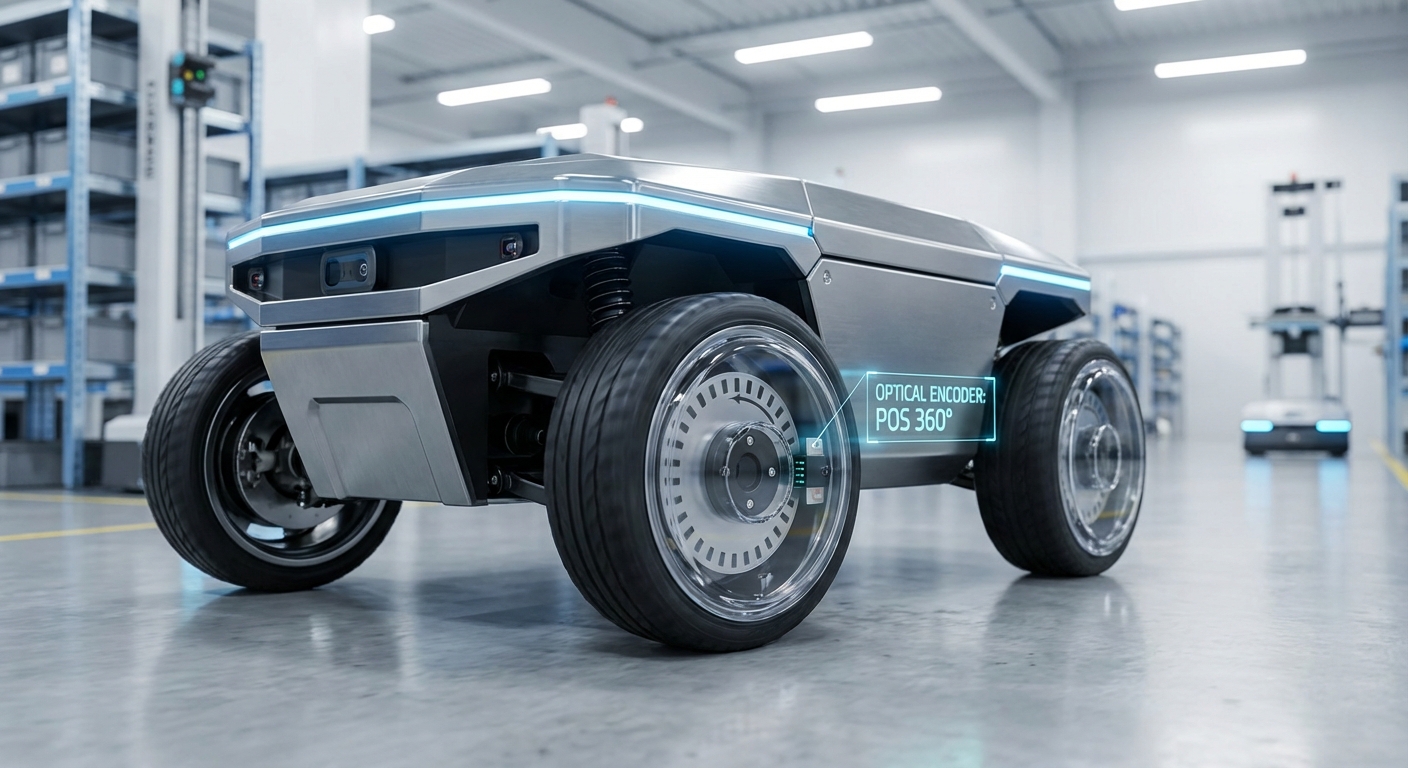
The sensor’s core: glass or metal disc with tiny etched lines. It chops the light beam into pulse signals.
Interference Immunity
Unlike magnetic encoders, optical ones shrug off magnetic noise—ideal near beefy motors in heavy-duty AGVs.
How It Works
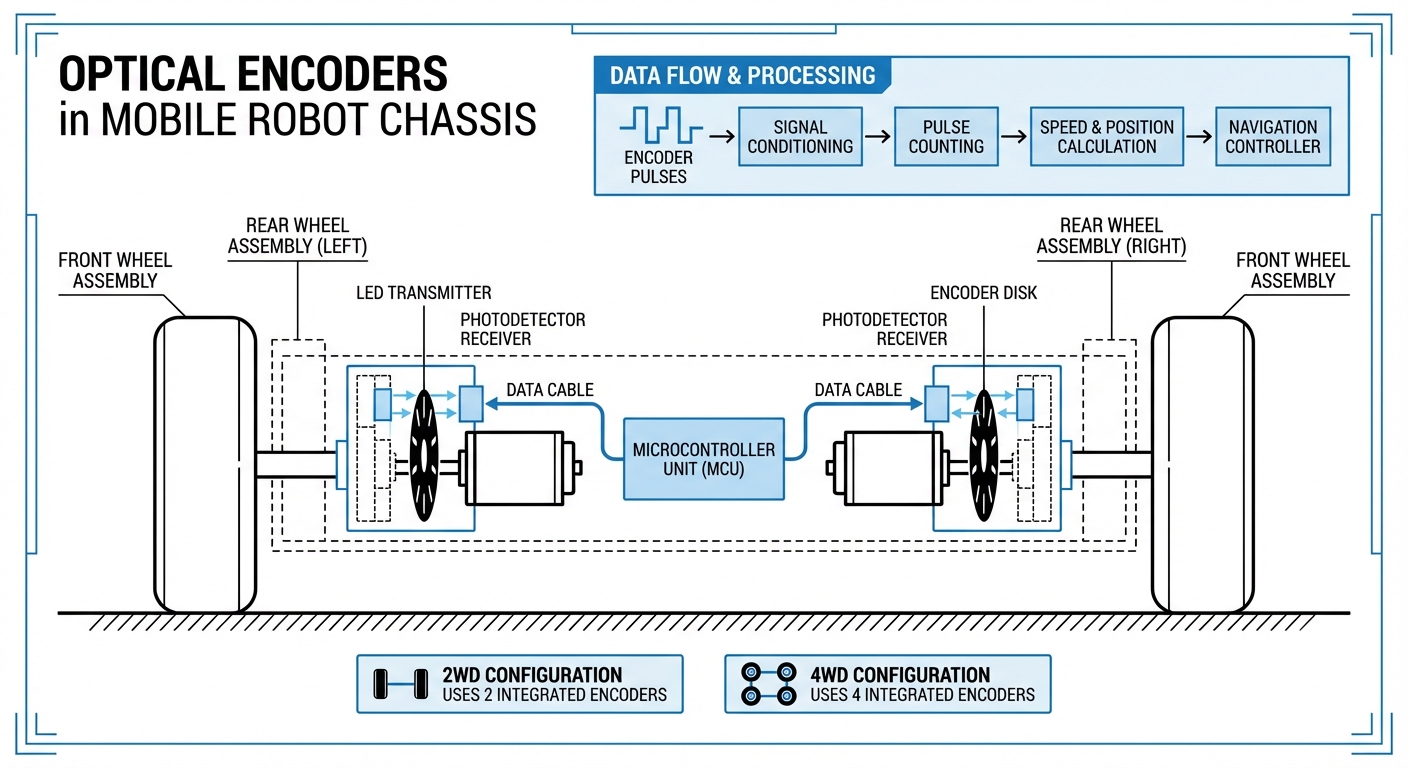
Optical encoders work on a brilliantly simple principle: blocking a beam of light. Inside the housing, an LED shines light straight at a photodetector, with a code disc spinning on the motor shaft right in between.
That disc has clear and opaque sections (called slots). As the motor turns, it chops the light into pulses. The photodetector picks up those pulses and turns them into a square wave electrical signal.
The AGV's main computer (a PLC or microcontroller) counts the rising and falling edges of that signal. It gauges speed by the pulse frequency and figures out distance traveled by the total pulse count—that's the magic of .
Real-World Applications
Wheel Odometry
They're the go-to for AGV positioning. Encoders on the drive wheels track every inch traveled to pinpoint X/Y coordinates on the warehouse map.
Precision Steering
In tricycle or Ackermann steering setups, absolute optical encoders make sure the drive wheel points exactly at the angle you command.
Lift Height Control
They're key in automated forklifts and VNA (Very Narrow Aisle) trucks, precisely positioning forks at rack heights for grabbing pallets.
LiDAR Rotation
Lots of spinning LiDAR sensors—crucial for SLAM navigation—rely on built-in optical encoders to line up the laser angle with the point cloud data.
Frequently Asked Questions
What’s the biggest edge optical encoders have over magnetic ones?
Optical encoders deliver way higher resolution and accuracy than magnetic types. Plus, they're totally immune to magnetic interference—a must when sticking them right on the powerful electric motors in industrial AGVs.
Why do AGVs start drifting if they're using encoders?
It's all about buildup of errors. Encoders track wheel spins, not real ground distance. Slippy floors, bumpy surfaces, or worn tires mean the actual travel doesn't match the count, so you need regular resets with LiDAR or QR codes.
What sets single-turn absolute encoders apart from multi-turn ones?
Single-turn ones give your position within a single 360-degree spin, then reset. Multi-turn versions track position in the current spin total revolutions, holding onto that info even without power—perfect for lifts.
How does warehouse dust mess with optical encoders?
They depend on light passing through, so dust, oil, or moisture can block the code disc. In tough spots, grab ones with top IP ratings like IP65 or IP67 to keep contaminants out.
What is the Index Channel (Z-channel)?
The Index or Z-channel fires off one pulse per full revolution. In incremental encoders, it sets a reliable 'home' position. Just spin the wheel till it triggers to confirm your mechanical zero.
How do you pick the right resolution (CPR) for your robot?
Aim for enough resolution to get 4 to 10 pulses per tiniest move you care about. But super-high CPR demands fast processing from your microcontroller—make sure your hardware can handle the output at top RPMs.
Can optical encoders measure speed as well as position?
Yes. Count the pulses for position, measure their frequency (or time between them) for speed. That's why they're perfect for PID motor control.
What are common output interfaces for optical encoders?
Incremental encoders usually output TTL (Transistor-Transistor Logic) or HTL (High Threshold Logic/Push-Pull). Absolute ones favor serial like SSI, BiSS-C, or fieldbuses such as CANopen and EtherCAT in industrial robots.
Do optical encoders require maintenance?
The optics don't wear out, but the shaft bearings do. Check cables for wear and seals for dust leaks regularly.
How does vibration affect optical encoders?
Glass code discs can shatter from big shocks, and vibes can mess readings or bearings. For rough-terrain AGVs, go for metal or tough mylar discs with beefy bearings.
What is Quadrature encoding?
Quadrature uses two channels (A and B), phased 90 electrical degrees apart. Which one leads tells direction. Counting all rising/falling edges on both quadruples resolution (x4 decoding).
Are optical encoders expensive compared to other sensors?
They're pricier than pots or basic magnetics because of the precision build. But in robots, that accuracy pays off in safer, smoother navigation.