Mecanum Wheels
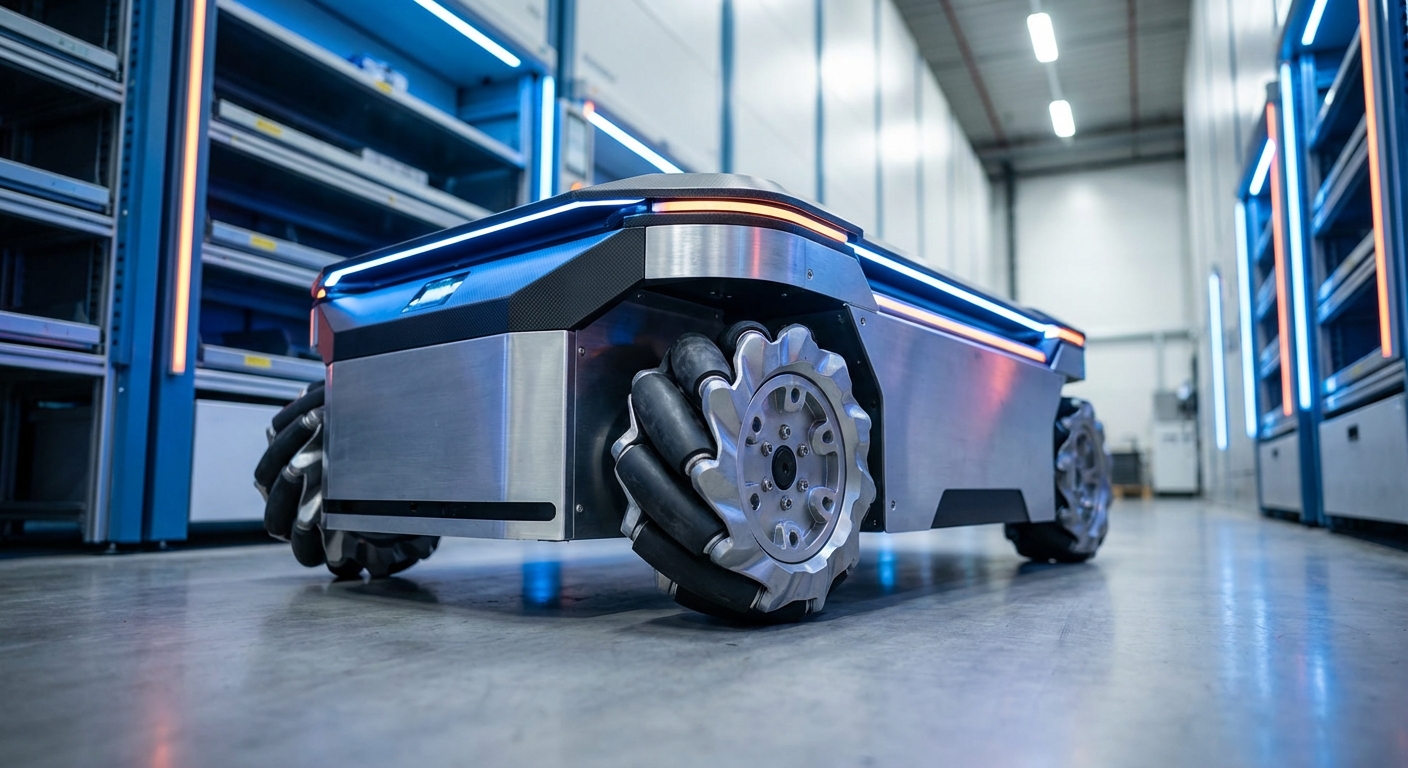
Unlock real omnidirectional moves for AGVs and mobile robots. Mecanum wheels let them zip sideways, diagonally, or spin on a dime—without turning the whole vehicle—transforming tight-space navigation.
Core Concepts
Holonomic Motion
Unlike simple differential drive, Mecanum gives true 3-DOF on a plane: forward/back (X), side-to-side (Y), and rotation (Theta) all at once.
45° Roller Geometry
The trick? Passive rollers on the wheel rim, angled at 45 degrees to the spin axis.
Vector Summation
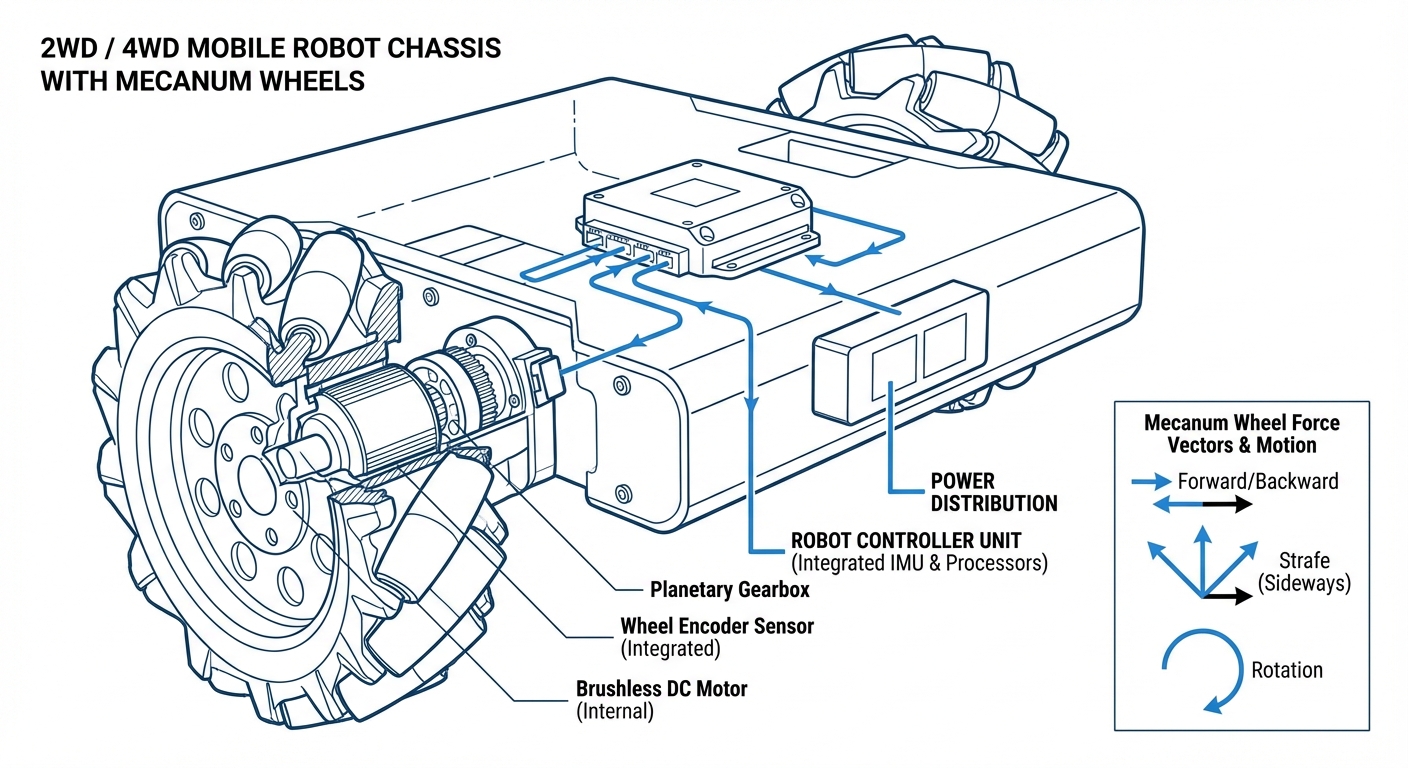
It’s all about vector math. Spin wheels opposite ways, and forces add up for pure sideways strafing.
Zero Turn Radius
Rotate perfectly in place by reversing left wheels and forwarding right ones—no extra space needed for turns.
Independent Drive
Each wheel needs its own motor and gearbox—no mechanical links; it's all software smarts.
Floor Requirements
With tiny roller contact patches, they shine on hard, flat, level floors like concrete or industrial tiles.
How It Works: The Physics of Strafing
Mecanum magic comes from force direction. Regular wheels push straight forward/back. Mecanum's diagonal free-rollers kick force at 45 degrees to the chassis.
Mount four in an 'X' setup (rollers aiming center), and the controller mixes those vectors for any move.
Take strafing right, for example: the front-left and back-right wheels spin forward, while the front-right and back-left ones spin backward. This cancels out the forward and backward forces, leaving just the sideways push.
This setup ditches complicated steering systems like Ackermann steering, but it does call for clever kinematic software to figure out wheel speeds in real time.
Real-World Applications
Warehouse Logistics
AGVs with Mecanum wheels pack storage tight by squeezing through super-narrow aisles. They grab pallets and slide sideways out of lanes without needing room for a wide turn.
Precise Assembly
In car and plane manufacturing, big parts need spot-on alignment down to the millimeter. Mecanum platforms let you nudge heavy components sideways for perfect bolt-hole matches.
Maintenance Platforms
Mobile scissor lifts for plane maintenance use omnidirectional wheels to slip under fuselages and wings, reaching work spots from any angle without risky multi-point turns.
Inspection Robots
Tiny rovers in tight spots like under-floor cable ducts or machine crawl spaces count on strafing to check out areas regular robots can't reach.
Frequently Asked Questions
What's the difference between Mecanum wheels and Omni wheels?
Both let you move every which way, but Omni wheels have rollers at 90 degrees to the wheel axis, while Mecanum's are at 45 degrees. Mecanum wheels work with a straightforward chassis (wheels parallel to the robot), but Omni wheels usually need angled mounting, like in a triangle setup, for full holonomic motion.
Can Mecanum wheels operate on carpet or uneven terrain?
Usually not. Mecanum wheels struggle on soft stuff like thick carpet or bumpy gravel. The rollers need a firm surface to glide on for those vector forces. On squishy ground, they sink in, ramp up friction, and kill the sideways slide.
Do I need a specific motor configuration?
Yep, you definitely need four separate motors, one per wheel. No linking them mechanically, like with a shared axle for the front pair, since strafing and turning often mean wheels on the same axle spin opposites ways.
Does the orientation of the wheels matter during assembly?
Absolutely, and it's key. Mecanum wheels come handed (left and right types). Mount them in an 'X' pattern from above (rollers aiming toward the center). An 'O' pattern? Your robot will fight to turn, and movement will be sloppy.
Are Mecanum wheels less efficient than standard wheels?
Yeah, usually around 65-70% efficient compared to regular wheels. Some force gets wasted as rollers push diagonally for forward motion, so you'll burn more battery covering the same ground than a skid-steer or differential drive bot.
What is the payload capacity?
Payloads tend to be lower than standard wheels of the same size since weight rides on just one tiny roller patch at a time. But heavy-duty industrial versions with tough steel rollers can haul thousands of kilos.
How does suspension work with Mecanum wheels?
Suspension's tricky but essential. All four wheels need ground contact constantly for the math to hold up. Lose one to a bump? Movement goes haywire. Rocker bogie or independent springs often save the day.
Why are they noisier than regular wheels?
They make a signature 'clack-clack' as load shifts roller to roller. Softer materials like polyurethane cut the vibe, but Mecanum wheels are almost always noisier than air-filled or solid rubber tires.
Can Mecanum robots climb ramps?
They handle gentle ramps okay, but traction's the killer. Free-spinning rollers mean gravity can pull the bot sideways or back on steeper slopes. Stick to 5-10 degrees max.
What kind of sensors are needed for navigation?
High-res encoders on each motor are a must to hit exact speeds from the kinematic model. For SLAM nav, LIDAR and IMUs fix the minor slips that come with Mecanum motion.
Are there maintenance concerns?
Sure. Those tiny roller axles snag hair, dust, and warehouse grit, jamming them up. Jammed roller? Wheel acts normal, ruining strafing. Clean and lube regularly.
How fast can they go?
Speeds match standard wheels, mostly capped by motor RPM and gearing. But crank it up, and roller chatter ramps vibration, messing with sensors and frame strength.