Magnetic Encoders
The tough, reliable heartbeat of today's mobile robots. Magnetic encoders give precise position and speed feedback for AGVs, shining in brutal environments where optical sensors just give up.

Core Concepts
Hall Effect Principle
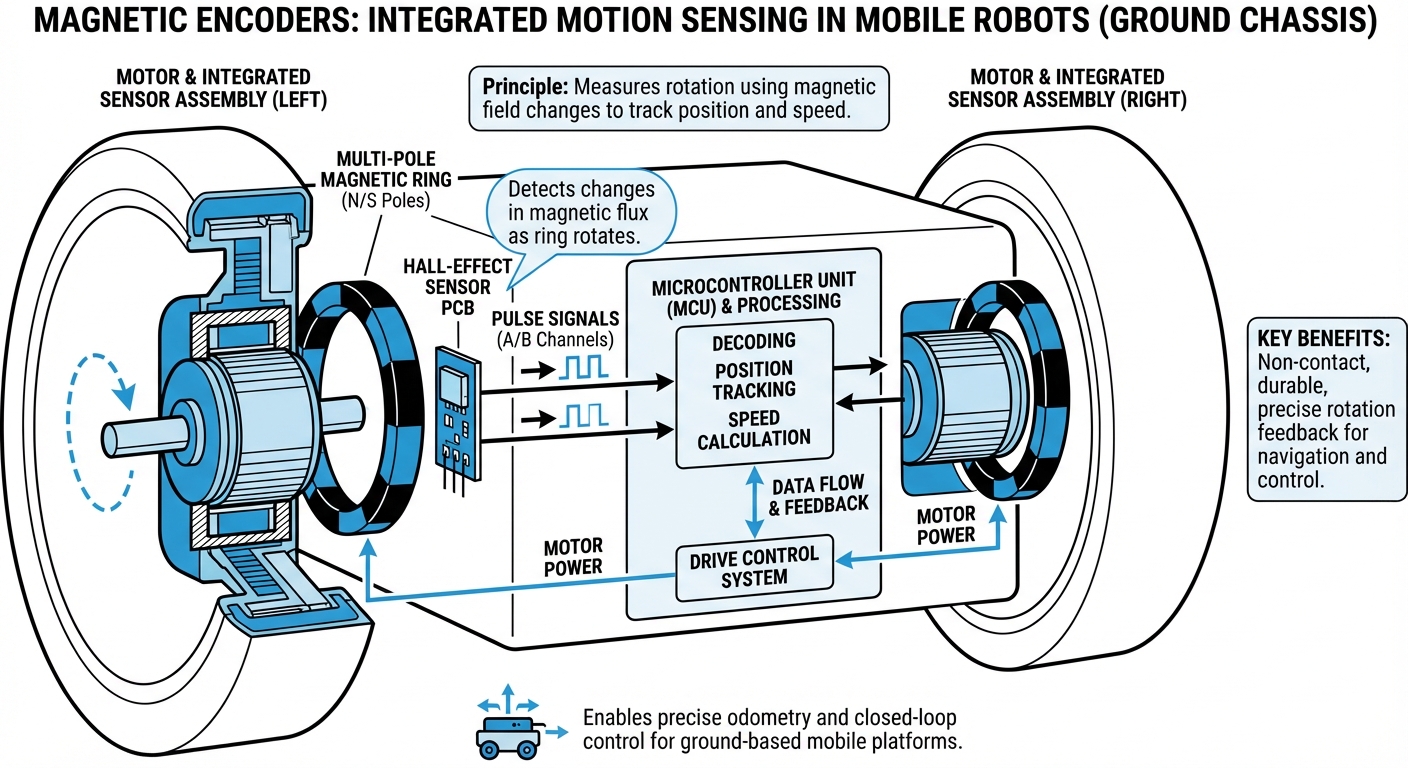
They use Hall Effect sensors to catch shifts in magnetic fields from a spinning magnet. This touch-free approach turns magnetic flux into voltage signals for spot-on position info.
High Durability
Unlike optical encoders, magnetic ones laugh off dust, oil, moisture, and vibrations. They're perfect for AGVs tackling warehouses or rough outdoor terrain.
Absolute vs. Incremental
Magnetic encoders come in incremental (tracks relative changes) or absolute (knows exact position) flavors. Absolute ones hold onto position data even after power cuts—vital for safety-critical robots.
Compact Form Factor
The sensor chip and magnet setup takes up way less space than bulky optical disks, letting you squeeze them into tiny motors and slim AGV frames.
Resolution Flexibility
Newer magnetic encoders let you program the resolution. Tweak pulses per revolution (PPR) through software to nail the sweet spot between speed and accuracy.
Cost-Efficiency
They're usually cheaper than top-tier optical options, yet plenty accurate for wheel odometry and lift systems in most logistics setups.
How It Works
Magnetic encoders seem deceptively simple but deliver big. Just two key parts: a magnetized rotor glued to the spinning shaft and a sensor IC fixed to the housing.
As the AGV motor turns, the rotor spins up a magnetic field. Hall Effect or magnetoresistive sensors pick up its direction. A built-in processor instantly turns the sine/cosine analog signals into digital output—like A/B quadrature pulses or protocols such as SSI or BiSS.
With no contact between sensor and magnet, and no light involved, it stays accurate even if hydraulic fluid, grease, or dust fills the gap.
Real-World Applications
Warehouse AMRs
Perfect for wheel odometry to track distance and rotation angles. They shrug off cardboard dust and debris in busy fulfillment centers.
Heavy-Duty Forklifts
Crucial for steering feedback and lift-height sensing. Their vibration resistance keeps them reliable on bumpy concrete floors.
Outdoor Agriculture Robots
Sealed magnetic encoders (IP67+) are the go-to for ag-bots facing rain, mud, and fertilizers—where optical seals would eventually fail.
Medical Transport Carts
Their whisper-quiet operation and tiny size make them ideal for hospital delivery robots weaving through narrow halls and patient rooms.
Frequently Asked Questions
What’s the biggest advantage of magnetic encoders over optical ones?
The top perk is their toughness in harsh environments. Magnetic encoders ignore contaminants like oil, grease, water, and dust that fog up optical code discs. They're also way better at handling shocks and vibrations.
Can external magnetic fields interfere with the encoder's accuracy?
Yes, strong external magnetic fields (like from big motor brakes) can mess with them. But modern ones use differential sensing and shielding to fight it off. In high-EMI spots, just place them right and add shielding.
What’s the typical resolution limit for a magnetic encoder?
Older ones lagged behind optical, but today's magnetic encoders hit up to 16-18 bits (over 200,000 counts per turn). That's plenty for most AGV wheel odometry and joint control needs.
Do I need absolute or incremental encoders for my AGV?
Incremental works fine for wheel speed. But for steering angles or robot arms, go absolute—they know their position right at startup, no homing needed.
How crucial is aligning the magnet and sensor?
They're more forgiving on misalignment than optical types. Still, stick to the maker's air gap spec between magnet and chip for clean signals and full resolution.
Are magnetic encoders suitable for high-speed motors?
Yes, plenty of magnetic encoders handle super high RPMs (over 10,000 often) with no contact parts or fragile glass. Just check latency matches your control loop speed.
How does temperature affect magnetic encoder performance?
Magnetic fields shift with temperature, but top encoders have built-in compensation. They reliably run from -40°C to +125°C—ideal for cold storage AGVs.
What are the maintenance requirements?
They're basically maintenance-free. No wear from contact (kit encoders skip internal bearings), no LEDs to burn out—they often outlive the motors.
Can I swap an optical encoder for a magnetic one?
Often yes, if the mounting, shaft size, output signals (like TTL quadrature or RS422), and voltage match your motor controller.
What is "On-Axis" vs. "Off-Axis" mounting?
On-axis puts the magnet right on the shaft end facing the sensor. Off-axis (hollow shaft) uses a ring magnet so the shaft passes through—handy when the end isn't free or for big joints.
How does the cost compare to optical encoders?
For everyday resolutions, magnetic encoders cost less to make and assemble. Ultra-precise optical ones run pricier but only needed for nanometer accuracy.
What communication interfaces are common for AGVs?
Basic motor control loves ABZ quadrature. For smart AGVs needing absolute position and diagnostics, protocols like SSI, BiSS-C, or CANopen rule.