Harmonic Drives
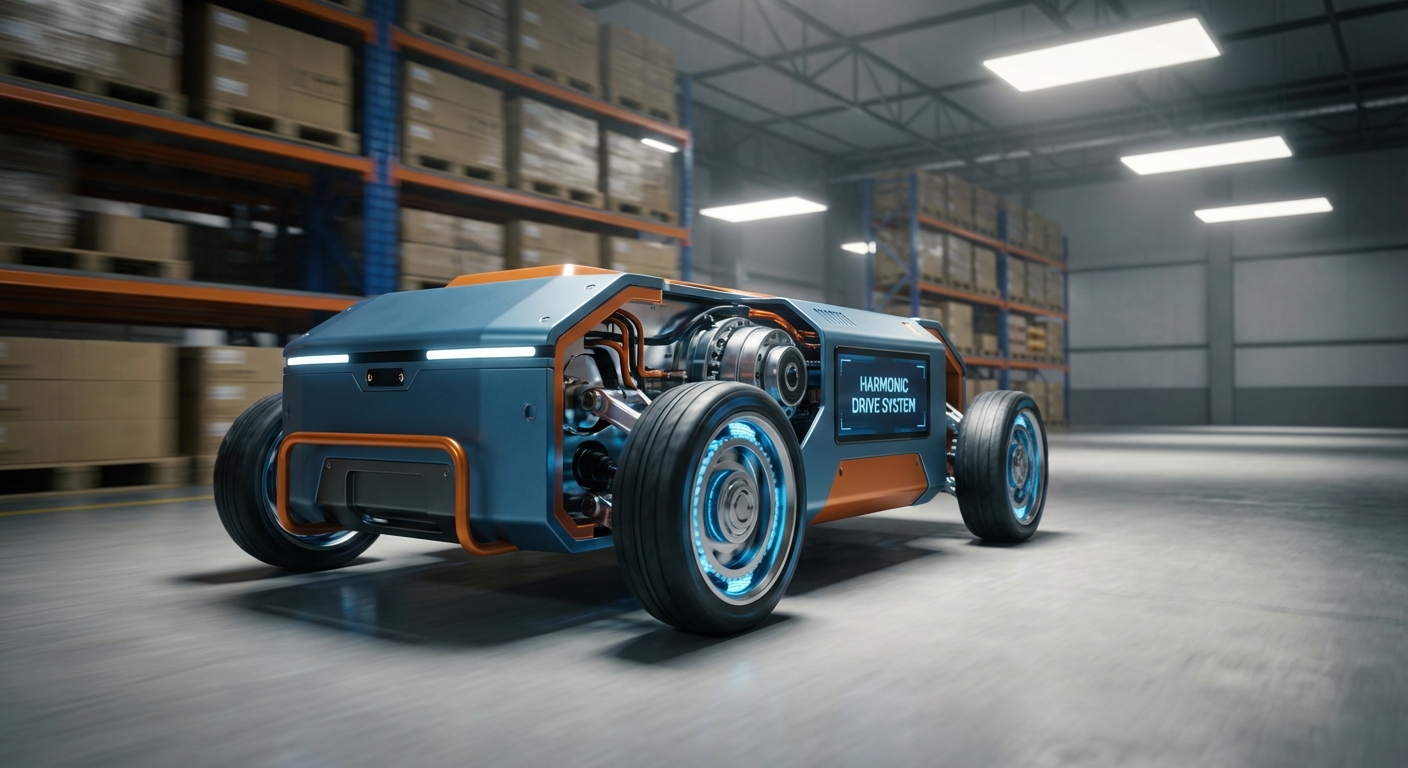
Unlock next-level precision in mobile robots with strain wave gearing from Harmonic Drive. They pack sky-high torque density and zero backlash—perfect for spot-on navigation and handling in today's AGVs.
Core Concepts
Zero Backlash
Unlike planetary gears, harmonic drives have zero play. That means AGV steering and arms hold position rock-steady, no slop or shake.
High Torque Density
They pump out huge torque from a tiny package. Compact AGVs haul big loads without clunky transmissions.
High Reduction Ratios
Get 30:1 to 320:1 ratios in one stage—no multi-gear headaches, fewer breakdowns, less upkeep.
The Three Components
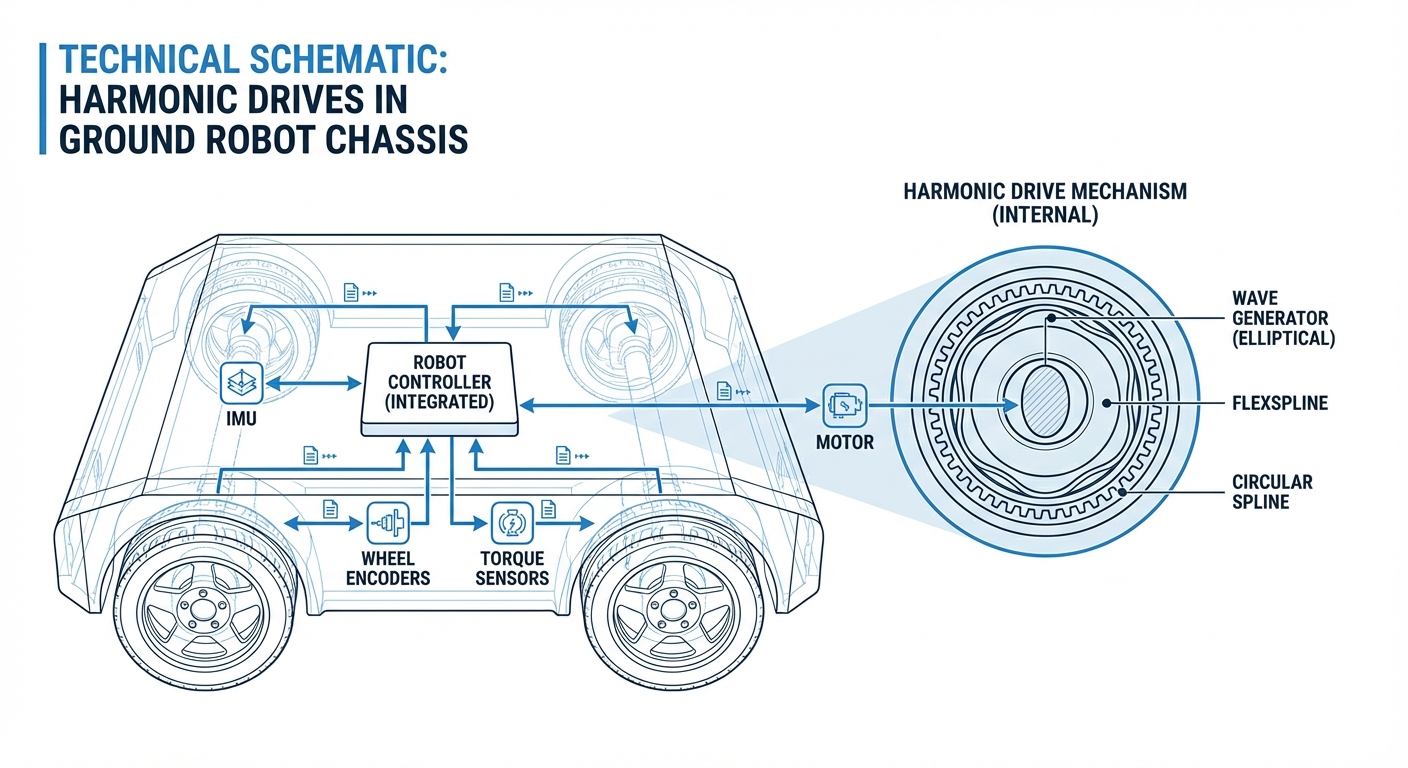
Just three simple parts: Wave Generator (input), Flexspline (flex cup), and Circular Spline (outer ring). Less to fail means top reliability.
Positional Accuracy
With ~30% of teeth meshed always, errors average out for killer repeatability on docks and paths.
Coaxial Geometry
Input and output shafts align coaxially. Easy-peasy for chassis design—motors line up straight with wheels or joints.
How It Works: Strain Wave Logic
At the heart of a harmonic drive is an elliptical plug called the . When inserted into the (a flexible, thin-walled steel cup with external teeth), it forces the Flexspline into an elliptical shape.
The is a rigid outer ring with internal teeth. Crucially, the Flexspline has two fewer teeth than the Circular Spline. As the Wave Generator rotates, it pushes the Flexspline teeth into mesh with the Circular Spline teeth along the major axis of the ellipse.
For every full rotation of the Wave Generator, the Flexspline rotates in the opposite direction by a distance of two teeth. This creates a massive reduction ratio in a incredibly compact space, converting high-speed motor input into low-speed, high-torque output.
- Input: High Speed (Wave Generator)
- Output: High Torque (Flexspline or Circular Spline)
- Efficiency: Contact across ~30% of teeth simultaneously
Real-World Applications
Steering Modules
In omnidirectional AGVs, harmonic drives power steering actuators to swivel wheel pods. Zero backlash lets odometry calculate positions without mechanical creep.
Mobile Manipulators (AMRs)
For AGVs with robotic arms (cobots), harmonic drives give joints the hold and silkiness to gently pick and place while rolling.
Compact Wheel Hubs
Their flat, 'pancake' shape fits right inside wheel hubs on compact warehouse bots, freeing space for batteries and goods.
Heavy-Lift Pallet Jacks
Autonomous forklifts use harmonic drives' torque boost in lifts to hoist heavy pallets skyward with modest motors.
Frequently Asked Questions
What is the primary advantage of a Harmonic Drive over a Planetary Gearbox?
The biggest win here is "Zero Backlash." Planetary gears often have a bit of wiggle room—or backlash—between their teeth, but Harmonic Drives use their flexible design to keep the teeth constantly pre-loaded and meshed. That delivers outstanding positioning accuracy and repeatability.
Are Harmonic Drives suitable for high-speed applications?
Generally, no. They're built for high-torque, low-speed output. Sure, the input speed from the Wave Generator can hit 6000-7000 RPM, but the heat from Flexspline deformation sets limits. Perfect for precise positioning, not endless high-speed spinning.
How does the efficiency compare to other gear types?
Harmonic drives aren't quite as efficient as planetary gears, usually hitting 80% to 90% depending on the ratio and speed. Efficiency takes a hit at super low temps or light loads because flexing that metal spline eats up energy.
What is "Ratcheting" and when does it occur?
Ratcheting is a total failure scenario where overload torque overwhelms the drive's grip, making the Flexspline teeth skip over the Circular Spline teeth. It often strikes during sudden shocks—like an AGV collision—and wrecks the teeth for good.
What maintenance is required for Harmonic Drives in AGVs?
Lubrication is key for maintenance. You'll need special harmonic grease, like lithium-based stuff with extreme pressure additives. Sealed 'component set' units might be good for life, but open ones need regular re-greasing to avoid fretting wear on the Flexspline.
Why are they more expensive than standard gears?
Making them is no joke—super demanding. The Flexspline demands top-tier steel that endures millions of bends without cracking, and those tooth profiles need micron-precise machining. That advanced materials and precision work jacks up the price.
What is the typical lifespan of a Harmonic Drive?
Lifespan is typically rated by 'L10 life' hours at given speeds and torques. Expect 7,000 to 10,000 hours from a standard unit. The bottleneck is usually fatigue in the Wave Generator's flexible bearing or the Flexspline cup.
Can Harmonic Drives handle high radial and axial loads?
Standard component sets aren't meant for heavy loads on the output shaft. But 'housed' versions often pack in cross-roller bearings right on the output, giving killer stiffness and handling big radial, axial, and moment loads—like on robot arms.
Are there different gear ratios available?
Yep, common ratios are 30, 50, 80, 100, 120, and 160:1. Since ratios come from tooth counts (whole numbers), they're set steps. Custom like 42.5:1? You'd have to redesign the whole gear set.
How does a Harmonic Drive impact AGV battery life?
They're a tad less efficient than planetary gears, but those sky-high ratios let you pair with smaller, thriftier motors. Overall, it boosts battery life by lightening the powertrain load—as long as you're not running in constant high-friction zones.