H-Bridge Motor Drivers
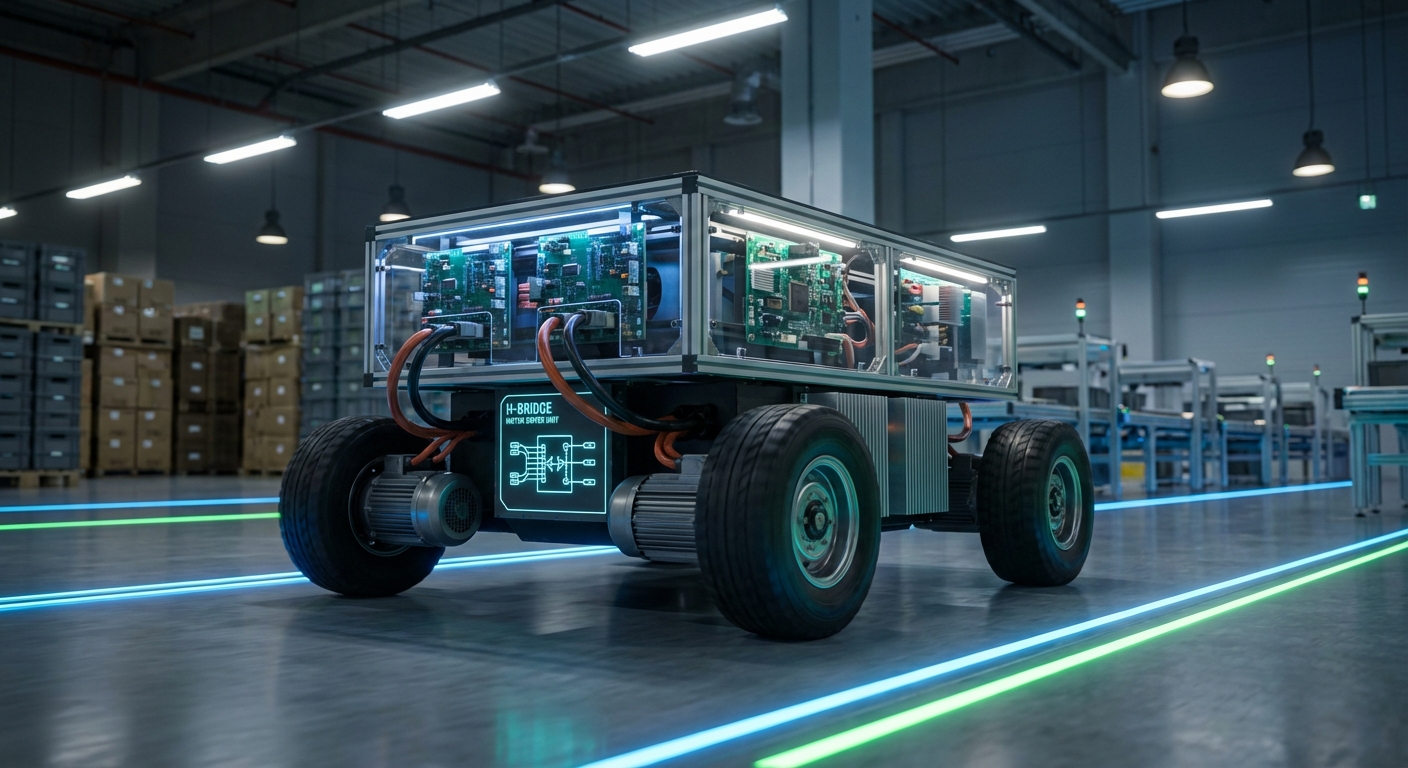
The core circuit giving AGVs pinpoint bidirectional control. It bridges low-voltage brains to high-power motors, powering navigation, speed tweaks, and smooth stops in today's robots.
Core Concepts
Bidirectional Control
An H-Bridge's key job? Flip motor polarity on a dime for instant forward/backward without clunky relays.
PWM Modulation
Pulse those transistors fast (PWM magic), and it dials voltage for silky acceleration and exact speeds.
MOSFET Efficiency
Today's drivers rock low-Rds-on MOSFETs, slashing voltage drops and heat—huge for squeezing more life from robot batteries.
Dynamic Braking
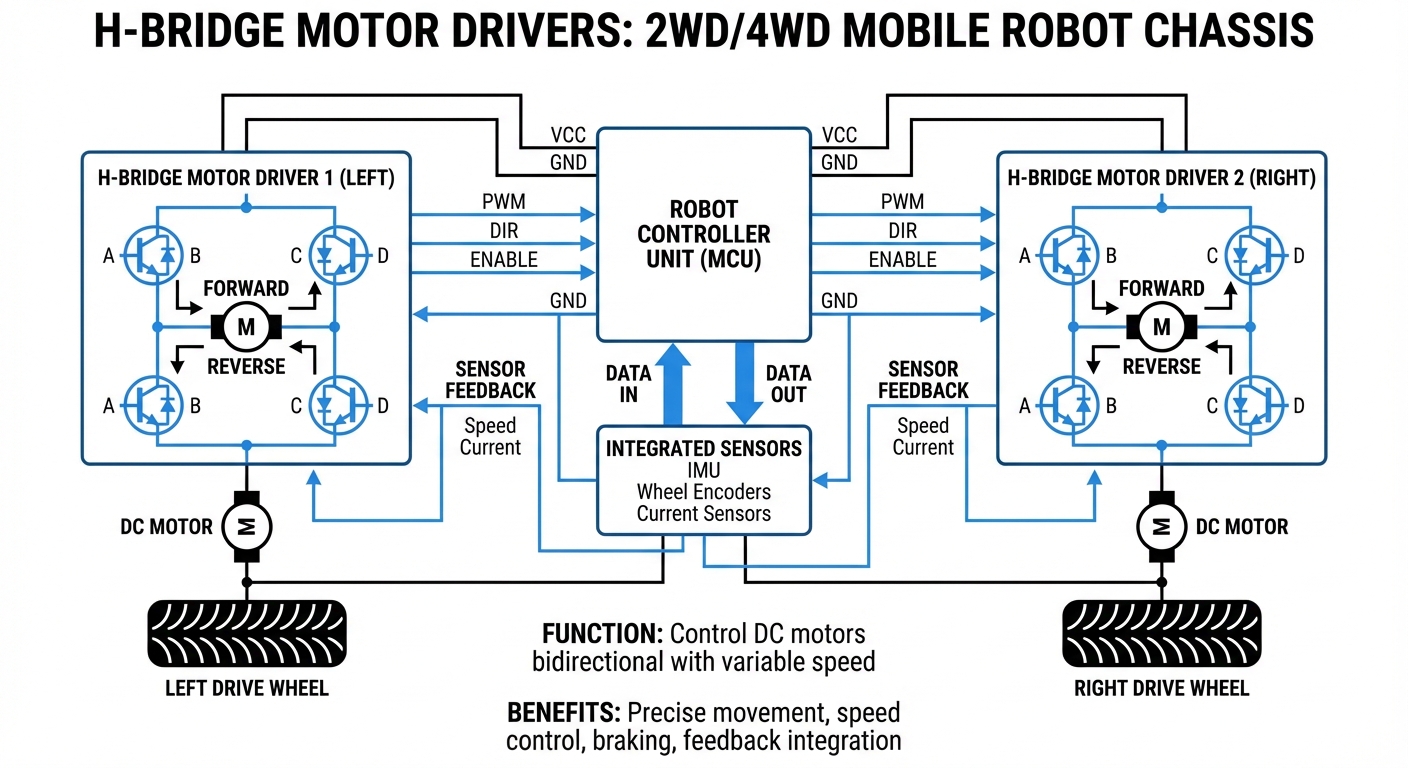
Short the motor leads (both bottom switches on), and back-EMF delivers quick, safe braking power.
Shoot-Through Protection
Smart drivers bake in 'dead time' to avoid top/bottom switches on one leg firing together—no boom, no shorts.
Logic Interface
These bad boys isolate beefy motor volts (24V/48V) from delicate MCU logic (3.3V/5V), shielding the robot's smarts from noise and spikes.
How It Works
'H-Bridge' comes from its H-shaped diagram. Four switches—MOSFETs in modern bots—with the motor smack in the middle.
Forward Motion:
Reverse Motion:
This elegant setup turns fancy path algorithms into real-world motion.
Real-World Applications
Automated Warehouses
Beefy H-Bridges muscle DC motors in forklifts and pallet jacks for pinpoint docking and heavy lifts.
Differential Drive Robots
Dual H-Bridges (left wheel, right wheel) let robots pivot on a dime by counter-spinning wheels.
Medical Transport Carts
Hospital bots need stealth mode. 20kHz+ PWM kills motor whine for quiet corridor cruises.
Mecanum Wheel Platforms
Omni-bots run four H-Bridges independently, sliding sideways without twisting the body.
Frequently Asked Questions
What's an L298N vs. a slick modern MOSFET driver?
L298N's old-school BJTs drop up to 2V and roast hot. MOSFETs barely resist, pushing max power to motors, staying cool—key for efficient AGVs.
Why do I need dead-time insertion?
Dead-time? A tiny pause flipping directions. Skip it, and top/bottom on one side overlap, sparking shoot-through that fries the driver and battery.
How does PWM frequency affect motor performance?
Low PWM buzzes and shakes motors audibly. Ultrasonic (>20kHz) is whisper-quiet but wastes more on switches. 10-20kHz sweet spot for AGV quiet and efficiency.
What is Regenerative Braking in the context of H-Bridges?
Regen braking turns the motor into a generator on decel, pumping energy back to the battery via the H-Bridge—boosting runtime in stop-go worlds.
Can I use a single H-Bridge for two motors?
Sure, technically you can wire them in parallel, but they'll always run at the same speed and direction. For steering with differential drive, you really need one independent H-bridge channel per motor wheel.
How do I calculate the current rating I need?
Don't just check the motor's continuous current rating. Size your driver for the stall current—the massive power draw when the motor's jammed and can't turn. A solid rule of thumb: pick a driver that handles at least 2x the motor's continuous current.
What protection features are standard in industrial drivers?
Pro-grade drivers pack in over-current protection (OCP), thermal shutdown (TSD), under-voltage lockout (UVLO), and ESD safeguards. They protect your pricey robotics gear from blowing up.
Why do I need a heatsink on my H-Bridge?
Even efficient MOSFETs heat up at high currents (like 20A+), thanks to resistance. Exceed 150°C at the junction, and it fails. Heatsinks wick away that heat to keep the driver safe and cool.
What is galvanic isolation and do I need it?
Galvanic isolation physically splits the high-power motor side from the low-power logic (often via optocouplers). For pricey industrial AGVs, it's a must to stop motor noise or faults from wrecking the main computer.
Can H-Bridges handle Stepper Motors?
Yep. A bipolar stepper needs two H-bridges (one per coil). Fire them in the right sequence for precise steps. Most stepper drivers cram both into a single chip.