Force and Torque Sensors
Force and torque sensors are like the central nervous system for today's AGVs and mobile robots. They deliver the touch feedback needed for spot-on interactions. Real-time force detection makes safe human-robot teamwork, smart navigation, and tricky handling possible—stuff vision alone can't touch.
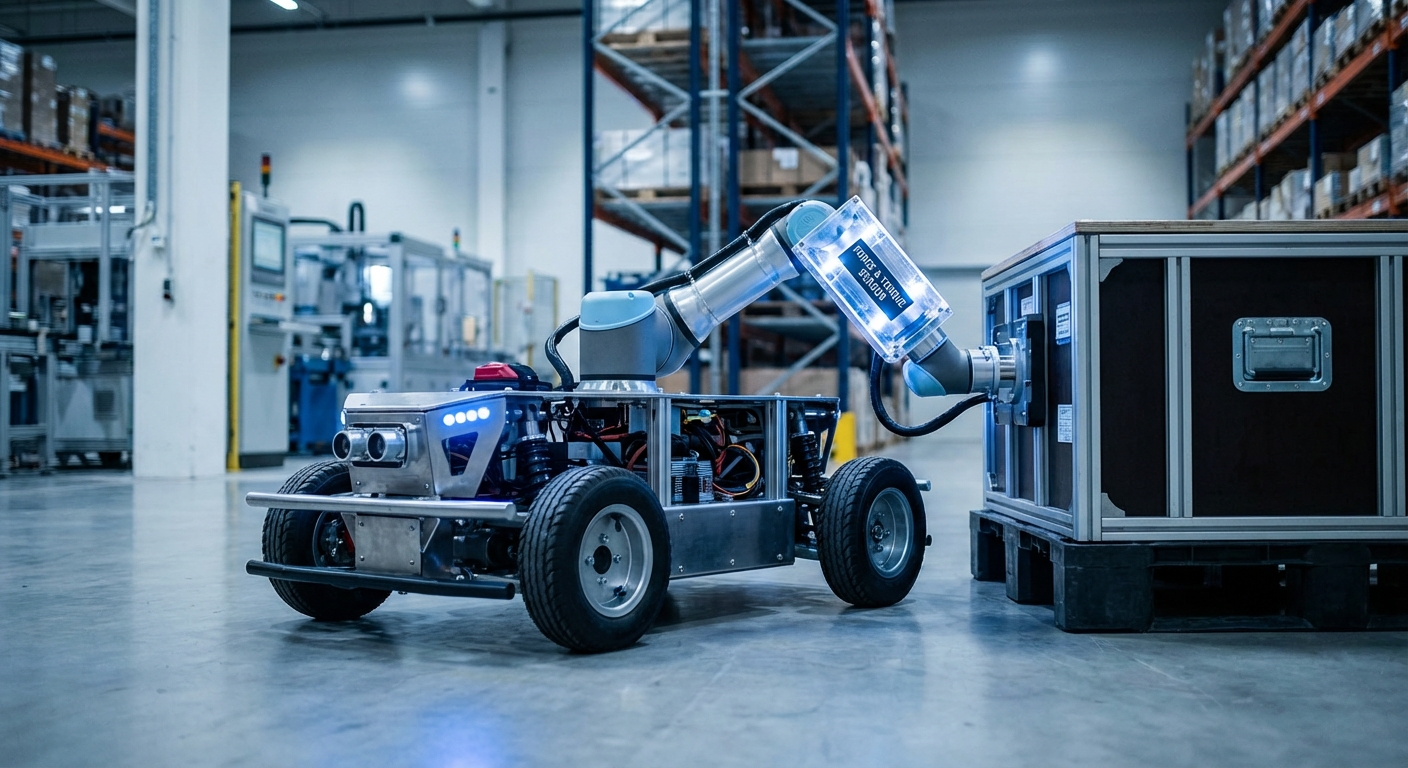
Core Concepts
6-Axis Measurement
Measuring forces (Fx, Fy, Fz) and torques (Tx, Ty, Tz) all at once across three axes gives robots full tactile sense of every physical touch.
Active Compliance
Unlike stiff coding, compliance lets the robot sense pushback and tweak its path right away, saving the payload or surroundings from damage in assembly jobs.
Collision Detection
High-sensitivity sensors catch surprise bumps quicker than motor current checks, hitting the emergency stop the instant something's touched.
Payload Verification
End-effector or lift sensors confirm a solid grip and weigh the load, keeping quality in check.
Center of Gravity
By crunching torque data, mobile manipulators figure out a load's Center of Gravity (CoG) and shift balance to avoid tip-overs while moving.
Lead-Through Teaching
Sensors make 'Zero-G' modes possible, where people hand-guide the arm to teach paths—the robot counters its own weight effortlessly.
How It Works
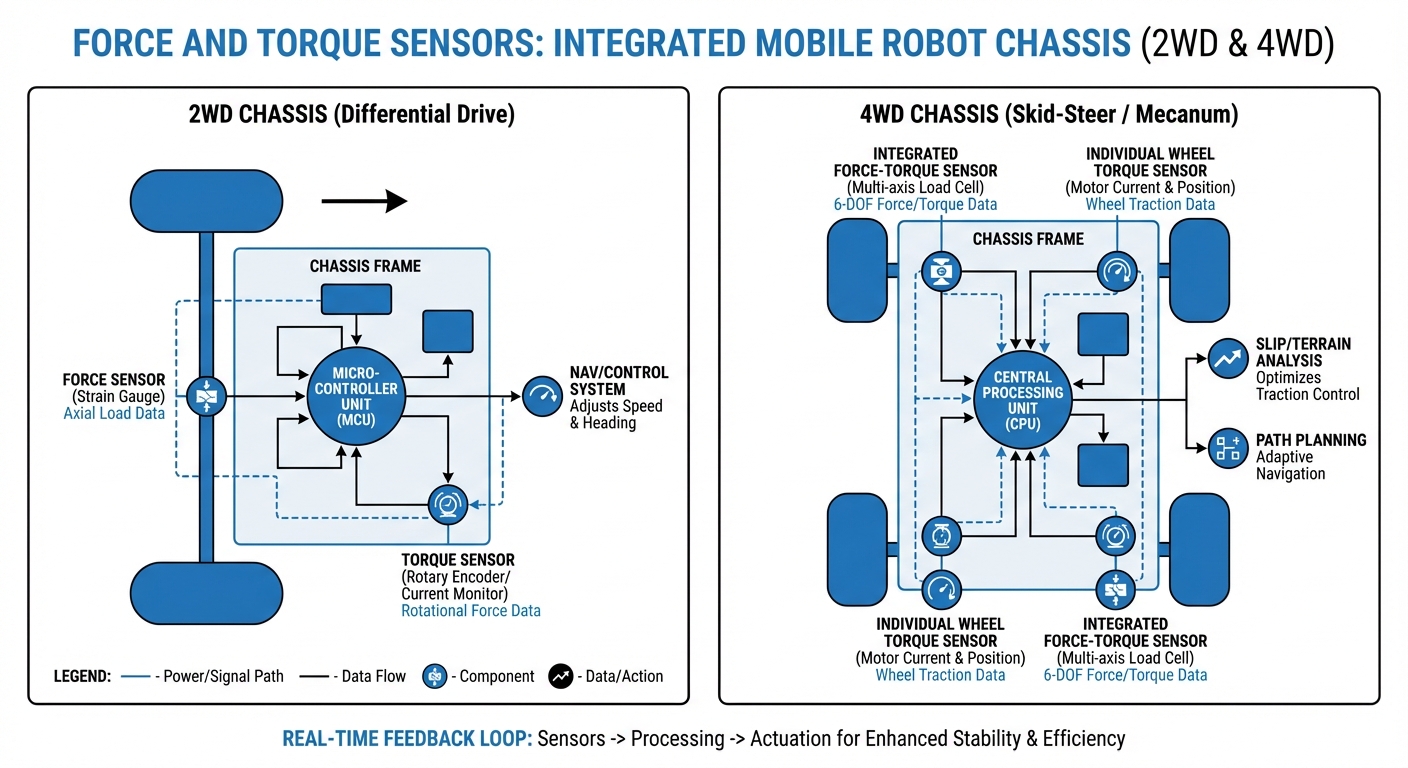
Force and torque sensors pack strain gauges, capacitive bits, or optical tech into a tough shell. An outside force bends it tiny amounts, which gets turned into electrical signals matching forces on X, Y, Z and twists around them.
Raw analog signals hit an onboard DSP that scrubs noise and temp drift. It then crunches exact force/torque numbers using a sensor-specific calibration matrix.
This info zips to the AGV or robot brain via fieldbuses like EtherCAT or PROFINET. The control loop uses it at blistering speeds (1kHz+), tweaking motors for smooth, human-like 'feeling' moves.
Real-World Applications
Precision Assembly
In manufacturing, robots nail 'peg-in-hole' inserts with force sensors. Feeling off-alignment resistance, they nudge into place without jams or breaks.
Surface Finishing
Sanding, polishing, deburring? Those need steady pressure. Force sensors hold perfect contact on wonky surfaces for even results.
Warehouse Logistics
AGVs with force-smart forks or grippers check pallet seating and spot shaky loads before rolling.
Medical Robotics
In surgery or rehab bots, force sensors send haptic vibes to surgeons, letting them feel tissue pushback from afar for safer, sharper work.
Frequently Asked Questions
What's the difference between a 1-axis and a 6-axis force sensor?
A 1-axis sensor checks force one way (like a fancy scale for push/pull). A 6-axis one grabs forces in X, Y, Z plus twists around them all at once. You need 6-axis for fiddly tasks where forces hit from anywhere.
How does force sensing boost AGV safety over LiDAR?
LiDAR owns long-range, no-touch dodging. Force sensing covers contact moments. Blind-spot bump on a person? Sensors feel it instantly and halt the bot, cutting harm.
Do force sensors require frequent calibration?
Most factory-calibrated industrial sensors fight drift well. Still, 'zeroing' (tare) via software before tasks accounts for tool weight. Full recalib? Only after big crashes or overloads.
What is "Cross-talk" in force sensors?
Cross-talk? That's when one-axis force fakes out another due to internal wobble. Top sensors use DSP decoupling math to fix it—no Z-force pretending to be X.
Can I retrofit a force sensor onto an existing robot arm?
Sure, wrist force/torque sensors are built for it. Strap one between flange and tool. Just confirm controller protocol match (EtherCAT, Modbus) and tweak TCP for the added height.
What is the typical overload capacity?
Sensors handle 200-500% overload safely. Push past? Permanent bend in the works—time for a new one. Size for peak jolts, not just steady weight.
How does temperature affect force sensor readings?
Temp swings stretch or shrink materials, messing strain readings (drift). Smart sensors have built-in fixes that tweak signals for steady accuracy across temps.
What's the difference between Joint Torque Sensors and Wrist Sensors?
Wrist sensors capture forces right at the tool tip where it meets the part. Joint torque sensors are built into every motor in the robot arm. Joint sensors excel at whole-arm collision detection and compliance, while wrist sensors deliver pinpoint precision for delicate assembly jobs.
Are optical force sensors better than strain gauge sensors?
Optical sensors detect deformation using light and photodiodes instead of electrical resistance. They're usually tougher against electrical noise (like EMI) and handle shocks better. Strain gauges are the classic choice—super common, cheaper, but they might need extra shielding to perform well.
How important is data latency in force control?
Super important stuff here. For rock-solid force control, sensor data needs to hit the controller fast (low latency) and often (high refresh rate, say 1000Hz). Too much delay, and the robot might wobble or react too slowly to contact, risking damage to your parts.
What IP rating is required for these sensors?
It really depends on your setup. Clean assembly lines? IP40 or IP54 works fine. Dealing with CNC coolant sprays or food washdowns? Go for IP65 or IP67 to keep liquids out and protect the electronics.