Cycloidal Gears
Unlock precise motion with cycloidal drives' unique mechanics. Built for high-torque, zero-backlash power, they're the go-to for next-gen AGVs and mobile robot actuators.

Core Concepts
Zero Backlash
Unlike regular gears, cycloidal drives keep constant contact, wiping out play for sub-arcminute accuracy that's crucial for LIDAR navigation.
High Torque Density
Cycloidal gears spread the load across about 30% of their teeth at once. That lets compact AGV wheel hubs haul massive payloads without breaking a sweat.
Shock Load Resistance
They're rated to handle emergency stops at up to 500% of normal torque. Internal pins soak up shear stress, dodging the tooth-shattering failures that hit planetary gears.
Rolling Contact
They roll instead of slide, cutting heat during endless AGV runs and stretching component life way longer.
Compact Footprint
Get sky-high reduction ratios (up to 185:1) in one stage. Perfect for sleek, low-profile robots that slide under pallets or racks.
High Stiffness
Their rock-solid rigidity means when the motor stops, the load stops—instantly. Barely any stretch, so pick-and-place tasks repeat flawlessly.
How It Works: The Eccentric Motion
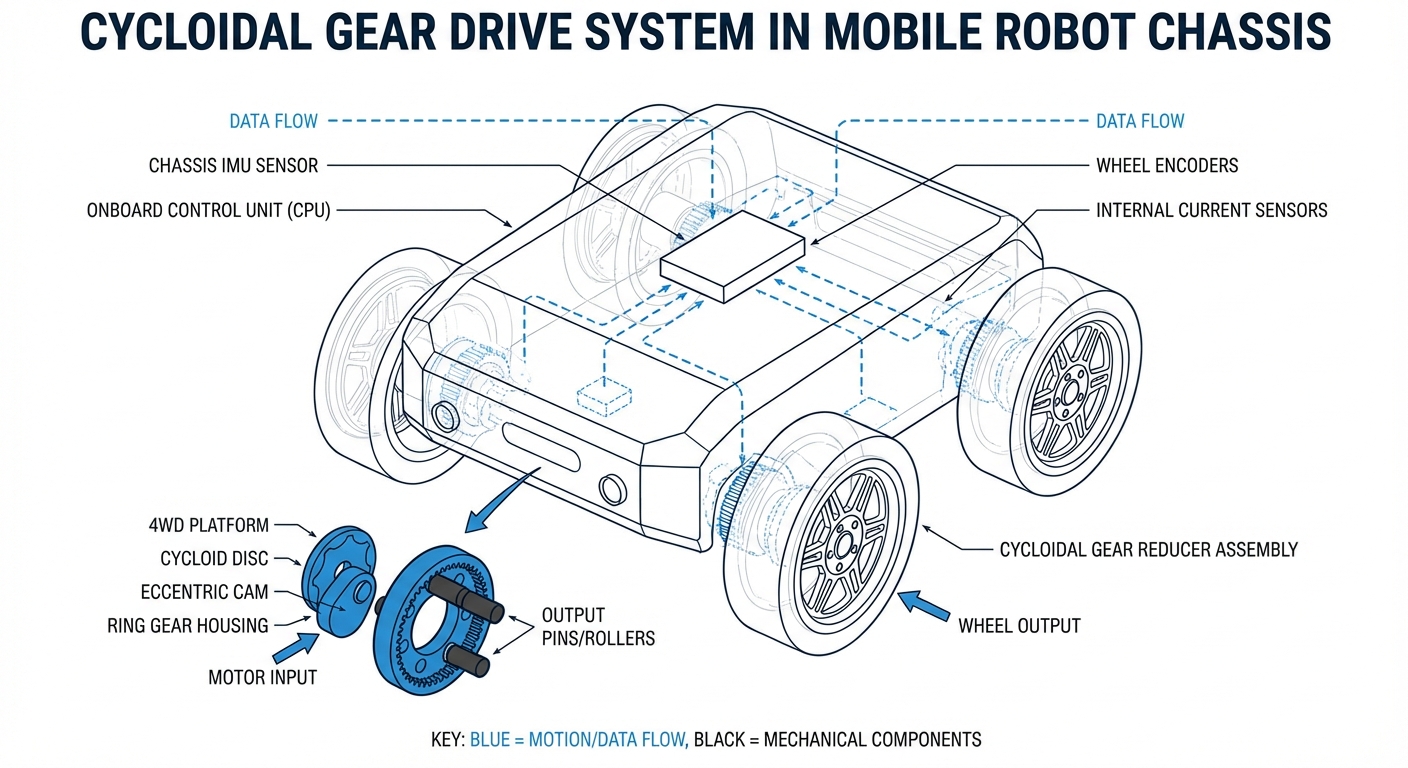
The secret sauce of cycloidal gears is their 'wobbling' action. An input shaft spins an eccentric bearing, making a cycloidal disc gyrate inside a housing full of fixed ring pins.
The disc has lobes, while the housing has pins. For every full turn of the eccentric input shaft, the disc advances exactly one tooth pitch the other way.
This clever setup packs huge gear reduction into tiny space with constant lobe-pin contact. You get smooth, vibration-free power transfer that's ideal for delicate robot sensors.
Real-World Applications
Direct Drive Wheels
Built right into warehouse AGV wheel hubs, they deliver torque to start 1,000kg+ loads from a dead stop—no belts or chains needed.
Robotic Articulation
They power joints in mobile manipulators (robotic arms on AGVs), keeping the arm rock-steady even as the vehicle moves.
Precision Steering
Key for Ackerman or Swerve drives, letting autonomous forklifts nail tight maneuvers in cramped warehouse aisles.
Medical Transporters
Perfect for hospital robots hauling sensitive stuff, where quiet, buttery-smooth motion avoids startling patients or spilling fluids.
Frequently Asked Questions
How does a cycloidal drive stack up against a planetary gearbox?
Planetary gears cost less and work fine for basic traction, but backlash builds up and kills accuracy. Cycloidals handle 500% shock loads (vs 300%) with near-zero backlash—better for precise positioning and constant starts/stops.
Why is "Zero Backlash" critical for AGVs?
Backlash creates a 'dead zone' on direction changes. For LIDAR or SLAM-guided AGVs, that means localization glitches—the robot's software says it's moved, but wheels lag. Zero backlash syncs motion perfectly with commands.
What reduction ratios are typical for cycloidal gears?
They deliver huge single-stage ratios, from 30:1 to 185:1 or more. Ditch multi-stage boxes to save space in the chassis and cut parts.
Are cycloidal gears backdrivable?
High-ratio cycloidals are tough to backdrive, which is great for safety. Power cuts? Friction locks the load like a brake, stopping rampside rollaways.
What kind of maintenance do they require?
Most robotic cycloidals ship sealed with lifetime grease. Rolling contact means minimal wear—they often run 20,000+ hours, matching the AGV's full life, no maintenance needed.
How do they handle emergency stops?
They handle shock loads brilliantly. Load shares across tons of pins/teeth at once, soaking up 5x rated torque spikes. No more E-stop tooth carnage like with planetaries.
Are they heavier than harmonic drives?
Yep, cycloidals are beefier and heavier than harmonic drives. Harmonics suit light arms; cycloidals rule mobile robot bases where torque and stiffness trump weight.
Do they generate significant noise?
Precision cycloidals are whisper-quiet thanks to rolling contacts and balanced design. High speeds might hum a bit, but smart mounting kills the noise.
What is the efficiency loss?
Efficiency hits 85-95%, based on ratio and lube. A tad below single-stage planetaries, but the torque density and zero backlash make it a no-brainer for AGVs.
Can I mount a servo motor directly?
Absolutely—most have standard flanges and collars that mate with big-name servos (Delta, Yaskawa, Panasonic) right out of the box, no machining.
How does temperature affect performance?
Rolling friction runs cooler than sliding, but heat can tighten fits. Top units use matched materials for expansion. For freezer warehouses (-30°C), grab low-viscosity synthetic grease.
What is "Lost Motion" in this context?
Lost motion's like backlash plus springiness under load. Cycloidals keep it tiny (often <1 arcmin), so they're super stiff and snappy—key for spot-on paths.