Brushed DC Motors
The go-to actuator for mobile robots—big startup torque, dead-simple control. See why Brushed DC motors stay essential and wallet-friendly for AGV drives and extras.
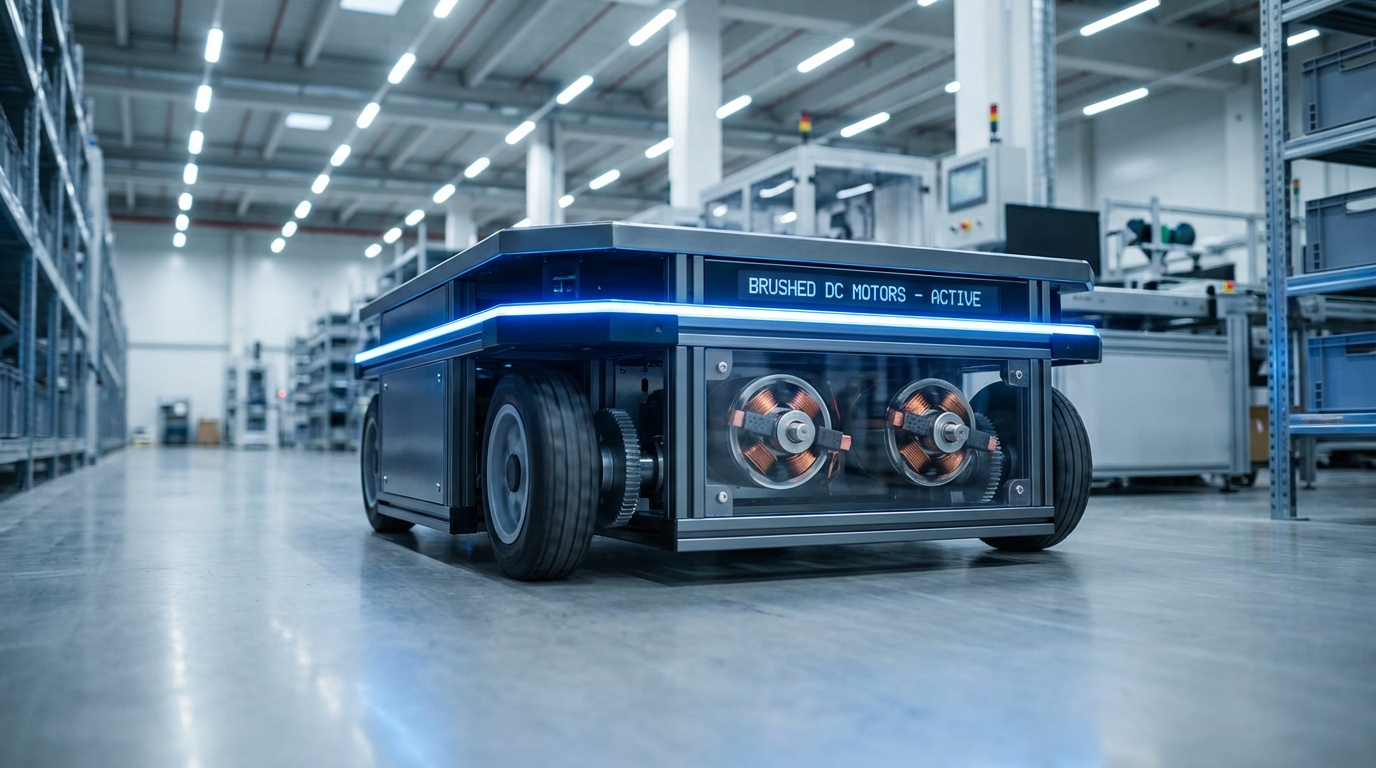
Core Concepts
Mechanical Commutation
Brushes rub a commutator for rotation. This built-in switching skips the fancy electronics BLDC needs.
High Starting Torque
Brushed motors crank max torque from a standstill—key for heavy AGVs breaking free from static friction.
Simplified Control
Speed tracks voltage directly, torque follows current. Super simple with H-Bridges and PWM.
Two-Wire Interface
Just two wires (plus and minus). Flip polarity to reverse—cuts cabling hassle in tight robot chassis.
Cost Effectiveness
Mature production and no Hall sensors or fancy drivers make brushed DC motors a steal for cost-conscious fleets.
Maintenance Factors
Sure, they're powerful, but those physical brushes wear down over time from friction and arcing. Getting a handle on the maintenance cycle is crucial for keeping your fleet running strong long-term.
How It Works
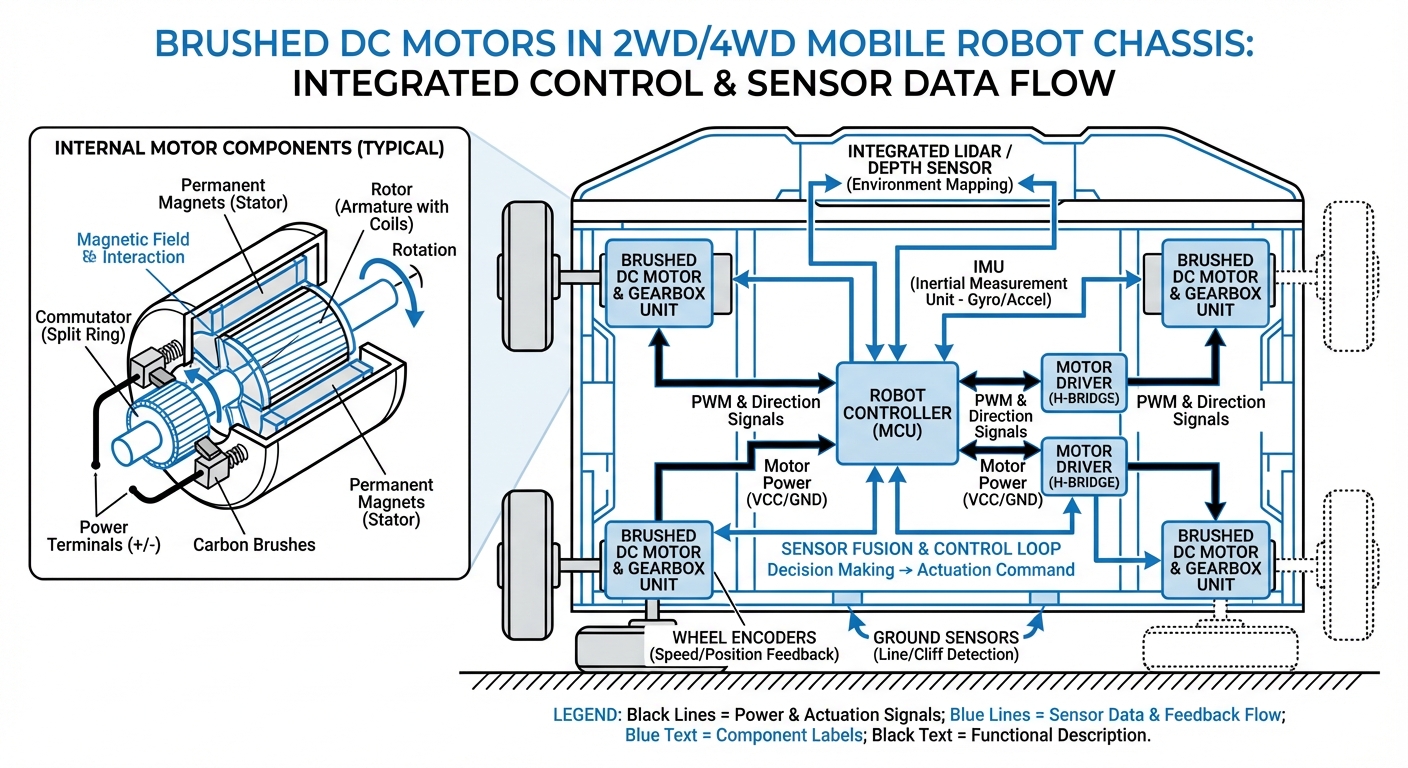
A brushed DC motor features a stator—the stationary part creating a steady magnetic field—and a rotor, the spinning part with the armature windings. The commutator-brush assembly is what makes it all work.
As current flows from the brushes into the commutator segments, it powers up the armature coils. This generates an electromagnetic field that interacts with the stator's magnets, producing torque to turn the rotor.
The key part? As the rotor spins, the commutator automatically switches the current direction in the windings at just the right moment to keep torque flowing steadily. This 'mechanical commutation' lets the motor run smoothly without needing external controls.
For AGVs, that means instant response. Hit it with voltage, and the robot takes off right away—perfect for those constant start-stop moves in logistics.
Real-World Applications
Material Transport AGVs
Great for 'tugger' AGVs that need serious torque to pull heavy carts, where pinpoint positioning isn't a big deal. The low cost makes it easy to roll out a bigger fleet.
Warehouse Picking Robots
Small to medium payload carriers use brushed motors for their main drives thanks to the simple PCB design, which frees up chassis space for batteries and cargo.
Robotic Lift Mechanisms
Beyond driving, they're awesome for linear actuators that lift or clamp loads. Their ability to hold torque for a bit makes heavy pallet lifting way simpler mechanically.
Inspection Crawlers
In rough terrain or pipe inspection robots, the tough, straightforward design of brushed motors delivers reliable performance that's hard for harsh environments to break.
Frequently Asked Questions
How does a brushed DC motor stack up against a brushless (BLDC) motor for AGVs?
Brushed motors are easier to control and cheaper upfront, but they need maintenance for brush wear. BLDC motors bring better efficiency, longer life, and more power density, though they require fancy electronic speed controllers (ESCs) and cost more. Pick brushed for budget-friendly projects and BLDC for high-performance, round-the-clock ops.
What’s the typical lifespan of brushes in a mobile robot?
Lifespan depends a lot on load and use, usually 2,000 to 5,000 hours. Heavy currents and lots of start-stops speed up wear. Most modern industrial brushed motors have replaceable brushes to keep the motor going longer.
How do I control the speed of a brushed DC motor?
Use Pulse Width Modulation (PWM). It rapidly pulses the voltage on and off to adjust the average voltage to the motor. Higher duty cycle means more average voltage and faster speed; lower slows it down.
Can I use regenerative braking with brushed motors?
Yes, when an AGV slows down, the motor generates power like a generator. With a smart H-Bridge driver, you can feed that back EMF back to the battery for recharging (regenerative braking) or dump it through a resistor (dynamic braking) for quick stops.
What is "Back EMF" and why does it matter?
Back EMF is the voltage a spinning motor generates that fights the input voltage. It naturally regulates things—as speed rises, back EMF grows, cutting current draw. You can even use it to gauge speed without extra sensors in basic setups.
Do brushed motors generate electrical noise?
Yes, brush arcing creates a ton of electromagnetic interference (EMI). Add capacitors across the terminals and use twisted-pair wires to stop that noise from messing with your AGV's LiDAR or microcontrollers.
Do I need an encoder for a brushed DC motor?
Nope, not for basic motion. But for SLAM or precise odometry on an AGV, you'll want an optical or magnetic encoder on the rear shaft to track distance and real speed.
What maintenance do brushed motors need in a warehouse?
Check brush length regularly—it's a must. Also, blow out the carbon dust buildup inside with compressed air now and then to avoid shorts or efficiency drops.
Why are geared brushed motors preferred for AGVs?
Standard DC motors spin super fast (thousands of RPM) with low torque. Pair them with a gearbox to drop the speed to robot-walking pace while boosting torque big time, so a small motor can haul heavy loads.
How does voltage rating affect motor selection?
Match the motor voltage (like 12V, 24V, or 48V) to your AGV's battery. Higher voltages mean lower currents for the same power, so skinnier wires and less heat in the electronics.
What happens if I stall a brushed DC motor?
Stalling happens when the load's too much for the motor. Current shoots up to 'Stall Current' max. Hold it too long—more than seconds—and you'll fry the windings or the driver.