Battery Cell Balancing
Boost fleet uptime and battery life by keeping every cell in your power pack at even voltage. For round-the-clock autonomous robots, cell balancing is your key defense against fading capacity and surprise breakdowns.

Core Concepts
State of Charge (SoC)
SoC is the charge level in an electric battery compared to its full capacity. Balancing makes sure every cell hits 100% at the same time.
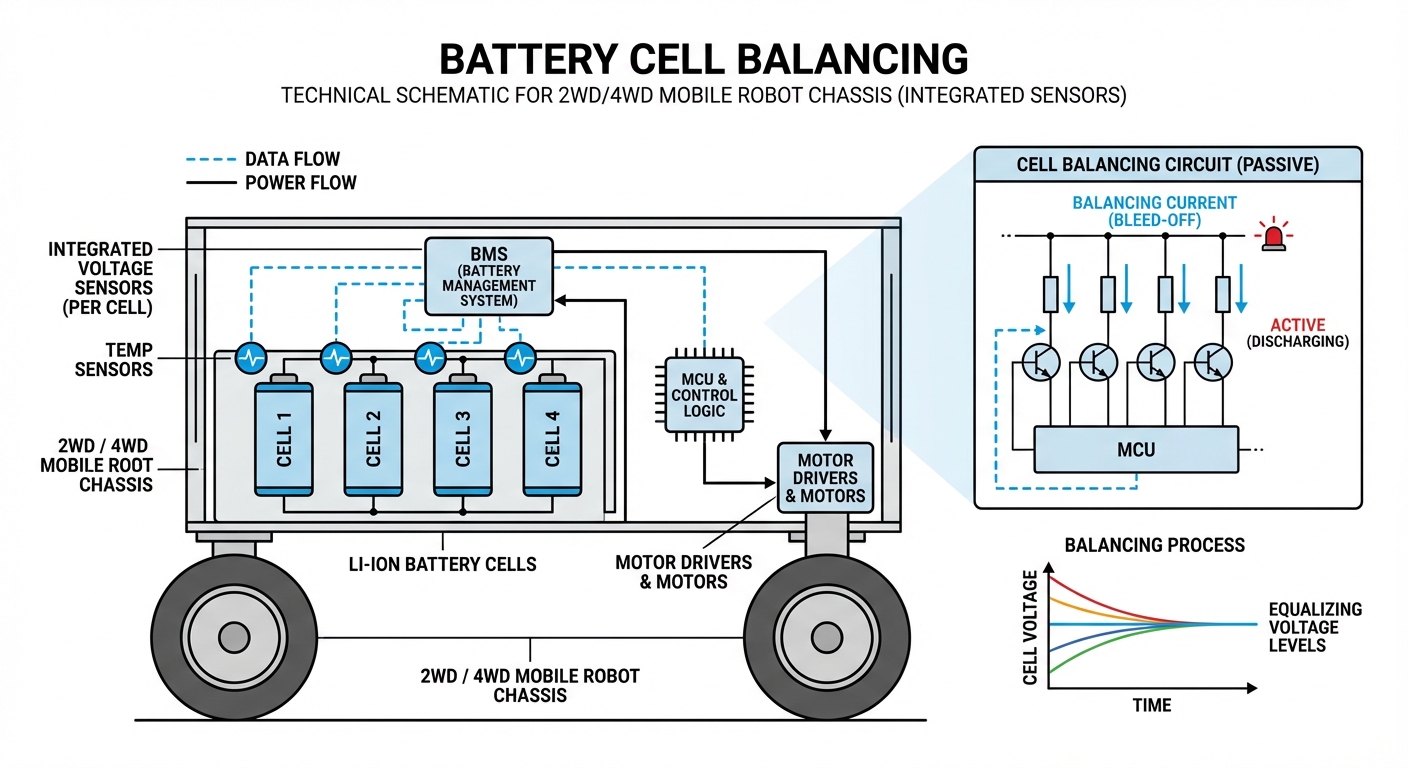
Passive Balancing
The go-to for AGVs: resistors drain excess from high-voltage cells to match the lows. It's cheap, reliable, and perfect for smaller packs.
Active Balancing
This shuttles energy via capacitors or inductors from high cells to low ones. Super efficient with less heat—ideal for big, high-power packs.
Internal Resistance
As cells age, their resistance drifts. Balancing evens it out to stop voltage creep during heavy draws.
BMS Control
The Battery Management System (BMS) watches cell voltages nonstop. It fires up balancing when the gap between cells gets too wide.
Pack Capacity
A battery pack's only as good as its weakest cell. Balancing unlocks the full capacity, instead of hobbling everyone to one laggard.
How It Works
In a standard AGV battery, cells link in series for voltages like 24V or 48V. Over time, tiny manufacturing diffs and heat variations make them charge and discharge at uneven paces.
No balancing means charging halts when the cell maxes out, leaving others short. And discharge cuts off when the dips too low, wasting juice in the rest.
Cell balancing steps in to fix it. While charging, it skips current past full cells (passive) or shifts energy around (active), syncing everyone to the same voltage. This squeezes max usable energy from every trip.
Real-World Applications
Warehouse Logistics AMRs
For 24/7 fleets, steady battery performance is everything. Balancing kills false low-battery alerts, letting robots finish picks without heading back to charge too soon.
Heavy Payload Forklifts
Heavy lifts pull big current, causing heat and voltage drops. Strong active balancing ensures even recovery across the pack, avoiding shutdowns mid-lift.
Cold Storage Robotics
Cold temps spike resistance differences in lithium cells. You need aggressive balancing to hold the pack together and dodge lithium plating in freezers.
Medical Service Robots
In hospitals where downtime isn't an option, spot-on cell balancing keeps safety systems humming and gives fleet managers accurate health readouts.
Frequently Asked Questions
What is the difference between Passive and Active balancing?
Passive balancing bleeds excess from high cells via resistors as heat, letting lows catch up—simple and cheap, but wasteful. Active balancing shuttles energy between cells with fancy circuits, saving power and cutting heat for big, high-demand packs.
Why do battery cells become unbalanced?
Cells drift from manufacturing quirks (capacity or impedance), uneven pack temps (thermal gradients), and varying self-discharge over time. Even top cells spread out after hundreds of cycles without balancing.
Does fast charging affect cell balance?
Yep, fast charging heats things up and widens resistance gaps, speeding voltage drift. Modern BMS can cope, but constant fast charges demand beefier balancing to keep packs healthy.
How often does the balancing process occur?
It depends on how the BMS is programmed. Typically, 'top balancing' happens toward the end of the charging cycle when cells are nearing 100% SoC. Some advanced active BMS systems balance continuously, even during discharge, to squeeze out maximum runtime.
What are the signs of an unbalanced battery pack in an AGV?
Watch for a sudden drop in range or runtime, the battery hitting 'full' way faster than usual (causing premature cutoff), or BMS alerts about 'Cell Delta' or 'Cell Variance.' The robot might also shut down unexpectedly under load.
Does cell balancing extend the total lifespan of the robot?
Absolutely. Keeping individual cells from overcharging or over-discharging cuts chemical stress on the battery chemistry. That means a healthier pack for more cycles, putting off that big battery replacement bill.
Can I replace a single bad cell in a balanced pack?
Generally, no. Mixing a new cell with worn-out ones creates huge mismatches in capacity and resistance that no BMS can fix. Industry standard is to swap the entire module or pack for safety and top performance.
Is balancing more important for LiFePO4 (LFP) or NMC chemistries?
Balancing is crucial for both, but LFP's super-flat voltage curve makes imbalances hard for the BMS to spot until the charge is almost done. So, precise and frequent balancing is especially vital for LFP packs in robotics.
What happens if the balancing circuit fails?
If balancing fails, voltage gaps between cells grow wider every cycle. Eventually, the weakest cell hits low-voltage cutoff the moment it's loaded, bricking the battery even if other cells still have charge—or triggering safety lockouts.
How much balancing current is needed?
For small service robots, 50mA to 100mA does the trick. But for big industrial AGVs with high-capacity packs (like 100Ah+), you'll want 1A to 5A balancing currents to fix issues in a practical charging window.
Does temperature affect the balancing process?
Yes. Most BMS units shut off balancing if the battery's too cold (below freezing) or too hot, to avoid damage. Passive balancing generates heat too, so the BMS keeps an eye on temps to prevent overheating the electronics.
Is manual balancing ever required?
In tough cases, like a pack left discharged for months, automatic balancing can be too slow. Techs might manually charge individual parallel groups to get them back in BMS range, but you'll need specialized gear for that.