5G Low Latency Communication
Unlock Ultra-Reliable Low Latency Communication (URLLC) to power real-time decisions in your autonomous mobile robots. Get near-instant data transmission that's crucial for safety-critical swarms and cloud AI.
Core Concepts
URLLC Architecture
Ultra-Reliable Low Latency Communication, per 3GPP, delivers data in milliseconds with 99.999% reliability—essential for safety protocols.
Network Slicing
Creates a virtual dedicated lane just for robot traffic, shielding it from everyday bandwidth noise.
Mobile Edge Computing
Handles sensor data at the network edge (MEC) instead of the cloud, slashing round-trip times for navigation.
Private 5G Networks
Rolling out localized 5G in your facility gives you full control over coverage, security, and QoS.
Time-Sensitive Networking
Blends 5G with TSN for precise, deterministic sync—so robots and conveyors run in perfect harmony.
Beamforming
Beams radio waves straight to the AGV instead of spraying everywhere, boosting signal strength and cutting latency.
How Low Latency Transforms Navigation
Wi-Fi often struggles with "handover latency"—the delay switching access points—which can pause navigation or trigger safety stops in busy spots.
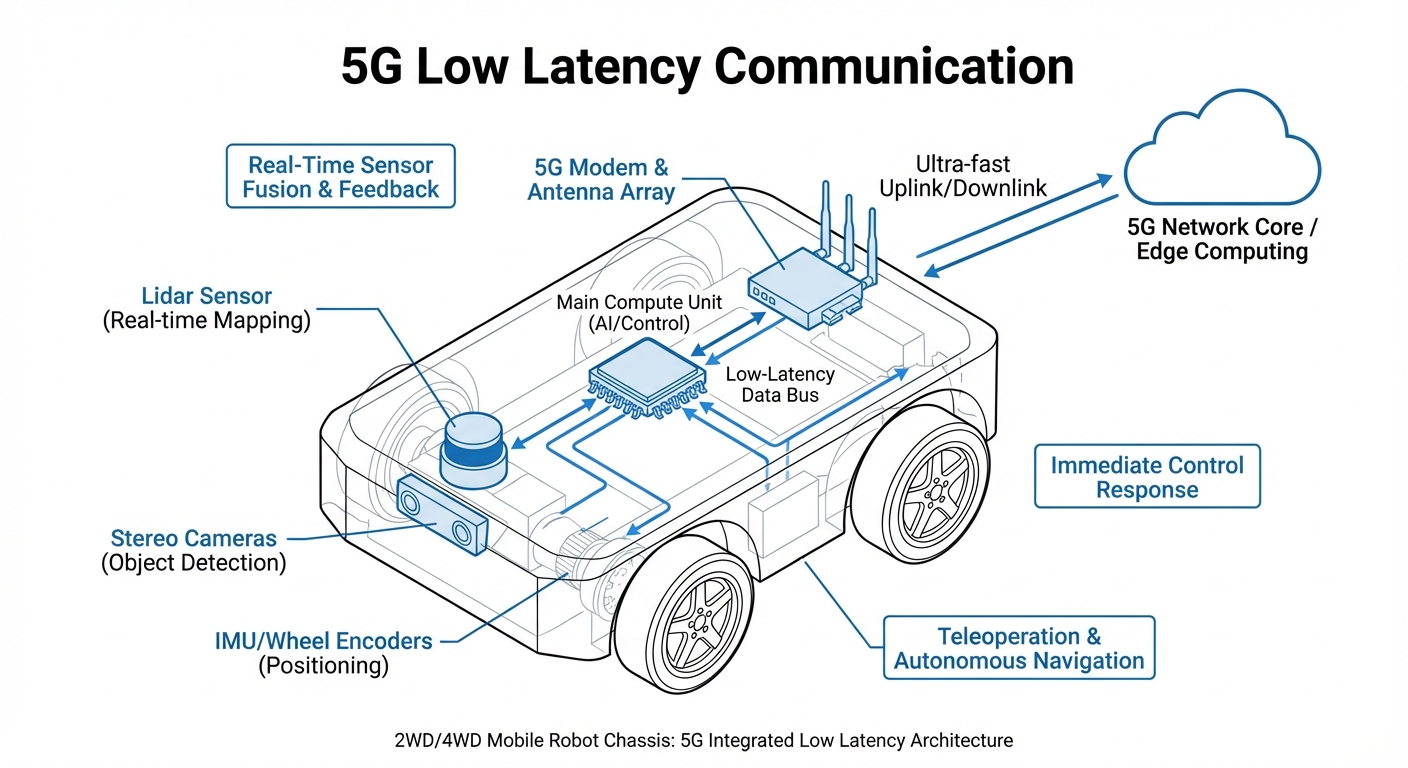
5G wipes out that issue. With 1-10ms latency, AGVs offload big tasks like SLAM or object detection to a local edge server: raw data out, instant processing, commands back faster than the robot can react.
This setup cuts the need for pricey onboard computers, making your fleet lighter, more efficient, and sharper with centralized AI updates.
Real-World Applications
Cloud-Based SLAM
Robots pipe LiDAR data to a central server for real-time dynamic maps—fleet-wide updates happen instantly, no reprocessing per bot.
Swarm Coordination
In packed high-density warehouses, hundreds of AMR shuttles swap position and speed data in milliseconds to thread through traffic collision-free.
Haptic Teleoperation
Operators remotely pilot robots in risky areas, with 5G delivering lag-free video and haptic feedback.
Real-Time Safety Interlocks
Facility safety sensors instantly trigger AGV emergency stops on human detection, backed by 5G's 99.999% reliability.
Frequently Asked Questions
What distinguishes 5G URLLC from Wi-Fi 6 for robotics?
Wi-Fi 6 packs bandwidth, but 5G URLLC nails deterministic reliability and smooth mobility. 5G handovers between antennas are seamless vs. Wi-Fi roaming—no more drops stalling AGVs in big spaces.
What latency do you typically get in a private 5G setup?
Optimized private 5G with edge computing hits 5-10ms end-to-end—far lower and steadier than Wi-Fi, which spikes from interference.
Do I need a private 5G network, or can public 5G work?
For mission-critical robotics, private 5G is the way to go. It keeps data secure on-site, ensures bandwidth, and lets you optimize for robot-heavy uplink traffic.
How does 5G affect the battery life of AGVs?
Modern 5G IoT modules are super power-efficient. Plus, offloading compute-heavy stuff like mapping to the edge means the onboard computer idles more, netting big energy savings.
What hardware is required on the robot side?
Your robots need an industrial 5G modem or router that works with your network's frequency bands (usually Sub-6GHz for coverage or mmWave for speed). Lots of modern AGV controllers even let you slot in M.2 5G modules directly.
How does 5G handle indoor obstacles like metal racking?
Metal causes multipath propagation with all those signal bounces. But 5G flips the script using "Massive MIMO" and beamforming to make reflections boost the signal instead. That said, a good site survey and small-cell deployments are key for solid coverage in packed racking areas.
Is 5G secure enough for sensitive industrial data?
Yep, 5G's architecture packs way stronger built-in security than Wi-Fi. It leans on SIM-based authentication (physical SIM or eSIM), beefier encryption, and network slicing to fully separate robot traffic from guest or employee streams.
Can we retrofit existing AGVs with 5G connectivity?
You bet. Legacy robots on Wi-Fi or Ethernet can just connect to a 5G-to-Ethernet bridge or gateway. Suddenly, they get all the mobility and range perks of 5G without touching the robot's core setup.
What’s the cost comparison between Industrial Wi-Fi and Private 5G?
Private 5G often means higher upfront CapEx for core network gear and spectrum licensing. But OpEx tends to drop thanks to fewer access points (better range) and much less downtime or troubleshooting than fiddly Wi-Fi meshes.
What happens if the 5G signal is momentarily lost?
Robots have built-in "heartbeat" failsafes. If the URLLC link drops, the AGV triggers an immediate controlled stop or flips to local fallback navigation until it's back online—keeping humans safe every time.
Does 5G support 'Upload-Heavy' traffic?
Unlike public networks tuned for video downloads, Private 5G lets you bias heavily toward uplink. That's crucial for robots beaming back multiple 4K video feeds or LiDAR point clouds to the server.
What is Time-Sensitive Networking (TSN) over 5G?
TSN guarantees packets land at precise, predictable times. Over 5G, it lets wireless robots sync flawlessly with wired machines—like a mobile arm snagging items from a moving conveyor, no cables required.