3D Printing in Robotics
Ready to transform your fleet with 3D printing? From quick prototypes to tough, ready-to-use parts, see how it speeds up development and unlocks custom solutions for your Autonomous Mobile Robots (AMRs) and AGVs.
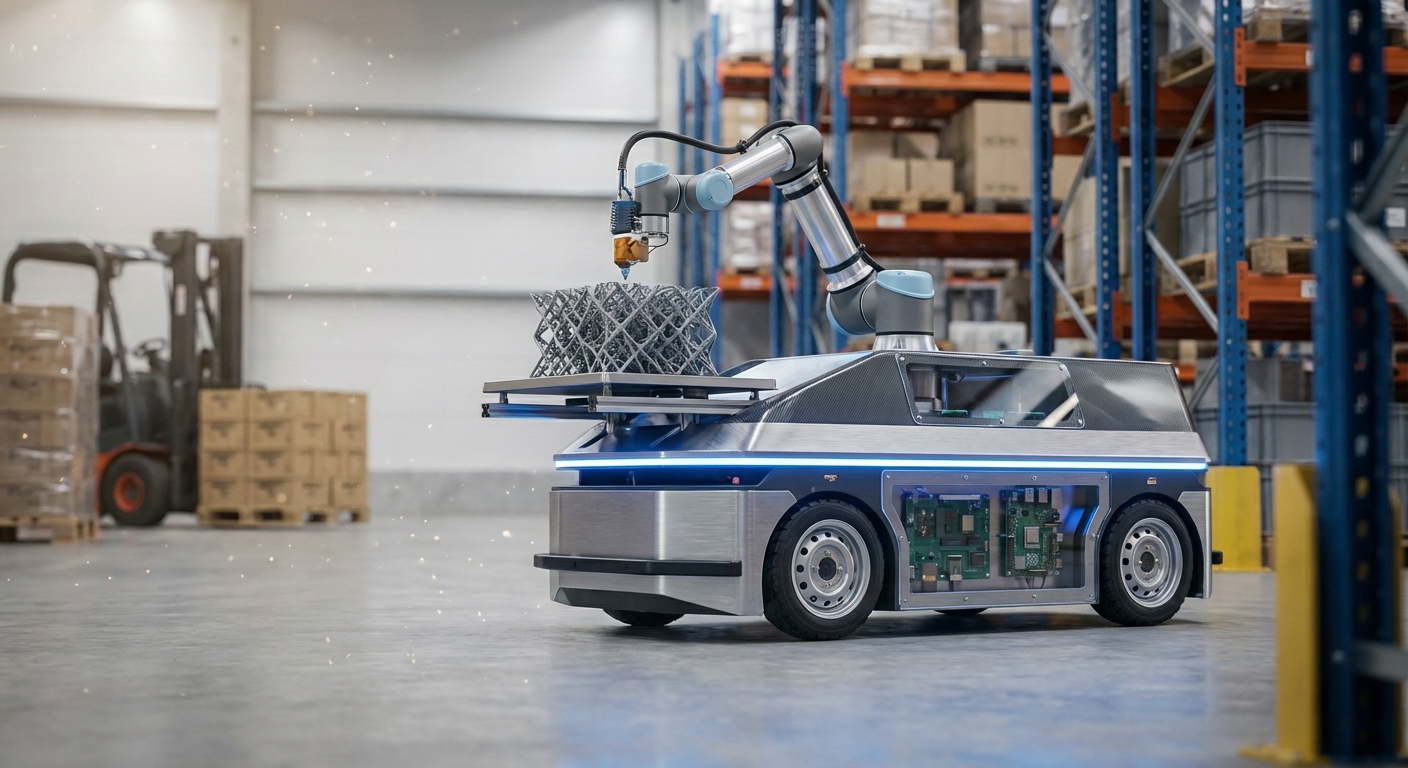
Core Concepts
Rapid Prototyping
Slash your design-to-deployment time dramatically. Engineers can now test AGV chassis tweaks and sensor mounts in hours instead of weeks, turbocharging the R&D phase.
Topology Optimization
Build lightweight parts that are still rock-solid. Generative design and honeycomb infills cut robot weight, stretch battery life, and keep durability intact.
Digital Inventory
Ditch physical spare parts storage. Keep a digital library of gears, brackets, and covers, then print replacements on-demand right at your facility.
Custom End-Effectors
Tailor robots to tasks on the fly. Whip up custom grippers, vacuum cups, or hooks that perfectly match the items your AGV hauls.
Complex Geometries
Make parts CNC machining can't touch. Bake in internal cooling channels or combine assemblies into one seamless printed piece to cut failure risks.
High-Performance Materials
Tap into engineering-grade plastics like Carbon Fiber Nylon, PEEK, or TPU. They deliver the heat resistance, flex, or stiffness your industrial robots demand.
How It Works: The Workflow
Bringing 3D printing into your robotics workflow goes way beyond basic desktop prototypes. It starts with CAD designs optimized for Additive Manufacturing (DfAM), where engineers fine-tune part orientations to handle the real-world stresses AGVs face.
Next, slicing software processes the file, dialing in infill density and shell thickness. For beefy robot parts, high-strength composites like chopped carbon fiber shine in Fused Deposition Modeling (FDM), while intricate sensor housings call for Stereolithography (SLA).
Post-processing seals the deal. It ensures parts fit perfectly on the robot chassis—think annealing for heat resistance or vapor smoothing for a sleek, dust-proof finish ideal for clean rooms.
Real-World Applications
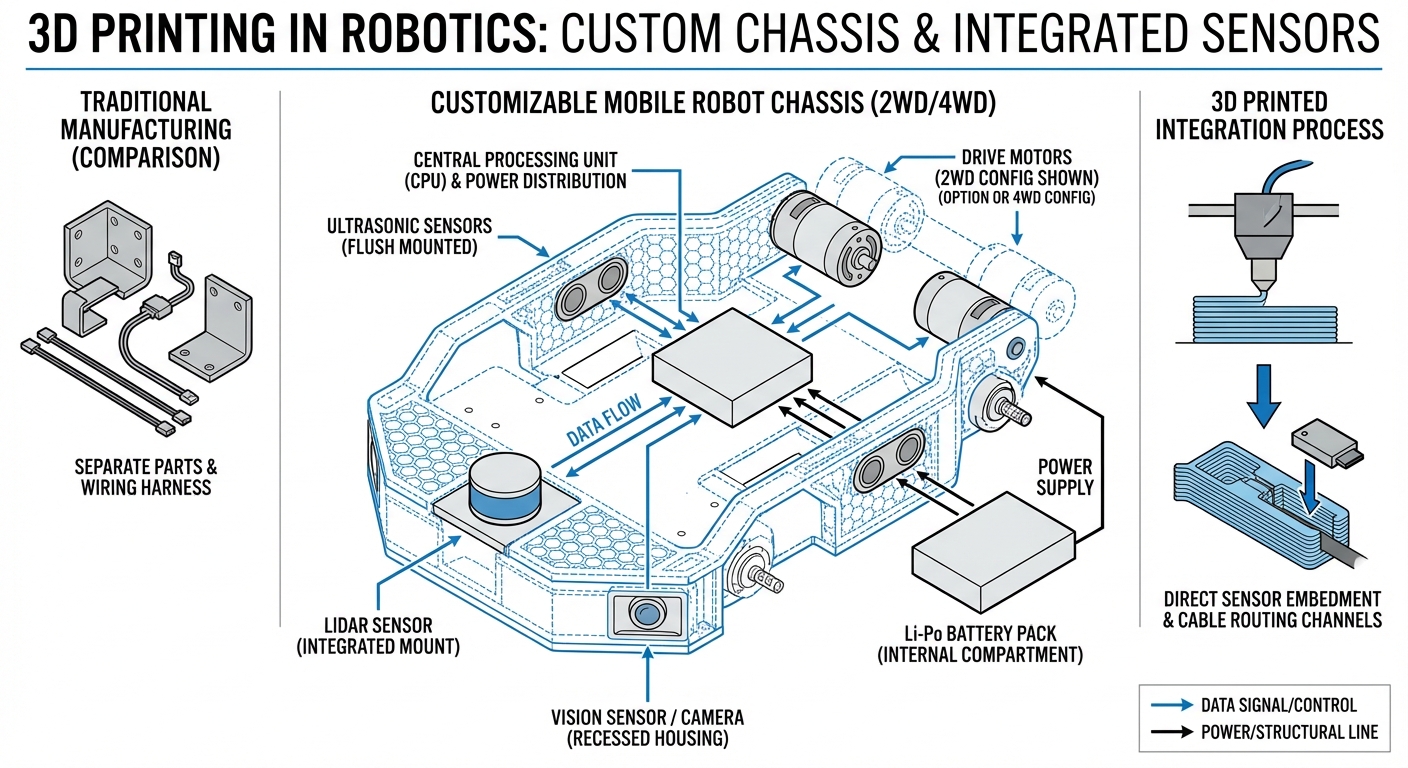
Custom LiDAR & Sensor Mounts
Every facility has its own quirks, needing unique sensor angles. 3D printing lets you craft custom brackets to position LiDAR and cameras at the perfect spots for navigation, skipping costly tooling swaps.
Soft Grippers for Fragile Cargo
With flexible TPU (Thermoplastic Polyurethane), outfit AGVs with 'soft' grippers. They're a game-changer in logistics for grabbing fragile or oddly shaped packages without crushing them like metal ones might.
Protective Bumpers & Skirts
Sacrificial parts keep AGVs running longer. 3D-printed bumpers soak up minor collision impacts, and they're cheap and simple to reprint, safeguarding pricey internals and chassis.
Cable Management Clips
Routing wires in tight mobile robots is tricky. Custom-printed cable guides and strain relief clips keep harnesses secure, dodging vibration-induced shorts.
Frequently Asked Questions
Are 3D printed parts tough enough for structural AGV components?
Yes—when you pick the right materials and design smarts. Stuff like Carbon Fiber reinforced Nylon or Polycarbonate packs tensile strength and stiffness rivaling aluminum for tons of uses, perfect for chassis bits and load-bearing brackets.
Which 3D printing technology is best for robotics?
FDM (Fused Deposition Modeling) rules for functional parts thanks to its material options and toughness. SLA (Stereolithography) shines for precise, tiny sensor housings. SLS (Selective Laser Sintering) nails complex, sturdy parts without support hassles.
Can we use 3D printed parts in ESD (Electrostatic Discharge) sensitive environments?
You bet. ESD-safe filaments like PETG or ABS are designed to dissipate static. They're key for end-effectors or trays handling electronics, preventing shock damage.
How does 3D printing affect the maintenance cost of a robot fleet?
It slashes costs big time. No more huge stockpiles of pricey spares or weeks-long shipping waits—print onsite for pennies, minimizing downtime.
What is the typical lifespan of a 3D printed robot part?
It depends on material and conditions. UV-resistant ASA holds up for years outside. Nylon gears endure heavy wear inside. Plus, they're cheap to swap, so proactive maintenance is easy.
Does 3D printing limit the size of the robot parts I can make?
Printer build volumes have limits, but big items like full AGV bumpers get printed in sections and bonded. Large-format industrial printers are making unibody chassis sections doable too.
Is post-processing required for printed robot parts?
Usually, yes. At minimum, remove supports. For moving parts, sand to cut friction. Heat-set threaded inserts for reliable metal threads to bolt things together.
How does weight reduction via 3D printing impact AGV performance?
Lighter chassis and non-payload parts boost the power-to-weight ratio. That means longer battery runs, bigger payloads, and less strain on motors and wheels.
Can 3D printed parts handle high temperatures?
Standard PLA softens at low temps (60°C), but Polycarbonate, PEEK, or PEI (Ultem) handle 100°C - 200°C+, ideal near motors or heat sinks.
Is it cost-effective for mass production of robots?
For low-to-mid runs (hundreds), 3D printing beats injection molding tooling costs. High volume (thousands)? Molding wins on price, but printing owns customization.
What software is needed to design for 3D printed robotics?
Everyday CAD like SolidWorks, Fusion 360, or Onshape works fine. But slicer features (variable infill) and Generative Design tools unlock additive manufacturing's full potential.
Are there food-safe options for restaurant service robots?
Yes, certified PETG filaments are food-safe. Layer lines can trap bacteria though, so a food-safe epoxy coating post-print seals it up nicely for service robots.