3D LiDAR
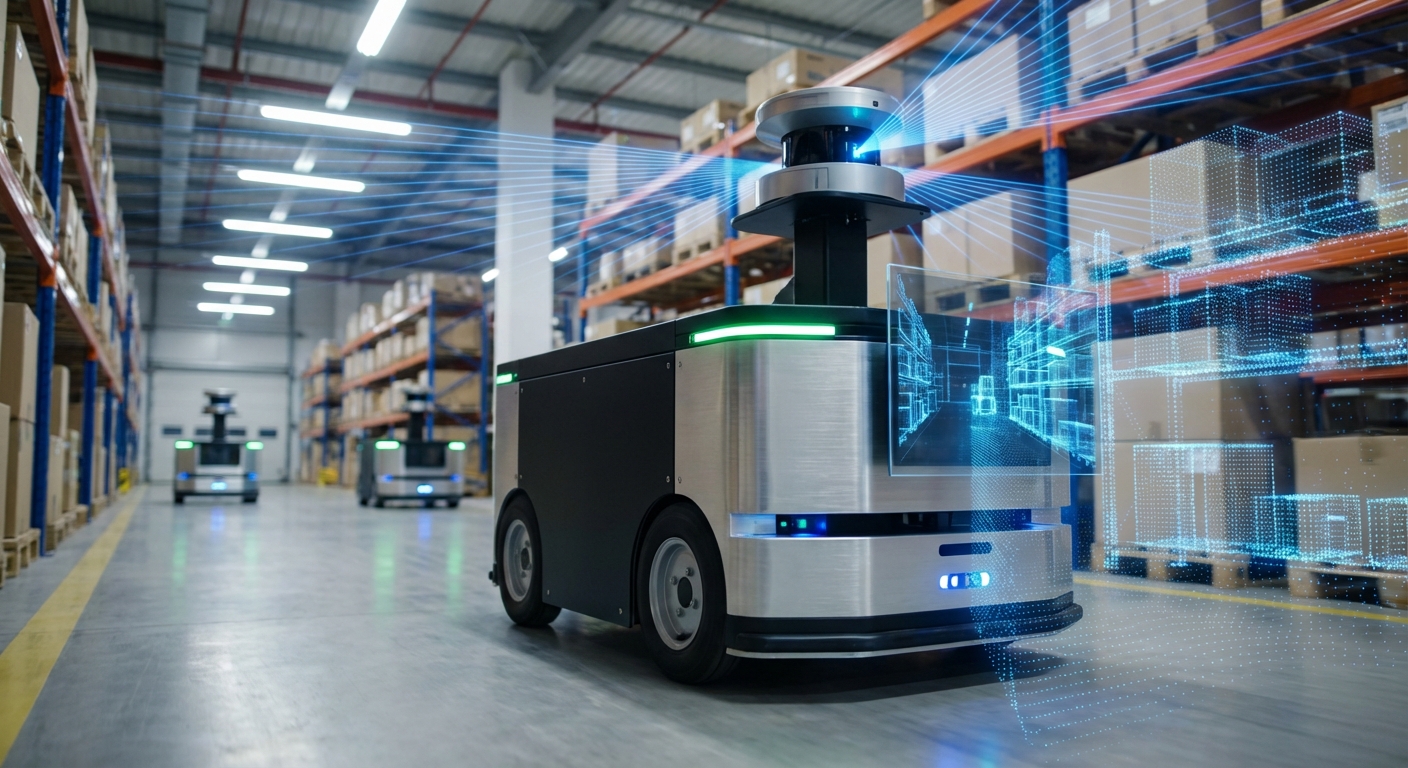
Give your mobile robots real 3D awareness. 3D LiDAR delivers detailed volumetric maps and obstacle spotting, helping AGVs tackle complex, ever-changing spaces with spot-on precision.
Core Concepts
Point Clouds
Raw 3D LiDAR output is a packed cloud of points in 3D space, capturing the true shape and distance of everything around.
Time of Flight (ToF)
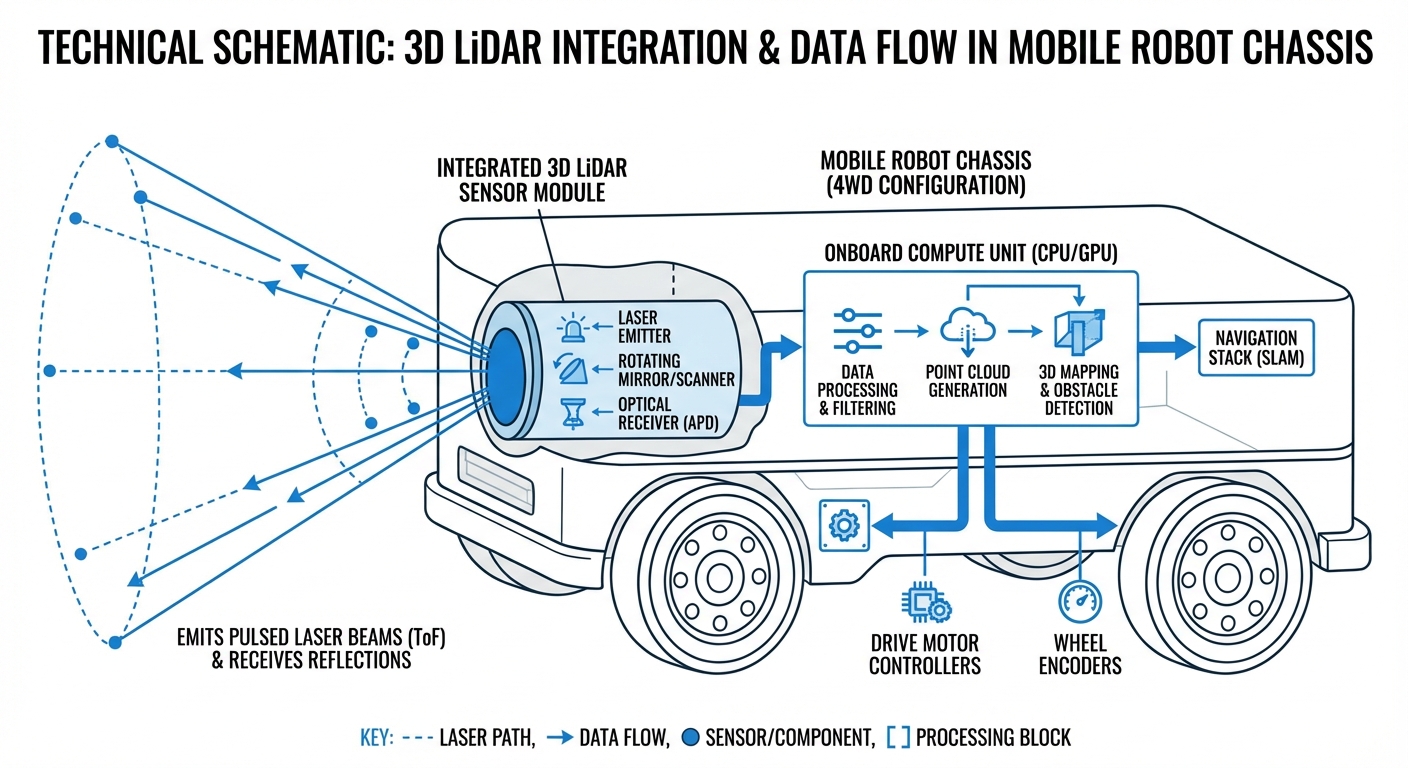
It measures distance by timing a laser pulse's round trip to an object and back to the receiver.
6-DoF SLAM
Unlike 2D sensors, 3D LiDAR powers full 6-DoF SLAM, crucial for ramps and rough terrain.
Solid State vs. Mechanical
Modern AGVs love solid-state LiDAR—no moving parts means better toughness and vibration resistance in tough industrial spots.
Vertical Resolution
Vertical channels (16, 32, 64, or 128) set your map's detail level and how well it catches small stuff like cables.
Semantic Segmentation
Smart algorithms sift the point cloud, spotting walls, people, other vehicles, or floor clutter.
How It Works
3D LiDAR blasts out laser pulses fast—hundreds of thousands per second. They bounce back from objects, and the sensor crunches time-of-flight or phase shift for exact distances.
While 2D LiDAR slices a single horizontal plane, 3D covers horizontal and vertical. Mechanical ones spin the laser array; solid-state uses phased arrays or flash tech to steer beams without big moving parts.
You end up with a full 3D map updating live, so AGVs spot overhangs, ceiling hazards, ramps, and tell a floor doodle from a real bump.
Real-World Applications
High-Bay Warehousing
Tall shelves kill 2D localization; 3D LiDAR uses ceilings to pinpoint position and catches overhanging pallets invading aisles.
Outdoor Navigation
For bots shuttling between buildings, 3D LiDAR is key—it sorts grass, curbs, and paths, and shines in any light where cameras flop.
Forklift AGVs
Automated forklifts grab pallets at all heights; 3D LiDAR's volume data nails pocket locations for safe lifts.
Crowded Manufacturing Floors
In people-packed facilities, 3D vision predicts pedestrian paths and weaves around moving obstacles without needless emergency stops.
Frequently Asked Questions
What's the biggest perk of 3D LiDAR over 2D for AGVs?
The killer feature is full volumetric sensing. 2D LiDAR just gets a flat slice at one height, but 3D sees it all—including overhangs like tables or drops like docks/stairs—dodging crashes a 2D scan would miss.
Does 3D LiDAR work in pitch black or blazing sun?
Absolutely. As an active sensor with its own laser light, it thrives in total dark. Top units filter sunlight too, so they're solid outdoors where cameras battle glare and shadows.
What is the difference between Mechanical and Solid-State LiDAR?
Mechanical LiDARs spin laser arrays for 360° coverage—awesome range but wear out from moving parts. Solid-state steers beams electronically: tougher, smaller, but narrower FoV might need multiples for full view.
Does 3D LiDAR demand beefier onboard computing?
Usually, yeah. Crunching millions of 3D points per second is heavy lifting vs. 2D lines. Grab an industrial PC with GPU or NVIDIA Jetson for real-time 3D SLAM and detection.
Can 3D LiDAR detect glass or transparent surfaces?
This trips up LiDAR: lasers zip through glass or bounce weirdly. Most setups pair it with ultrasonics/cameras or software 'no-go' zones for glass walls.
How does rain or fog affect 3D LiDAR performance?
Rain and fog speckle the cloud with droplet hits, but newer 3D LiDARs use multi-echo to separate rain (first hit) from walls (last), letting software scrub the noise.
Is 3D LiDAR safe for humans working nearby?
Yes, industrial LiDARs are Class 1 eye-safe lasers—harmless to retinas even stared at directly, at safe wavelengths.
What's a good range for indoor AGVs?
Indoor warehouses? 30-50 meters covers aisles and far walls for localization. Outdoor bots need 100m+ to brake safely at speed.
Can 3D LiDAR replace safety scanners (PL-d / SIL 2)?
Navigation LiDARs weren't safety-rated before, but new 'Safety 3D LiDARs' hit PL-d certs. Otherwise, stick to certified 2D scanners for e-stops; use 3D just for nav and soft avoidance.
How do I hook up 3D LiDAR with ROS?
Big makers like Velodyne, Ouster, Hesai, Robosense offer ROS/ROS2 drivers out of the box. They pump out `sensor_msgs/PointCloud2` data, plug-and-play with PCL, OctoMap, Navigation2.
What are the maintenance requirements?
Keep the lens/window spotless—dust or gunk messes readings. Outdoor ones often have wipers or air blasts. Mechanicals need motor swaps eventually; solid-state? Zero moving-part maintenance.
Ready to implement 3D LiDAR in your fleet?
Upgrade your AGV's perception capabilities today.
Explore Our Robots