2D LiDAR
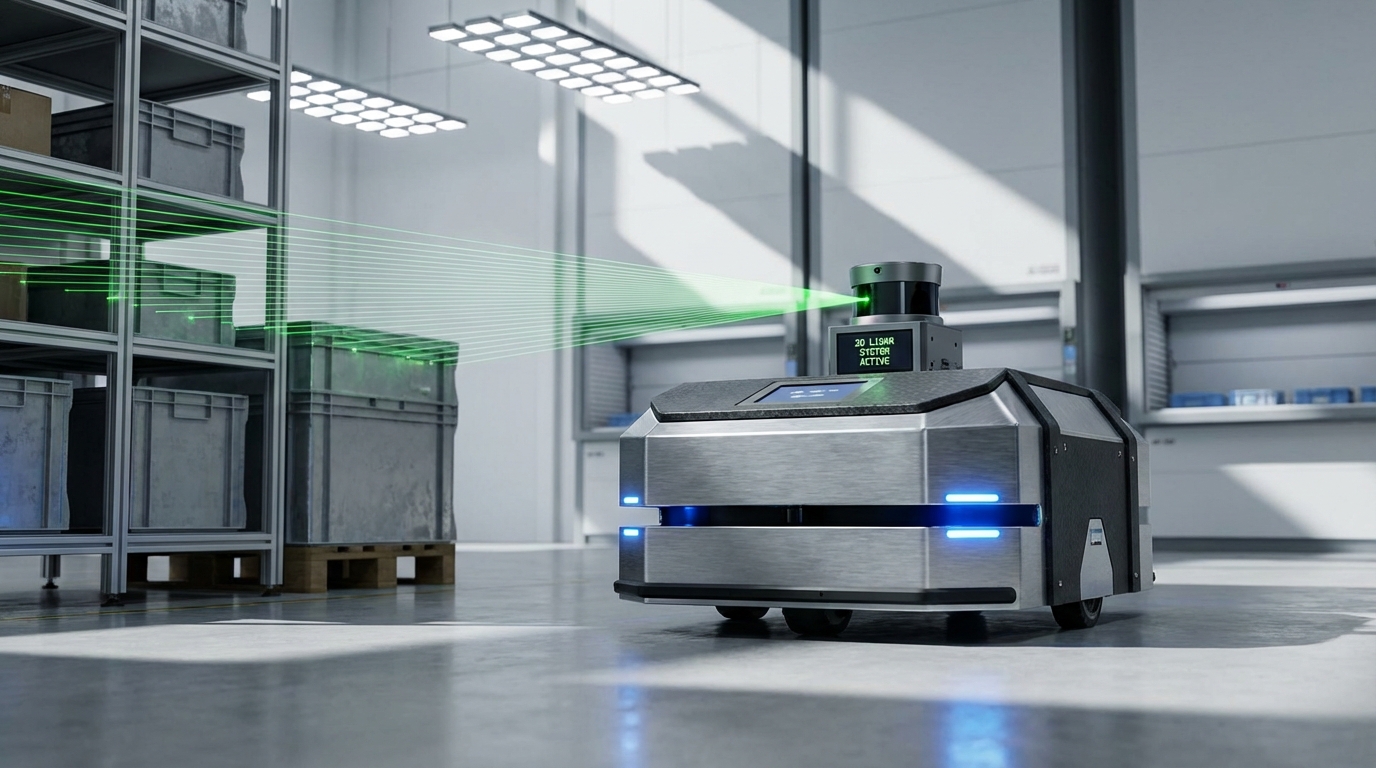
The must-have "eye" for cutting-edge nav: 2D LiDAR delivers precise single-plane laser scans for SLAM, obstacle avoidance, and safety certs on AGVs and mobile robots.
Core Concepts
Time of Flight (ToF)
It measures distance by clocking the exact time a laser pulse takes to hit an object and echo back.
Angular Resolution
Sets data point density. Finer angular resolution (e.g., 0.1°) nails small objects and skinny shelving legs.
Scan Rate (Hz)
Scan rate for a full 360° spin. Higher Hz (like 25Hz) is vital for fast AGVs to track positions live.
Reflectivity Intensity
Modern LiDARs go beyond distance, gauging return signal strength to differentiate retro-reflective tape, matte walls, and metal.
Safety Zones
Customizable virtual zones (Warning vs. Protective) that slow speeds or trigger e-stops when crossed.
SLAM Ready
SLAM leverages point clouds to map unknown areas while tracking robot position.
How It Works
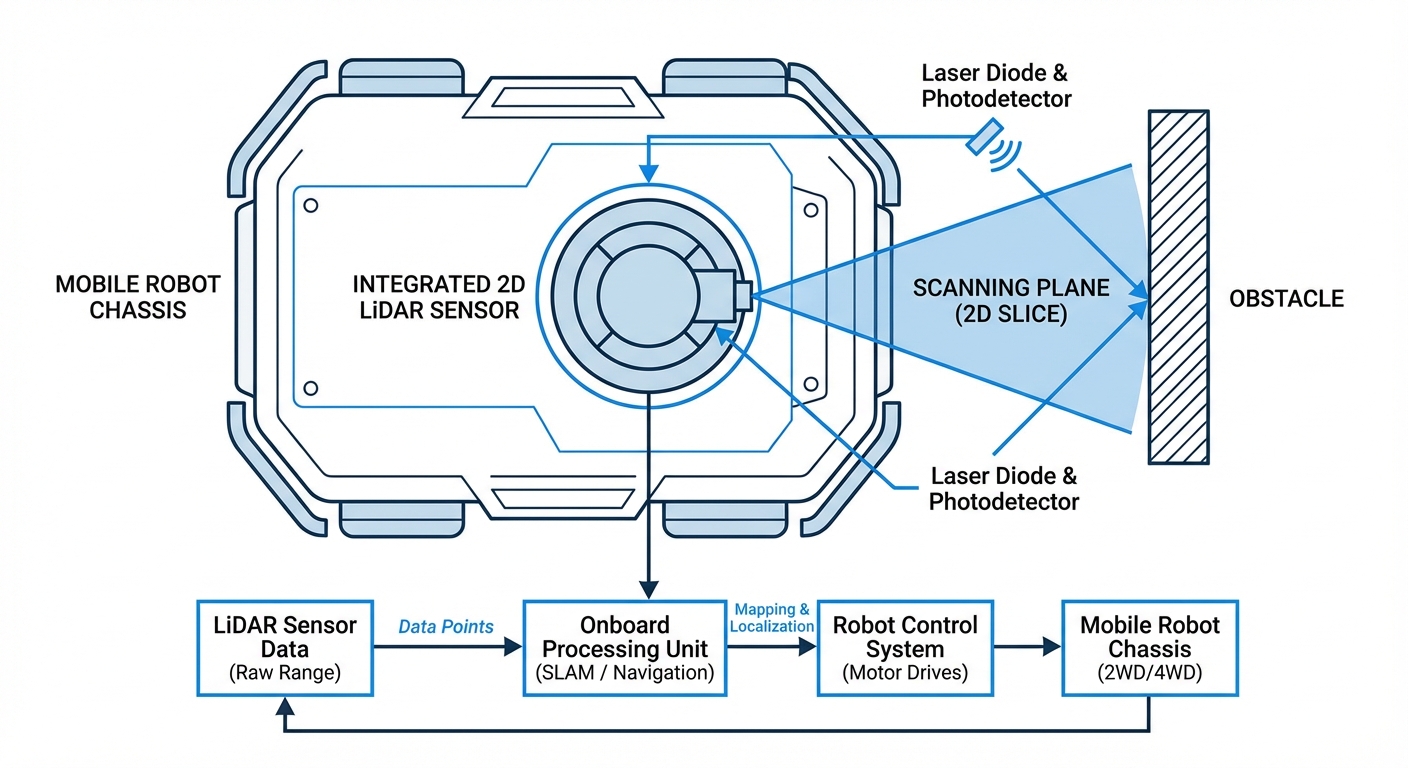
2D LiDAR runs on zippy laser telemetry: a laser fires pulses at a spinning mirror, sweeping the beam across one horizontal plane (2D) into the world.
Light hits a wall, pallet, or person and bounces back. The sensor computes distance via Time of Flight (ToF) or phase shift—thousands of hits per second.
Out pops a polar map (distance + angle) called a "Point Cloud." This raw feed hits the nav stack (ROS typically) for geometry, obstacle ID, and costmap updates to plan paths.
Real-World Applications
Warehouse Logistics (AMRs)
AMRs use 2D LiDAR to navigate bustling warehouse aisles, swerving forklifts and workers while hauling pallets—no magnetic tape required.
Industrial Safety Curtains
Stationary 2D LiDAR guards hazard zones near robotic arms, slamming machinery to a halt if humans breach the perimeter.
Hospital Delivery Robots
Service robots harness high-res LiDAR for corridor cruising, spotting slender items like IV stands and sailing through packed elevators.
Outdoor Patrol Bots
Tough 2D LiDAR sensors with multi-echo tech cut through rain and fog, so security robots can keep patrolling perimeters reliably in all kinds of weather.
Frequently Asked Questions
What's the difference between 2D and 3D LiDAR for robots?
2D LiDAR scans a single horizontal plane, keeping things cost-effective and light on processing power—perfect for indoor floor mapping and safety features. 3D LiDAR captures the full volume (height, width, depth) for a complete picture of the environment, but it demands much more computing muscle and usually costs a lot more.
Can 2D LiDAR detect glass or transparent surfaces?
Regular lasers often sail right through clear glass or bounce off it in unpredictable ways (that's specular reflection), creating 'invisible' obstacles. Smarter navigation setups blend LiDAR data with ultrasonic or camera sensors to handle transparent surfaces, or you can just add some opaque tape at the scan height.
How does sunlight affect 2D LiDAR performance?
Intense ambient light, like direct sunlight, can overload the sensor's receiver and blind it completely. For outdoor use or spots with big windows, go for LiDAR built to handle high ambient light (measured in Lux, usually >40,000 Lux for outdoors).
What's the typical range needed for an indoor AGV?
In most warehouse setups, 10 to 25 meters is the sweet spot for detection range. It gives the robot plenty of stopping distance even at speed for smooth deceleration. If you've got huge open halls, longer ranges like 30m+ really help with localization.
Why is "Angular Resolution" important for navigation?
Angular resolution is all about the spacing between laser points at a distance—the lower the angle (say, 0.1°), the denser the points. It's key for spotting small or skinny objects like table legs from afar, so the robot doesn't think a thin barrier is clear space.
What's the difference between Navigation LiDAR and Safety LiDAR?
Safety LiDARs are certified (SIL 2/PL d) with built-in redundancy to reliably hit the emergency stop and protect people. Navigation LiDARs focus on dense data and long range for mapping, but they're not meant to be the only safeguard for human safety.
How often does the device need maintenance?
2D LiDARs are pretty low-maintenance overall. Just keep the optical window clean from dust, oil, or fingerprints. Mechanical ones have motors that might wear out after 20,000-50,000 hours, but solid-state versions last much longer.
What is "Crosstalk" or interference between robots?
When multiple robots share a space, one bot's laser can blind another's receiver. Today's LiDARs use multi-echo or clever encoding and frequency modulation to ignore signals that aren't from their own emitter.
Can 2D LiDAR be used for SLAM (Simultaneous Localization and Mapping)?
Absolutely—2D LiDAR is the go-to sensor for 2D SLAM (think Gmapping or Cartographer), building those handy floor-plan maps. That said, it can't pick up on ceiling details or floor patterns, so it's usually paired with wheel odometry and IMUs.
Does the color of the object matter?
Yep, dark black surfaces (low reflectivity) soak up the light and cut detection range, while shiny ones like mirrors or polished metal scatter it everywhere. Top-tier LiDARs rate their range for 10% reflectivity (think black) to work reliably on anything.
Is ROS (Robot Operating System) support standard?
Pretty much every industrial or research-grade 2D LiDAR maker offers open-source ROS and ROS2 drivers. It's plug-and-play for your navigation stack, spitting out LaserScan messages right away.
What happens if the scanning plane is blocked?
Since 2D LiDAR only scans a single line, stuff below or above it—like a dangling forklift tine or low hurdle—gets missed. Robots fix this by adding 3D depth cameras or bumper sensors alongside the main LiDAR.