Welding Automation
Upgrade your line with precision robotic welders. Superior seams, quicker cycles, safer for workers, and rock-solid consistency every time.
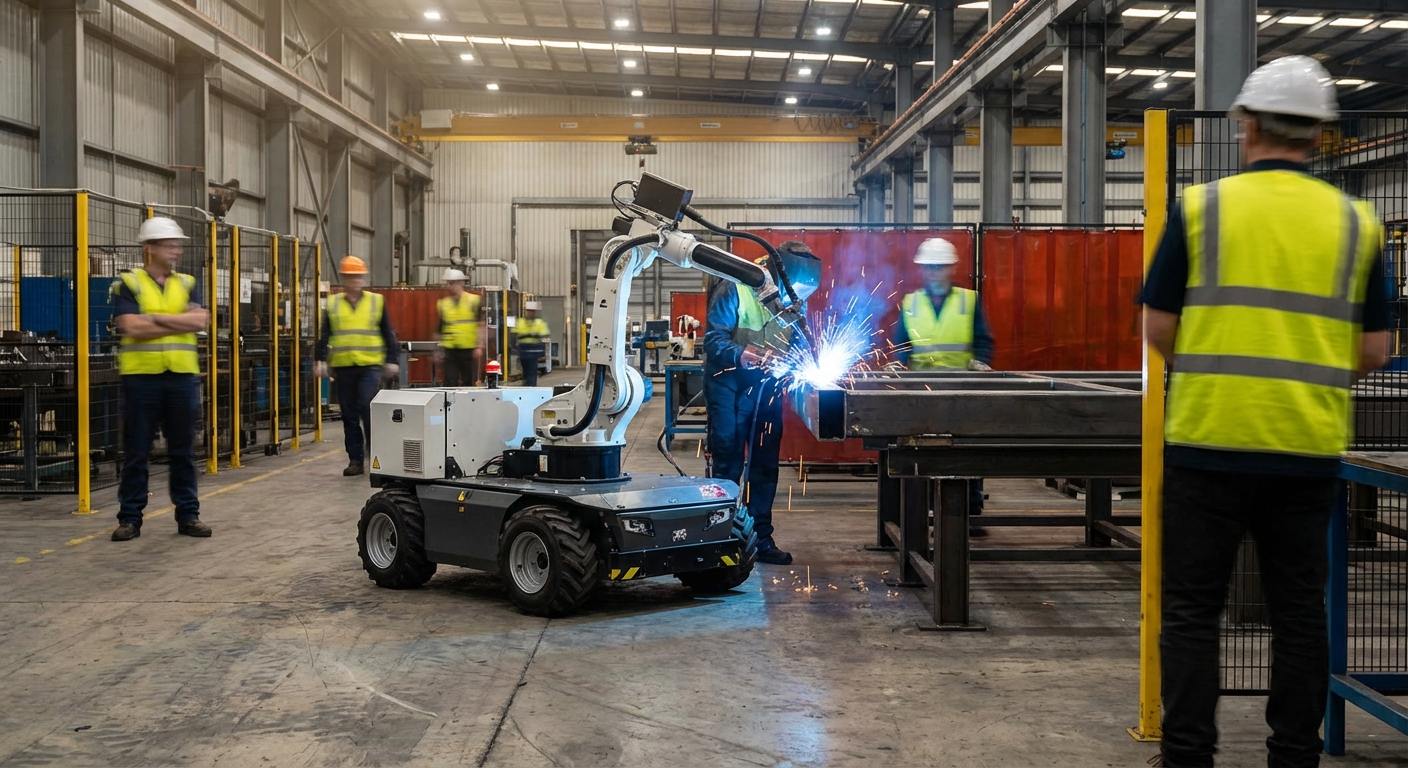
Why Automate Welding?
Pinpoint Accuracy
Fraction-of-mm precision puts welds exactly right every time.
Enhanced Safety
Shield workers from fumes, burns, strain via automation.
Increased Throughput
Nonstop runs crank parts-per-hour, ease bottlenecks.
Material Efficiency
Tight wire/arc control cuts waste, post-weld work.
Unwavering Consistency
No shift dips—8 AM matches 5 PM quality.
Lower Labor Costs
Repurpose welders for oversight, cut hard-to-fill hires.
Technical Implementation
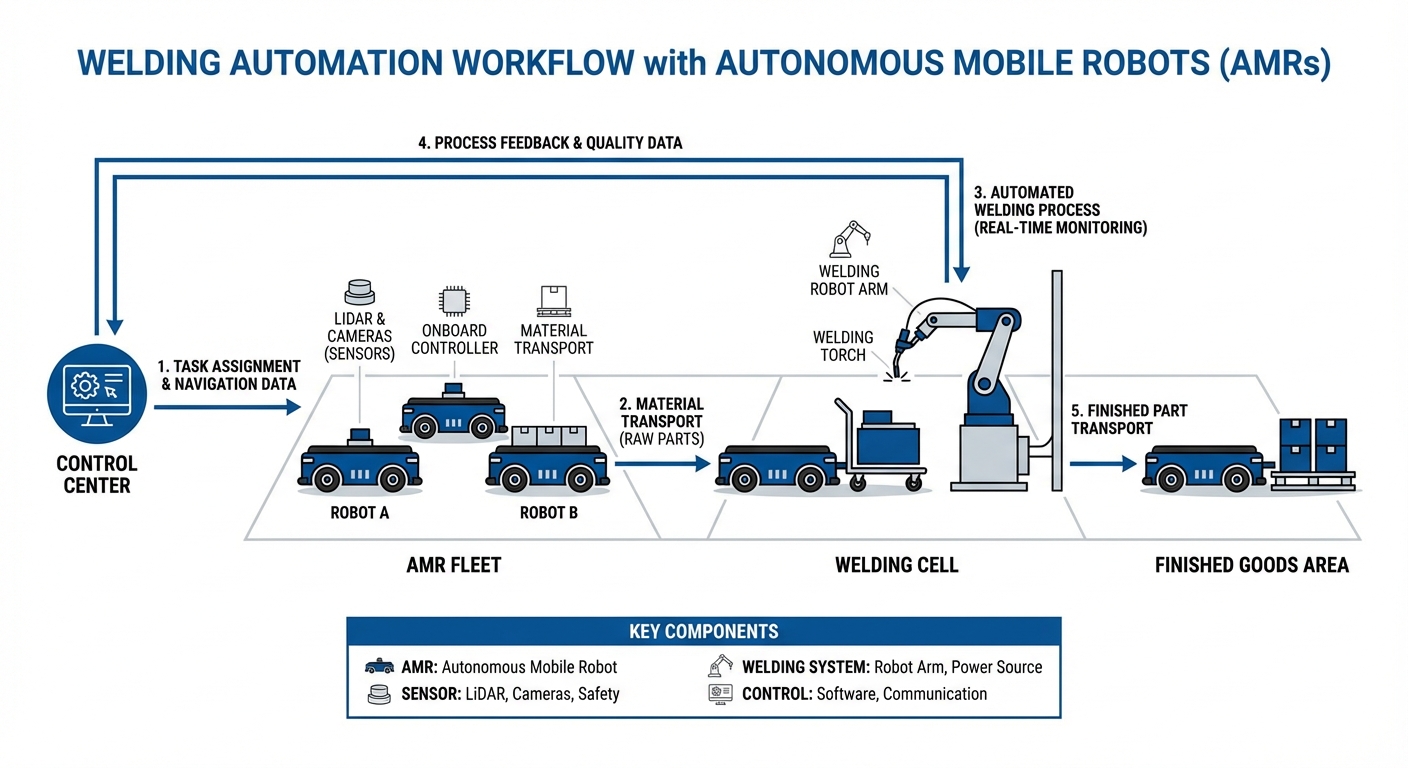
It starts with programming. Teach pendant or sim software maps paths to the part. 3D vision fine-tunes for fixture wobbles.
In the welding phase, the robot arm pairs with the power source, precisely setting travel speed, voltage, wire feed rate, and weave patterns. Real-time seam tracking sensors adjust the path instantly for any thermal distortion.
The cycle ends with quality inspection. Built-in sensors monitor arc data, catching issues like porosity or burn-through on the spot. It auto-rejects bad parts or flags operators, so only perfect products ship.
Where It's Used
Automotive Manufacturing
It's the go-to for chassis assembly, spot welding body panels, and exhaust systems—anywhere speed and high volume make a difference.
Heavy Machinery
Ideal for those marathon multi-pass welds on excavators, tractors, and mining equipment – it really cuts down on operator fatigue.
Structural Steel
Great for joining beams and trusses on construction sites, ensuring rock-solid structural strength while meeting all those strict building codes.
Energy & Pipelines
Provides top-notch orbital welding for pipelines and pressure vessels, crucial for preventing leaks even under extreme pressure.
What You Need
| Component category | Requirements & Recommendations |
|---|---|
| Robot Arm | A 6-axis industrial arm with the perfect payload (5kg to 50kg+) and reach (1.4m to 3m). Outstanding path accuracy and repeatability (±0.05mm). |
| Welding Equipment | Digital power source for MIG/MAG/TIG with robot-ready interfaces (Fieldbus/Ethernet). Liquid-cooled torch designed for heavy-duty cycles. |
| Sensors & Vision | Touch sensing or laser seam tracking to locate parts perfectly. Through-arc tracking adjusts the path in real time. |
| Safety Systems | Safety PLCs, light curtains, perimeter fencing, and fume extractors – all fully compliant with OSHA/ISO standards. |
| Software | Offline programming software that minimizes downtime; weld parameter monitoring for reliable quality assurance. |
Frequently Asked Questions
Which welding processes can be automated?
Pretty much any standard process is fair game, from MIG/MAG (GMAW), TIG (GTAW), spot welding (RSW), laser, and plasma. MIG takes the lead with its speed and versatility.
Is robotic welding suitable for small batches?
You bet – with modern offline programming tools and cobots. They make fast changes a breeze, so high-mix, low-volume jobs really pay off.
How do robots handle gaps or poor fit-up?
Standard robots follow a fixed path, but toss in laser seam tracking or through-arc sensing, and it detects joint gaps, tweaking weave or speed right then and there for perfect results.
What is the typical ROI period?
ROI varies, but most shops see payback in 12-24 months from less scrap, lower labor costs, and higher daily output.
Do I need to hire a specialized programmer?
Not necessarily. New interfaces are super intuitive with drag-and-drop or hand-guiding features. That said, train your welders to operate it – their expertise will dial in those parameters perfectly.
How safe are welding robots?
Totally safe with the right setup. Cells feature fencing and light curtains. Fume extraction is even better, right at the torch tip.
What maintenance is required?
Just routine maintenance: swap out torch consumables like tips and nozzles, clean wire liners, check TCP alignment, and grease the robot (usually yearly).
Can existing manual fixtures be used?
They often do need some adjustments. Robotic fixtures require tighter precision and repeatability than manual ones, plus enough clearance for the torch to access every angle.
Does it work with aluminum?
Yes – robotic welding excels with aluminum. Precise speed control manages heat to prevent burn-through on thin materials.
What is a positioner and do I need one?
A positioner rotates the part while the robot welds. Vital for complex shapes, keeping welds flat or horizontal for maximum strength.